A well-planned cabinet can make a home darts area feel neater, more intentional and easier to live with between matches. dartboard cabinets with integrated lighting promise an especially tidy solution because the board, light source and storage all sit in one controlled zone. The catch is that a good-looking cabinet still has to work as a playing setup: the board must be correctly positioned, the light must not create glare, and the doors must not get in the way.
Hard-wired cabinet lighting, spur connections or alterations to an existing lighting circuit should be carried out by a qualified electrician to ensure compliance with UK electrical safety requirements and the relevant Building Regulations.
In brief
- Integrated lighting can reduce clutter compared with a separate ring light or lamp, but it needs careful placement to avoid shadows and reflected glare.
- The cabinet must allow proper dartboard height, oche distance, board rotation and access to the number ring.
- Doors add storage and a traditional look, but they need enough side clearance and should not clash with nearby furniture.
- Wall protection still matters; a cabinet protects part of the area, not every missed dart zone.
- Plug-in lighting is simpler for most homes, while any fixed electrical work belongs with a qualified electrician.
Start with the playing line, not the cabinet
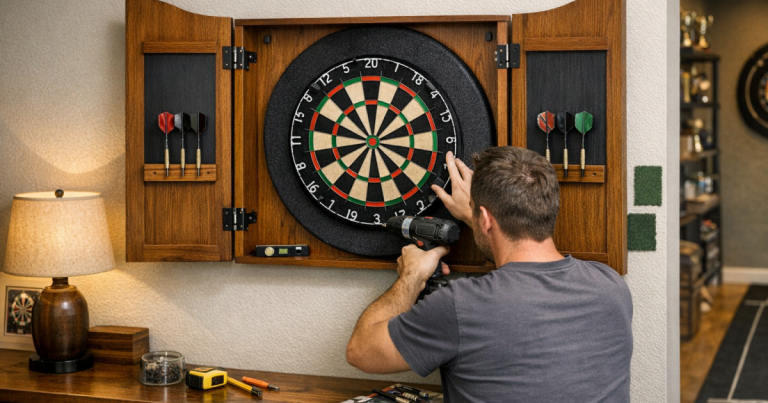
The easiest mistake is to choose the cabinet first and then try to make the room fit around it. For a usable home setup, begin with the board centre, throwing distance and standing area. Once those are fixed, you can judge whether the cabinet width, door swing and lighting position make sense.
Measure the wall, the floor space and any furniture nearby. A cabinet that looks compact online can feel awkward if one door opens into a bookcase, radiator, curtain rail or corner wall. If the darts area is in a spare room or garage, also think about how people move through the space when nobody is playing.
Before drilling anything, check the official board height and oche layout. The cabinet should support the correct setup rather than forcing a compromise. If you are marking out the area from scratch, use this guide to set dartboard height and oche distance correctly before deciding exactly where the cabinet will sit.
What integrated lighting changes
A separate dartboard light usually surrounds or sits proud of the board. An integrated cabinet light is more contained, which can be attractive in a living room or shared space. It may look less like a dedicated practice bay and more like part of the furniture.
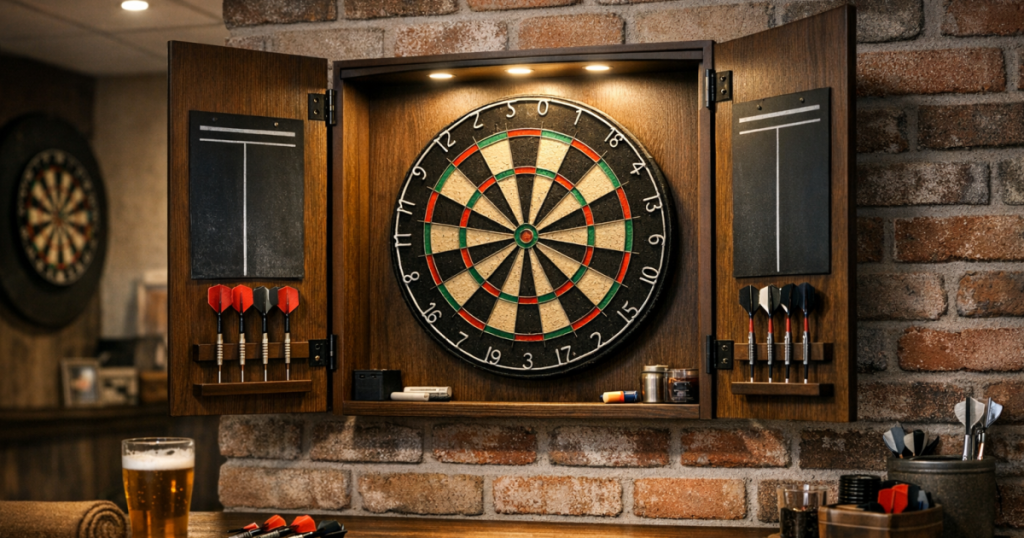
Well-planned dartboard cabinets with integrated lighting can also help keep cables tidier, especially where the light source is designed around the cabinet frame. That said, the light still needs to illuminate the whole board face evenly. If the light is too high, too narrow or too directional, it can create a bright patch at the top and leave the lower doubles less clear.
The main lighting questions are practical rather than cosmetic:
- Does the light reach the outer doubles and the lower board clearly?
- Does it shine into the thrower’s eyes from the oche?
- Does the cabinet finish reflect light back off glossy doors or trim?
- Can the board still be removed or rotated without disturbing the light?
- Is the switch easy to reach without leaning across the board?
If visibility is your main concern, compare the cabinet idea with a dedicated lighting arrangement. The broader dartboard lighting guide explains the key issues around glare, shadow and setup standards in more depth.
Cabinet depth, board access and everyday use
A darts cabinet is not just a picture frame around the board. It has to give enough depth for the dartboard, mounting bracket, number ring and any lighting component. It also needs enough clearance for you to retrieve darts comfortably without scraping knuckles or catching flights on the doors.
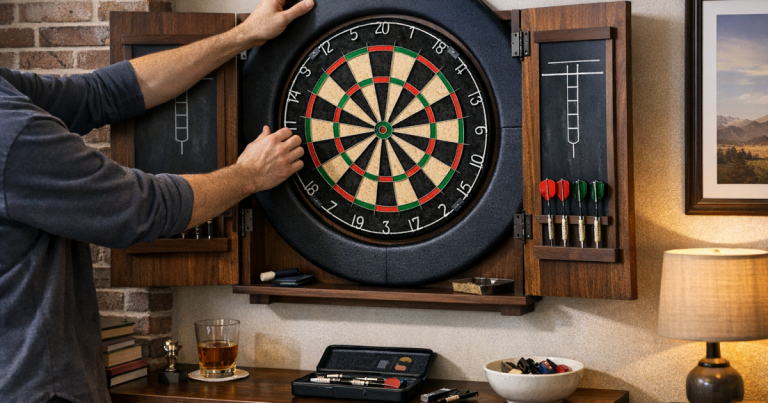
Board access matters more than many people expect. Bristle boards should be rotated periodically to spread wear. Whether you use a simple club-style board or a Winmau Blade 6 Triple Core, check that the cabinet design lets you lift the board off its bracket and rotate it without dismantling the whole arrangement. Avoid boxing the board in so tightly that maintenance becomes a chore.
Also think about scoring. Some cabinets include chalkboard-style panels inside the doors, which can work well for casual games. Others leave room for a separate scoreboard or tablet stand nearby. If the lighting only works when the doors are fully open, make sure the open doors do not block the scoring area or cast shadows across it.
The trade-off between neat storage and missed-dart coverage
Cabinets are often chosen partly because they look tidier than bare boards. Closed doors hide the board, darts and chalk marks when the area is not in use. They can also provide a small amount of storage for darts, chalk, flights and shafts.
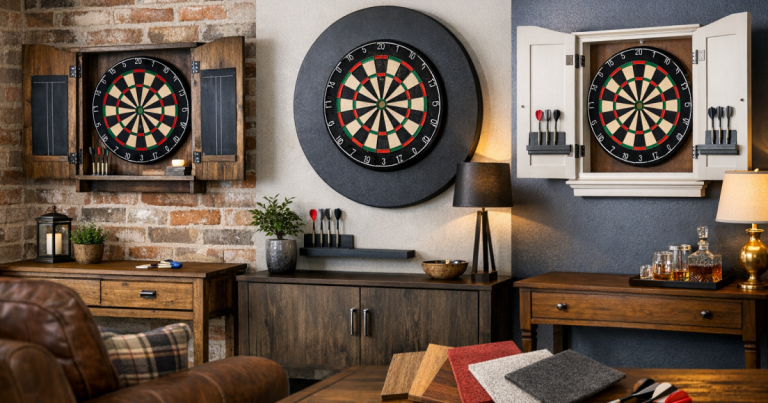
However, a cabinet is not the same as a full surround or backboard. Most cabinets protect the immediate area around the dartboard, but wild misses can still hit plaster, wallpaper or paint outside the cabinet outline. This is particularly relevant in family homes, rental properties and rooms where beginners or guests will play.
A wider surround, backboard or protective panel may be better if wall damage is your main worry. You can still use a cabinet, but it may need to sit within a larger protection zone. For a fuller breakdown of the choices, see these wall protection options for dartboards, including cabinets, surrounds and backboards.
Where integrated cabinets work especially well
An integrated cabinet can be a strong fit in a room where appearance matters as much as practice time. In a dining room, office or shared living space, closing the doors keeps the setup discreet. Built-in lighting avoids the look of a separate lamp clamped to the wall, which may suit more traditional décor.
They can also work well for casual match nights. The cabinet gives a clear focal point, keeps basic accessories nearby and helps the board feel like a permanent feature rather than something temporarily hung on the wall. If the lighting is simple to switch on, people are more likely to use it properly instead of playing in uneven room light.
For compact spaces, the benefit is neatness. The risk is congestion. If the cabinet doors, oche mat, players and furniture all compete for the same small area, the setup can feel fussy. A slim board-and-surround arrangement with separate lighting may sometimes be easier to live with.
Where a separate light or surround may be better
The strongest argument against an integrated cabinet is flexibility. A separate surround can be wider and more forgiving. A separate light can be positioned to suit the board rather than the cabinet shape. If you later change the board, move the setup or alter the room, separate components may be easier to adapt.
There is also the issue of component failure. If an integrated light stops working, check whether the lighting part can be repaired or replaced without replacing the whole cabinet. Do not assume this will be straightforward; look at the product information and installation details before committing. For plug-in units, cable routing and access to the plug are just as important as the light itself.
Separate lighting may also suit more serious practice spaces. If you throw daily and care about consistent visibility around the treble and double beds, a dedicated lighting setup can be easier to fine-tune. The cabinet may still be attractive, but the lighting should be judged by what it does to the board face, not by how tidy it looks when switched off.
Small details that make a big difference
The best cabinet setups tend to get the unglamorous details right. These are the checks that affect day-to-day use:
- Door swing: confirm that both doors open fully without hitting shelves, curtains, radiators or nearby walls.
- Finish: matt and satin finishes usually behave better around light than highly glossy surfaces.
- Storage: make sure dart holders are secure and positioned away from children’s easy reach where relevant.
- Cable route: avoid loose trailing leads across the throwing area or around the oche.
- Board removal: check that the board can be lifted away from its bracket for rotation and replacement.
- Noise and vibration: a rigidly mounted cabinet can sound louder on a hollow partition wall, so wall type matters.
- Room lighting: integrated lighting should complement the room, not fight against a bright ceiling light behind the thrower.
FAQ
Do integrated cabinet lights remove all dartboard shadows?
Not automatically. They can improve visibility, but the result depends on the position, spread and direction of the light. Check the whole board face, including the lower doubles, from the oche.
Can I fit an integrated lighting cabinet in a rented home?
Possibly, but wall fixing and cable routing need care. Use suitable fixings for the wall type and check your tenancy terms before drilling or making any permanent changes.
Is a cabinet enough to protect the wall?
Only partly. It protects the area it covers, but missed darts can land outside the cabinet. Beginners, children and social players usually justify a wider protection area.
Should the cabinet doors stay open during play?
Yes, in most setups. Open doors give access to scoring panels and prevent darts from striking the doors. Make sure they sit clear of the throwing line and do not create shadows.
Are plug-in lights easier than wired-in cabinet lighting?
For most home setups, yes. Plug-in lighting avoids fixed electrical work, but the cable still needs safe routing so it does not create a trip hazard or interfere with play.
Final thoughts
An integrated lighting cabinet is at its best when it solves several small problems at once: tidier storage, a more finished-looking wall, convenient match-night lighting and a board area that feels ready to use. It is less convincing when the light is treated as decoration rather than part of the playing setup.
Plan from the oche backwards. Get the board position right, test how the light will fall, leave enough space for door swing and board maintenance, then decide how much extra wall protection the room needs. Do that, and the cabinet becomes more than a stylish frame; it becomes a genuinely practical part of a home darts setup.