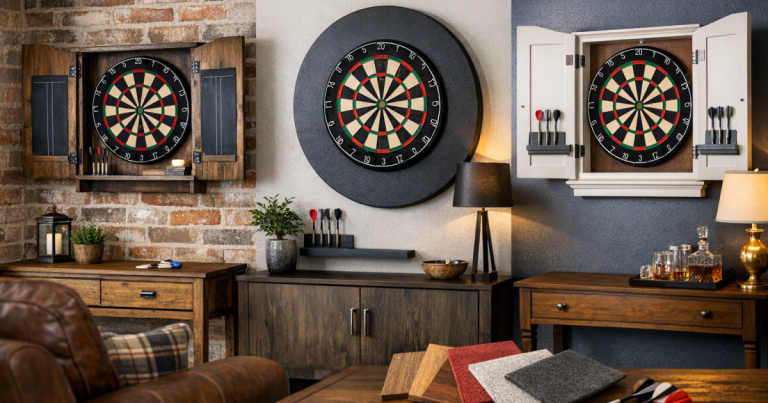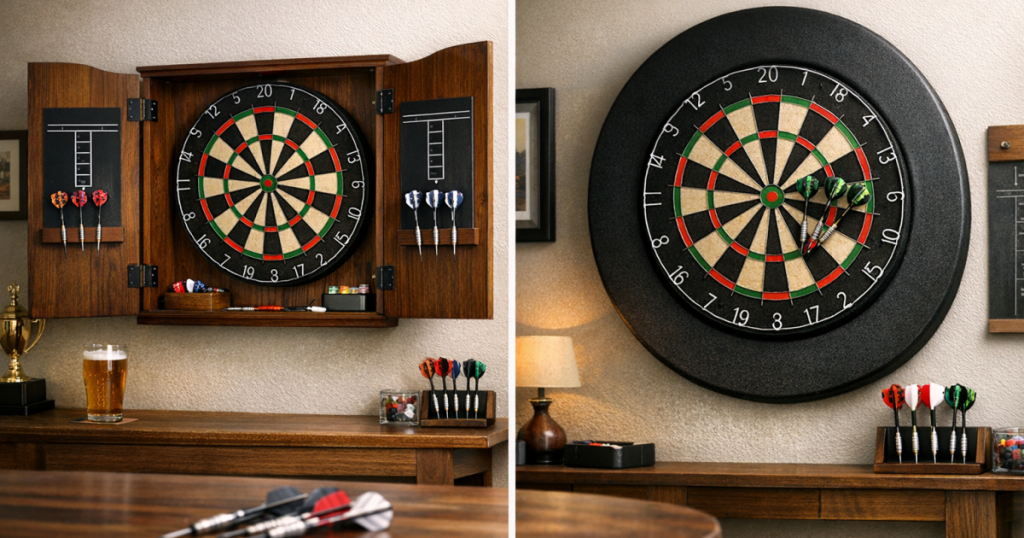
A neat darts area has to do three jobs: keep the board looking intentional, protect the wall, and stop spare darts and chalk from drifting around the room. The choice of dartboard cabinets vs surrounds is really a choice between tidy storage and soft-edged impact protection, with style sitting somewhere in the middle.
Neither option is automatically better. A cabinet can make a board look more like furniture and gives you useful storage, while a surround is usually simpler, more forgiving around the scoring area, and less visually heavy. The right answer depends on the room, the players, and how permanent you want the setup to feel.
The short version
- Choose a cabinet if you want built-in storage, a more finished look, and doors that hide the board when it is not in use.
- Choose a surround if your main priority is wall protection around the board, easy fitting, and a cleaner practice-focused setup.
- Use both only when it makes sense: some rooms benefit from a cabinet plus extra side or lower protection, but a bulky arrangement can look awkward.
- Check board alignment first, because a stylish cabinet or surround will not compensate for a board mounted at the wrong height or angle.
What a cabinet actually adds to a darts setup
A dartboard cabinet is more than a frame. In a home setting, its biggest advantage is organisation. The doors can hold score panels, chalk or marker pens, and sometimes small accessory spaces for flights, shafts and spare points. That matters if your board is in a living room, kitchen-diner, garage conversion or spare room where darts kit would otherwise end up on shelves, window sills or the floor.
Cabinets also change the feel of the room. A bare board on a wall looks sporty and direct; a cabinet makes it look more deliberate. In a shared space, that can be the difference between a board that feels temporarily stuck up and one that belongs with the rest of the room.
The trade-off is that a cabinet creates a fixed rectangular footprint. Open doors need side clearance, and the unit has to be mounted accurately so the bull remains at the correct height. Before deciding on any wall furniture around the board, it is worth checking the standard dartboard measurements, especially if you are also planning a mat, raised oche or tight throwing lane.
What a surround does differently
A surround is a protective ring or panel system that sits around the board. Its job is straightforward: catch stray darts before they mark the wall. For practice sessions, beginners, children under supervision, guests, or anyone working on grouping, that wider protective area can be more useful than storage.
Surrounds usually keep the board visually open. There are no doors, no score panels, and less of a furniture feel. That can suit a garage, games room, shed bar or compact practice corner where the setup is used often and does not need to disappear when play stops.
The limitation is storage. A surround will not solve clutter by itself. You still need somewhere for darts, spare flights, shafts, a sharpening stone, chalk or whiteboard pens. If the rest of the room already has a drawer, shelf or small case, that is not a problem. If not, the board area can still feel untidy even with the wall well protected.
Storage: cabinets win, but only if you use them well
Storage is the clearest difference between the two. A cabinet gives your darts kit a natural home. That helps in three common situations: family rooms where small accessories need to be kept together, shared houses where equipment gets moved, and practice spaces where you want scoring tools within arm’s reach.
That said, cabinet storage is usually shallow and modest. It is best for everyday essentials rather than everything you own. A sensible cabinet setup might hold:
- One or two sets of darts used regularly.
- A few spare flights and shafts.
- Chalk, a marker pen or a small eraser.
- A checkout card or simple scoring reference.
- A small cloth for wiping the board area and cabinet surfaces.
It is less suitable for bulky cases, multiple boxed sets, spare boards or large tool kits. If you own a lot of darts gear, the cabinet should be treated as quick-access storage rather than the whole storage plan. Otherwise, the doors become cluttered, accessories fall out, and the neat look disappears.
A surround offers no built-in answer, so it works best when paired with a separate storage habit: a drawer below the board, a compact darts case, wall-mounted tool strip, or small shelf placed outside the throwing lane. The advantage is flexibility. You can keep the board clean and uncluttered, then store accessories wherever they make most sense for the room.
Style: cabinets feel furnished, surrounds feel minimal
Style is not just about taste; it affects whether the board feels acceptable in a shared space. Cabinets tend to suit rooms where the darts setup needs to blend in. A dark wood-effect cabinet can look traditional, while a plainer black or grey unit can sit more quietly in a modern games room. Doors also let you hide a worn board face between sessions, which can be useful in a multi-purpose room.
Surrounds lean more towards a practice-room look. A black surround around a sisal board is simple, tidy and common in home setups. Coloured surrounds can work, but they make the board more prominent. That may be exactly what you want in a dedicated darts corner, but less ideal in a lounge where the board is not meant to dominate the wall.
The room size matters too. In a narrow space, cabinet doors can feel awkward when open. In a low-ceiling garage or alcove, a large cabinet can make the board area look boxed in. A surround is usually visually lighter, though it still needs enough wall space around the board to look balanced rather than squeezed.
Protection: surrounds cover the danger zone better
For wall protection, a surround normally has the edge. It protects the area immediately around the board, which is where most missed darts land. This is particularly useful for newer players, social games, or practice routines that involve moving around the board and risking deflections.
A cabinet protects some surrounding wall area when the doors are open, but it is not the same kind of protection. Darts can strike door edges, hinges, score panels or exposed wall around the cabinet, depending on the design and the throw. Closed doors protect the board when not in use, but they do not help during play.
There is also the area below the board to consider. Bounce-outs and low misses can damage skirting boards, floors or walls beneath the setup. If your room has plasterboard, painted walls or hard flooring, you may need a wider protection plan than either a cabinet or surround provides. For heavier-duty wall and floor ideas, the discussion of rubber gym flooring tiles behind a dartboard is useful when planning a more resilient practice area.
Fitting and alignment: the overlooked difference
Surrounds are usually more forgiving to fit. Many sit around the board without needing much adjustment, provided the board is secure and correctly positioned. If you rotate your board regularly, check that the surround does not make rotation fiddly or encourage you to leave a worn segment in place for too long.
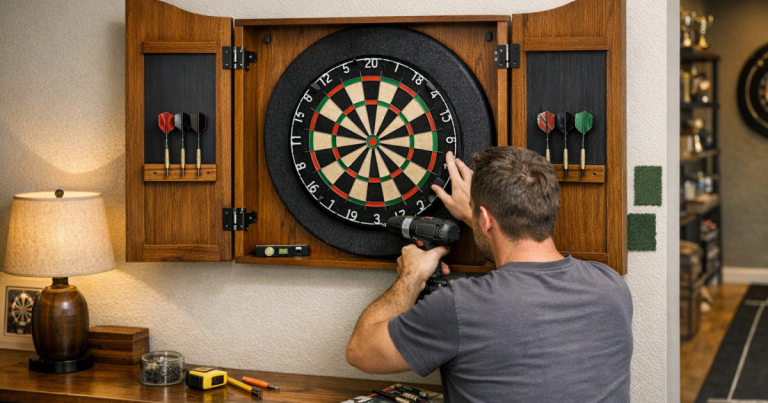
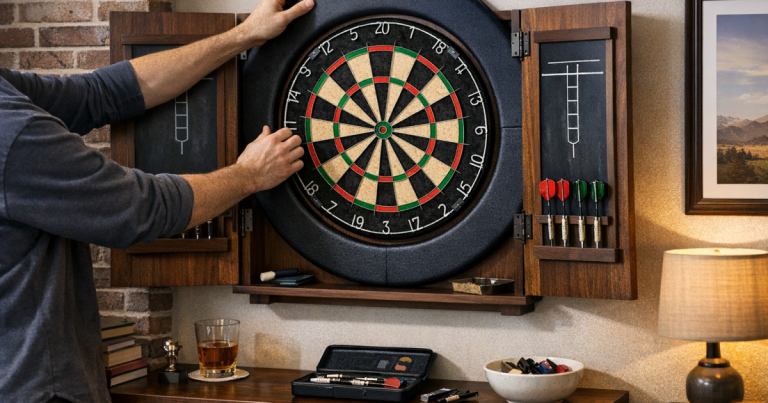
Cabinets demand a bit more care. The cabinet must be level, the board bracket must sit centrally, and the bull must end up at the correct height. A small error can make the whole setup look wrong, even if the board is technically playable. Door swing, wall fixings and the depth of the cabinet also matter, especially on uneven walls or in older UK homes where plaster may not be perfectly flat.
If you are mounting a cabinet, take time to mark the wall, measure twice, and check the board position before committing to final fixings. A separate walkthrough on how to fit a dartboard cabinet without misaligning the board is worth reading before drilling, because alignment mistakes are much easier to avoid than correct afterwards.
When a cabinet makes more sense
A cabinet is usually the stronger choice when the darts area is part of a furnished room. If the board is in a lounge, dining room, hallway end or home office, closing the doors can make the setup feel less exposed. It also keeps scoring tools and spare parts where players expect to find them.
Cabinets are also handy for casual players who do not want a separate accessory station. If you only keep one main set of darts and a few spares, the built-in storage is often enough. The setup becomes self-contained: open the doors, play, close everything away.
The main reasons to avoid a cabinet are lack of side clearance, awkward wall construction, or a room where maximum impact protection matters more than appearance. A cabinet can also feel unnecessary in a dedicated practice space where the board is always visible and accessories already have a proper home.
When a surround is the better fit
A surround is usually better for high-use practice spaces, beginner-friendly setups and rooms where wall marks are the main concern. It keeps attention on the board, gives a generous buffer around missed doubles, and avoids the visual weight of doors and panels.
It is also a good option if you rotate or replace boards regularly. Because there is less structure around the board, maintenance tends to be simpler. For serious home throwers who care more about repetition than presentation, that simplicity is a real benefit.
The drawback is that you need a separate answer for storage and scoring. That does not have to be complicated. A small case, a nearby drawer or a modest wall organiser can keep the space tidy. The key is to plan it deliberately rather than letting accessories collect under the board.
Can you use a cabinet and a surround together?
Sometimes, but it is not always elegant. A cabinet and surround combination can work if the cabinet is wide enough, the surround fits neatly, and the doors still open properly. In many home setups, however, the two compete for the same space. The result can look bulky, and the board may sit too recessed or awkwardly framed.
A more balanced approach is to decide which problem matters most. If storage and a finished look are the priority, start with a cabinet and consider extra protection only where misses are actually happening. If protection is the priority, start with a surround and add separate storage nearby.
For shared spaces, it can help to think in zones: the board zone, the scoring zone, the storage zone and the floor zone. A cabinet combines some of those zones; a surround keeps them separate. Neither is wrong, but mixing everything together without a plan can make the wall feel busy.
A simple decision framework
If you are still weighing the two, use the room rather than the product as the starting point:
- Living room or dining area: a cabinet often looks more intentional and keeps accessories hidden.
- Garage, shed or games room: a surround is often simpler and more protective for regular practice.
- Beginner-heavy household: prioritise the surround or add wider wall protection, because missed darts are more likely.
- Minimal gear setup: either can work, but a cabinet may be enough storage on its own.
- Lots of accessories: do not rely on cabinet storage alone; plan separate storage whichever option you choose.
- Tight wall space: check door swing before choosing a cabinet, and check surround diameter before assuming it will fit.
Common questions
Do surrounds protect the wall better than cabinets?
Usually, yes. A surround protects the area immediately around the board during play, while a cabinet is more about storage, presentation and hiding the board when not in use.
Will a cabinet stop bounce-outs damaging the floor?
No. A cabinet sits around the board and does not protect the floor. If bounce-outs are marking hard flooring, look at a darts mat, carpet offcut or other floor protection.
Is a cabinet suitable for a serious practice setup?
It can be, provided the board is correctly aligned and the doors do not get in the way. Many regular players still prefer a surround because it keeps the setup simpler.
Can I fit a surround around any dartboard?
Most standard bristle boards work with common surrounds, but you should check the fit before buying or fitting. Non-standard boards, unusual mounts or tight cabinets can cause compatibility issues.
Which option looks better in a small room?
A plain surround often looks lighter, but a slim cabinet can look tidier if you need to hide accessories. The better choice depends on wall width, door clearance and the rest of the room.
Final thoughts
The cabinet-versus-surround decision is less about which accessory is superior and more about which problem you need to solve first. Cabinets make a darts area feel organised, furnished and easier to close away. Surrounds give stronger day-to-day wall protection and keep the board area simple for practice.
For most shared rooms, start by asking how visible you want the setup to be when nobody is playing. For most dedicated practice spaces, start by asking how much protection the wall needs. Once that priority is clear, the right choice becomes much easier: storage and style point towards a cabinet; protection and simplicity point towards a surround.
Quick Buying Links
Dartboard Cabinets
The choice of dartboard cabinets vs surrounds is really a choice between tidy storage and soft-edged impact protection, with style sitting somewhere in the middle.Neither option is automatically better.
Surrounds: Storage, Style and Protection Compared
Worth considering if its strengths better match your needs.