Choosing between a darts mat vs oche is really a question of what problem you are trying to solve: protecting the floor, marking the throw line accurately, creating a firmer toe stop, or making the whole setup feel more permanent. For most home players, the right answer is not automatically the most professional-looking one.
A mat gives you floor coverage and a visible line. An oche gives you a physical throwing boundary. Some setups benefit from both, but plenty of spare-room, garage and rented-home boards work perfectly well with just one carefully measured solution.
What to know first
If you want the short answer: use a darts mat if you need floor protection, a tidy visible throw line and a setup that can be rolled away. Use a raised oche if you want a more fixed, match-style toe line that is hard to creep over during play. Use a simple marked line if space, budget or rental restrictions matter more than presentation.
The important bit is measurement. A regulation steel-tip setup is based on the throwing distance from the face of the board to the oche line, not simply from the wall. The bull should also be set at the correct height before you measure the floor position. If you are setting up from scratch, check the standard board height and throw distance in the darts measurements and regulations guide before fixing anything in place.
Once the board is right, the floor decision becomes much easier. A mat, raised oche or taped line should all mark the same legal throwing point; they just do it in different ways.
What a darts mat actually does
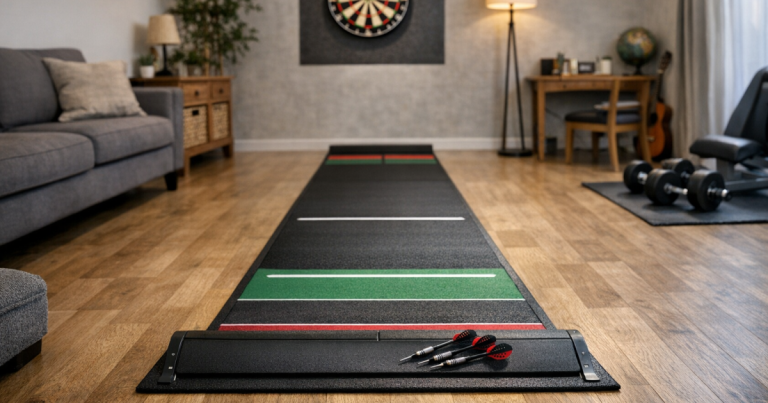
A darts mat is the most common home solution because it does two jobs at once. It marks the throw line and adds a layer of protection where dropped darts, bounce-outs and foot traffic usually land. That makes it useful on laminate, vinyl, tiled floors and other surfaces where a steel point can leave marks.
A mat also helps define the playing area. In a living room or shared family space, that visual boundary can be useful: the board stops feeling like a random object on the wall and starts feeling like a small darts zone. It also gives guests a clear place to stand without needing to explain measurements every leg.
The trade-off is movement. Thin mats can shift on smooth floors, curl at the ends or creep out of alignment if people walk across them. Thicker mats usually feel more stable, but they may not sit neatly under doors, over uneven flooring or against skirting boards. On carpet, some mats can ripple rather than lie completely flat.
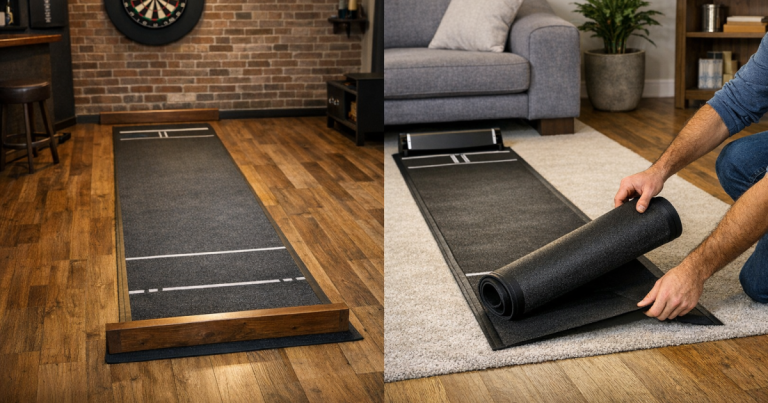
A mat is usually the most sensible answer when the room is multi-use. You can roll it away, move furniture back and avoid committing to a raised strip on the floor. It is also forgiving if you are still experimenting with the best board location.
What an oche does differently
An oche is the actual throw line or boundary. In home setups, people often use the word to mean a raised toe stop, but technically a taped line, printed mat line or recessed strip can all serve as the oche if correctly positioned.
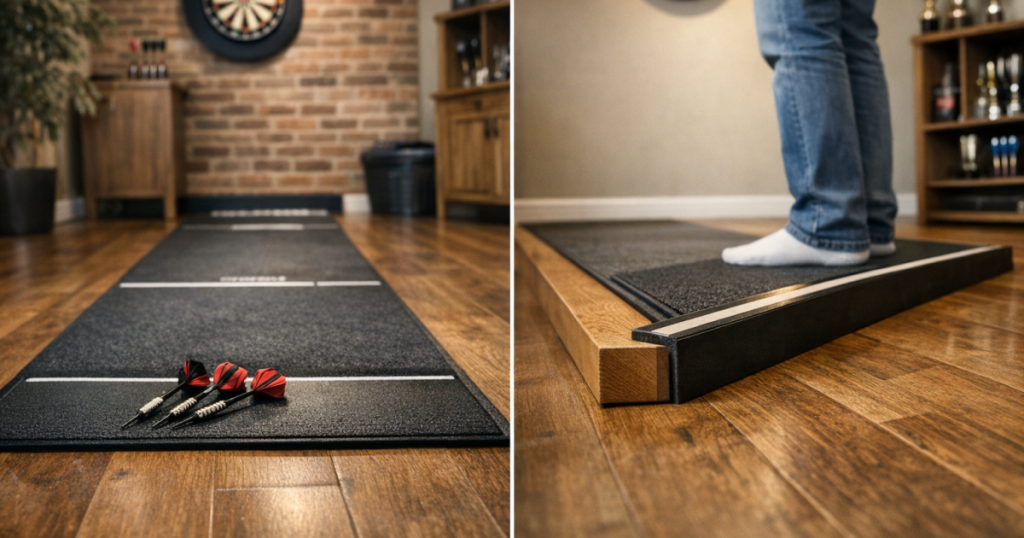
A raised oche changes the feel of throwing. Instead of looking down to check whether your foot is behind the line, you can place your toe against a physical edge. That makes it harder to drift forward during long practice sessions and gives the setup a more club-like rhythm.
The downside is permanence. A raised oche can get in the way in a narrow room, become a trip point when the board is not in use, or annoy anyone sharing the space. It also needs to stay square to the board and fixed at the correct distance. If it slides, twists or gets nudged, it stops doing its job properly.
A marked line is the simpler version. It can be tape, a floor marker, a removable strip or the line printed on a mat. It is less immersive than a raised oche, but it is often enough for casual home games. For a fuller breakdown of the different formats, see the guide to raised, recessed and marked oche types.
Which one fits common home setups?
Spare room or home office
A mat usually makes the most sense here. It protects the walking and landing area, keeps the throw line visible and can be moved if the room needs to become an office or guest room again. A raised oche can work if the darts area is permanent, but it may feel intrusive in a compact room.
Garage or outbuilding
This is where a raised oche becomes more appealing. If the floor is concrete and the board stays up all year, a physical toe line can make practice feel more consistent. A mat may still be useful for comfort underfoot and to define the lane, but floor protection may be less urgent than in a furnished room.
Living room or dining area
A roll-out mat or removable line is normally the better compromise. Raised oches can look odd in a shared living space and may become an everyday obstacle. If your board is inside a cabinet, a mat helps make the setup feel temporary and controlled rather than permanently taking over the room.
Rented home
A mat is usually easier to justify than anything fixed. You can avoid attaching anything to the floor and still get a repeatable throw line. If you use a removable marker, check that it will not leave adhesive residue or lift the floor finish.
The measurement mistake that catches people out
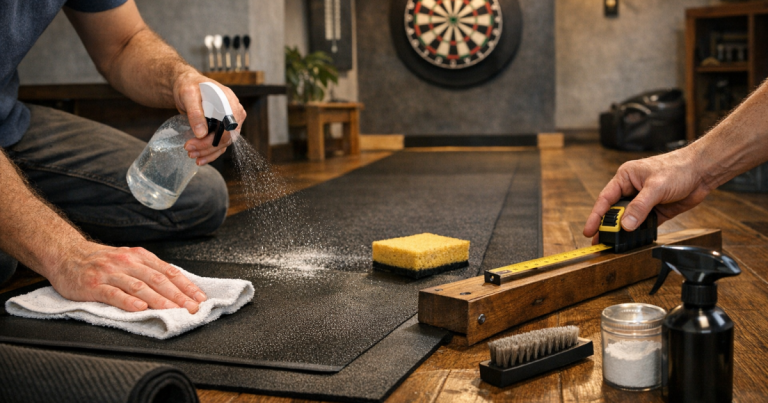
The most common error is measuring from the wall rather than the face of the dartboard. Sisal boards have depth, and cabinets or mounting systems can change how far the board face sits from the wall. If you mark the floor from the wall, the throwing distance can end up too short.
Measure after the board is mounted. Use the board face as the reference point, then mark the oche position on the floor. If your mat has a printed line, line it up with that mark rather than assuming the end of the mat should touch the skirting board or wall.
This matters whether you are using a premium mat, a budget mat, tape, or a wooden raised oche. The surface type is secondary; the position is what makes the setup fair and repeatable.
Floor protection versus throwing accuracy
The darts mat vs oche decision often comes down to which problem is more important in your room. If the floor is vulnerable, a mat has the obvious advantage. It can catch bounce-outs, reduce scuffs and stop the area around the board looking battered after a few months of play.
If your main concern is consistency, the raised oche has the advantage. It gives your stance a fixed physical reference. Players who practise regularly often like that because the setup feels the same from visit to visit.
There is a middle ground: a mat with a raised oche attachment or a separate raised strip placed at the correct distance. That can work well, but only if the mat stays flat and the raised edge does not move. If the mat shifts, the oche shifts with it, so the setup needs checking now and again.
For a deeper look at mat length, line placement and room fit, choosing a dart mat that sets the right oche is the natural next step.
When you genuinely need both
You do not need both for a legal home setup, but there are times when the combination makes sense. A mat plus raised oche works well when you have a permanent darts area, want a clean lane on the floor, and still need protection from dropped darts.
It is also useful for households where several people play. Beginners and occasional guests tend to step over a flat printed line without realising it. A raised toe stop makes the boundary obvious, while the mat protects the floor from missed catches and bounce-outs.
The combination is less useful in cramped rooms. If the mat has to be folded, angled, tucked under furniture or constantly moved, adding a raised oche can make the setup more awkward rather than better. In that case, a neat marked line may be more practical.
Simple checks before you decide
- Is the floor worth protecting? If dropped darts would bother you, start with a mat.
- Will the board stay in one place? Permanent boards suit raised oches better than temporary ones.
- Does the room have clear walking space? Avoid raised edges where people may trip or where furniture moves regularly.
- Can the mat lie flat? Curling, ripples and sliding make even a good-looking setup frustrating.
- Are you practising seriously? A raised oche can help make your stance more repeatable.
- Do other people use the room? In shared spaces, removable solutions usually keep the peace.
FAQ
Can I just use tape as an oche?
Yes, a clearly marked tape line can work for home play as long as it is measured from the board face and stays visible. Use a floor-safe tape and replace it when the edge starts lifting.
Does a darts mat make the throw distance accurate?
Only if it is positioned correctly. The printed line on a mat is useful, but you still need to line it up with the correct measurement from the board face.
Is a raised oche better for practice?
It can be. A raised edge gives your front foot a repeatable stop, which helps reduce creeping over the line during longer sessions.
Will a mat stop all floor damage?
No. It reduces risk in the main landing area, but darts can still bounce or fall outside the mat. A surround or backboard may also be needed if wall protection is a concern.
What is best for a rented home?
A roll-out mat or removable floor marker is usually the safest choice because it avoids fixing anything to the floor. Check that any tape or backing will not mark the surface.
What stands out
A darts mat is the better all-round home solution when you want protection, a tidy playing lane and flexibility. A raised oche is better when the space is permanent and you care most about a consistent, physical throw line. A simple marked line is perfectly acceptable when space, cost or room-sharing matters more than a club-style feel.
The best setup is the one that stays correctly measured, lies where it should and fits the room without becoming a nuisance. Get the board height right first, measure from the board face, then choose the floor solution that solves the real problem in your space.
Quick Buying Links
Darts Mat
Choosing between a darts mat vs oche is really a question of what problem you are trying to solve: protecting the floor, marking the throw line accurately, creating a firmer toe stop, or making the whole setup feel more permanent.
Oche: What Do You Actually Need?
Worth considering if its strengths better match your needs.