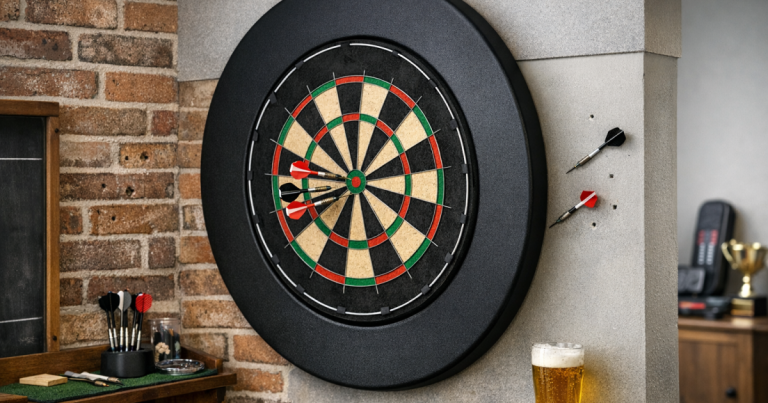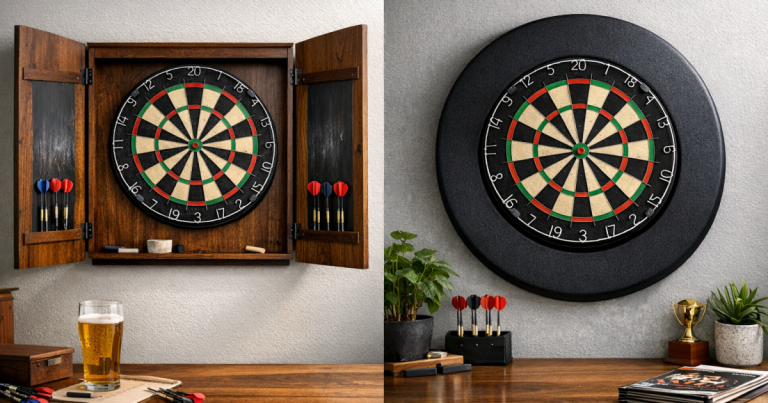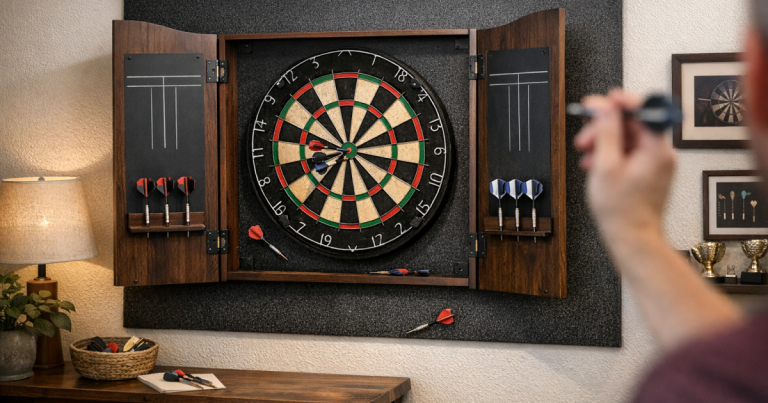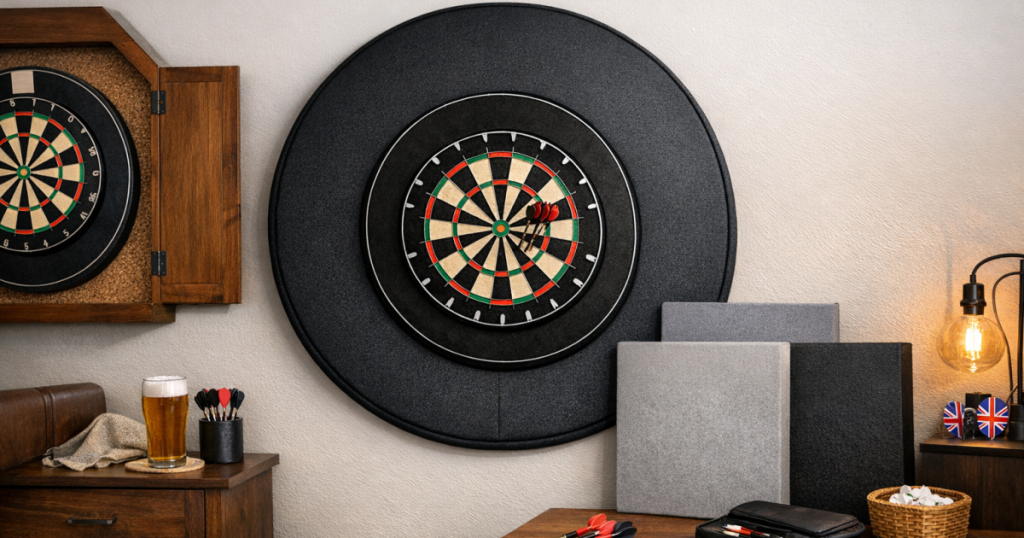
A neat home board needs protection that looks intentional, not like an afterthought. This Dart-Stop Professional Backboard review looks at whether the premium, framed backboard approach gives enough wall coverage for real missed darts, and where a simpler surround or cabinet-style setup might make more sense.
Quick verdict: it is a strong option for players who want a more furniture-like finish around a permanent board. The main reasons to pause are footprint, cost and whether the protected area matches your usual miss pattern.
Product overview
The Dart-Stop Professional Backboard is a wall-protection backboard designed to sit behind a steel-tip dartboard and catch stray darts before they mark plaster, paint or wallpaper. It is aimed less at temporary practice corners and more at home boards that stay up all year, where the setup needs to look tidy in a spare room, garage conversion, games room or shared living space.
Its biggest appeal is the presentation. Standard foam surrounds do the job, but they can make a board look like training-room equipment. Dart-Stop’s framed style gives the whole area a more deliberate, finished look, which matters if your board is visible rather than tucked away in a shed. It also avoids the cupboard-like bulk of a full dartboard cabinet.
Before buying, check the current listing for the exact dimensions, finish options, included fixings and compatibility with your dartboard bracket. Backboards like this are only as useful as their placement: the board centre must still sit at regulation height, the board must sit square, and the backboard needs enough clearance around the doubles ring.
If your board is going onto masonry rather than plasterboard, plan the fixing properly. The principles in our guide to mounting a dartboard on a brick wall are worth reading before you start, because the wall type affects plugs, screws and how securely the whole setup sits.
Key specs
- Product type: wall-protection backboard for a steel-tip dartboard setup.
- Main purpose: protects the wall around the board from missed darts and bounce-out damage.
- Typical use case: permanent or semi-permanent home darts area rather than a temporary pop-up board.
- Fit: designed to sit behind a standard dartboard; verify your board, bracket and any lighting clearance before fitting.
- Finish: framed, decorative backboard style; check the live product listing for current colour and finish choices.
- Installation: wall-mounted; confirm included hardware and choose fixings suitable for your wall surface.
- Best environment: indoor home setups where appearance matters as much as basic wall coverage.
Pros and cons
Pros
- Looks more polished than many plain foam or rubber surrounds.
- Gives a defined protective zone around the dartboard, helping to hide and prevent wall marks.
- Works well for permanent home setups where the board is part of the room rather than an occasional accessory.
- Can suit players who dislike the visual bulk of a full cabinet but still want a finished backdrop.
- Simple to live with once fitted, as there are no moving parts or storage routines to manage.
Cons
- Coverage is still finite, so very wide or high misses can reach the surrounding wall.
- It is not the most discreet option for rented homes or rooms where you cannot drill confidently.
- Usually less flexible than a removable surround if you regularly change boards or room layout.
- The framed look will not suit every décor, so finish choice matters.
- You need to verify dimensions carefully, particularly if you already use a light ring, cabinet or unusual bracket.
Performance in real use
Wall coverage
For typical home play, the backboard gives useful protection around the area most likely to suffer: just outside the doubles and around the upper-left and upper-right sections where casual misses often land. It is not a magic shield for every wayward dart, though. Beginners, children and party-night players can miss by a long way, so a larger wall panel or a more generous DIY backing board may still be safer for busy family rooms.
The key is to think about who is throwing. A steady league-style player who occasionally drifts outside double 1 or double 5 needs different coverage from a mixed household where some throwers are still learning grip, stance and release. For a serious home practice board, the Dart-Stop approach feels well matched. For a very casual social setup, the protected area should be assessed more cautiously.
Fit around the board
The most important fitting detail is clearance around the doubles ring. Any backboard or surround that sits too close, bows forward or pinches the edge of the dartboard can interfere with scoring areas and create frustrating deflections. With a framed backboard, check that your board sits proud enough and remains easy to rotate.
If you are moving from a ring-style surround, our guide on how to fit a dartboard surround without blocking doubles explains the same clearance issue in more detail. The principle applies here too: protection should sit behind the board, not crowd the scoring bed.
Room appearance
This is where the product makes its strongest case. A fabric-faced or framed backboard can make a darts area feel designed rather than improvised. That matters in UK homes where a board might share space with bikes, storage, a home bar, a utility area or a spare bedroom desk. It gives the wall a focal point and helps the board look less like it has simply been screwed onto a blank surface.
The trade-off is that a framed backboard draws attention. If you want the board to disappear visually when not in use, a cabinet may hide things better. If you want a clean practice zone that still shows off the board, this style works nicely.
Ease of fitting and adjustment
Installation should be straightforward for a competent home DIYer, but it still rewards careful measuring. Mark the bull height, confirm the board centre, check the oche distance after fitting, and make sure the board does not wobble when darts are pulled. The backboard should sit flat enough that it does not flex or rattle during normal use.
One practical point: think about future access. You may want to rotate a bristle board, swap a bracket, add a lighting ring or move a scoreboard. A backboard that looks perfect on day one can become annoying if it traps you into a layout with no space for upgrades.
Durability and maintenance
Any dart-catching surface will show evidence of use eventually, especially if the same areas are hit repeatedly. The Dart-Stop format is best treated as protective décor: it should take normal missed darts, but it still deserves sensible use. Pull darts straight out rather than levering them sideways, keep the area dry, and avoid using it as a pinboard or general storage surface.
If the finish is a major reason you are buying it, check close-up product photos and recent buyer images where available. Wall protection has to perform, but in this case the visual finish is part of the value.
Who it’s best for / who should skip it
- Best for: home players with a permanent steel-tip board who want a tidy, framed look and better protection than bare wall space.
- Best for: spare rooms, games rooms, garages and home bar areas where the dartboard is meant to be seen.
- Best for: players who already have a reasonably accurate throw and mainly need protection around the board rather than across a whole wall.
- Skip it if: you are in rented accommodation and cannot make secure wall fixings or repair marks later.
- Skip it if: your throwers are complete beginners who may miss far beyond the board area.
- Skip it if: you already use a deep cabinet, oversized surround or lighting system that may clash with the backboard footprint.
Alternatives
The nearest alternative is a standard foam or rubber dartboard surround from brands such as Winmau, Target or Mission. This is usually the simpler route if you want quick wall protection without a decorative frame. A surround is also easier to remove, replace or swap between boards, which can be helpful in multi-use rooms.
The second realistic alternative is a larger custom backing panel, such as a plywood or MDF panel finished with felt, cork tiles or another dart-friendly covering. That route can give broader wall coverage, but it needs more planning and may look more homemade unless finished carefully. It is better for high-risk walls and beginner-heavy households, while the Dart-Stop option is better for a cleaner, ready-made look.
Helpful questions
Will it stop every missed dart?
No. It protects the area it covers, but very wide, low or high misses can still hit the surrounding wall. Match the backboard size to the accuracy of the people who will actually use the board.
Can it be used with a dartboard light?
Usually this depends on the light design, bracket depth and backboard clearance. Check the light’s mounting method and compare it with the backboard dimensions before committing.
Is it better than a normal surround?
It is better for a polished, permanent-looking setup. A normal surround is usually better if you want a cheaper, simpler and more removable protection option.
Will it suit a rented home?
Only if your tenancy and wall type allow secure fixing and later repair. Many renters will be better served by a less permanent setup or a freestanding protection panel.
Does it replace good room planning?
No. You still need correct board height, oche position, lighting and enough clear space around the throw. Wall protection is one part of the setup, not the whole setup.
Verdict + score
The Dart-Stop Professional Backboard is a convincing upgrade for players who want wall protection that looks at home in a proper darts corner. Its strength is not just catching stray darts; it is making the board area feel finished. It loses marks for limited coverage compared with larger custom panels and for being less flexible than a basic removable surround, but for a permanent home board with a smart finish, it is easy to recommend. Score: 8.3/10.
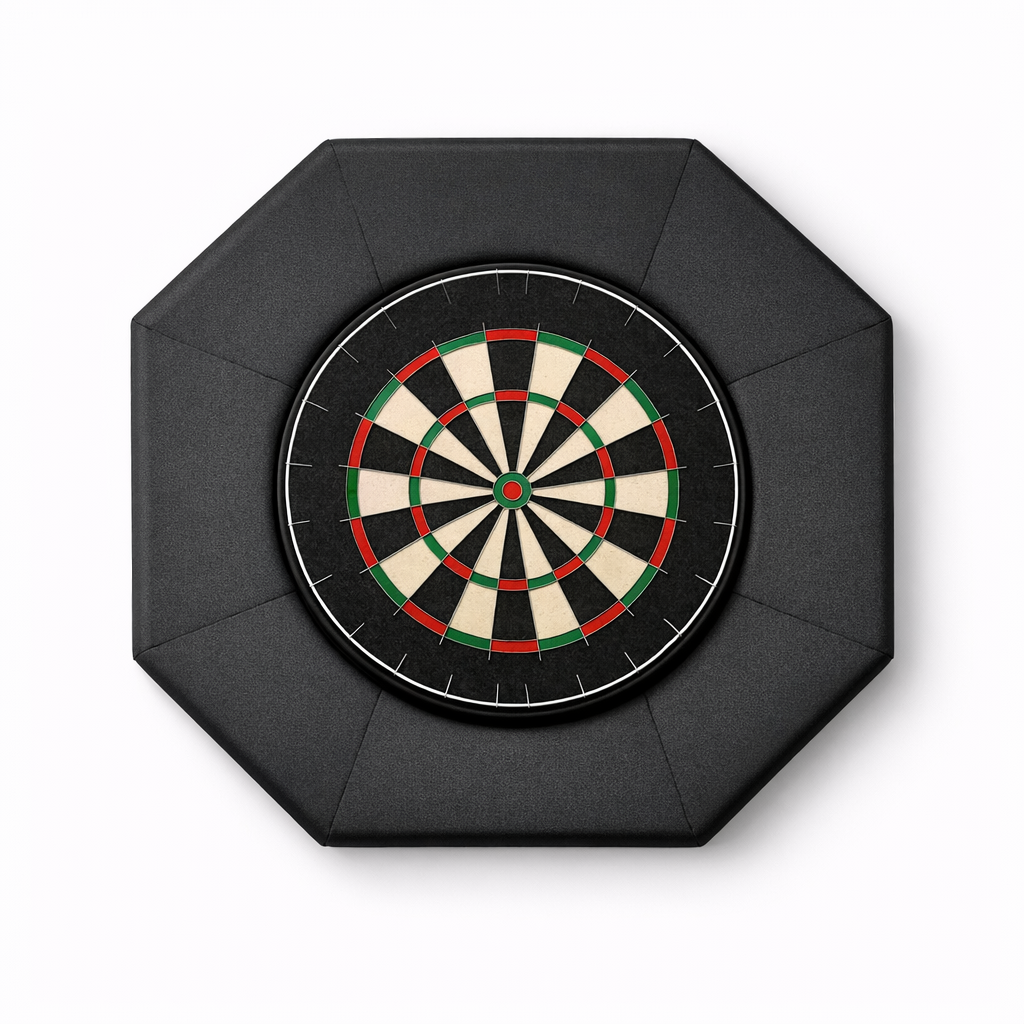
Dart-Stop Professional Backboard
It loses marks for limited coverage compared with larger custom panels and for being less flexible than a basic removable surround, but for a permanent home board with a smart finish, it is easy to recommend.
You might also like: How to Stop Flights Getting Crushed in Storage.