A well-lit board makes scoring easier, but a badly placed lamp can throw awkward shadows across treble 20 or bounce glare straight back at you. The aim with dartboard lighting is simple: even light on the face of the board, a clear sightline from the oche, and no bright source sitting in your eye line.
Most home setups can be improved without rebuilding the room. The key is to start with the thrower’s viewpoint, not the position of the nearest ceiling light.
Hard-wired light fittings, new sockets, spurs and changes to fixed wiring should be carried out by a qualified electrician so the work complies with UK electrical safety standards and Building Regulations.
The short version
- Use light that falls evenly across the whole board, not a single harsh beam from one side.
- Keep the visible light source out of the thrower’s direct eye line from the oche.
- Avoid relying on a normal room ceiling pendant behind the player, as it often creates hand and dart shadows.
- Test from the actual throwing position before fixing anything permanently.
- Check the setup at the time of day you usually play, as windows and reflective surfaces can change the result.
Step 1: Stand at the oche and read the board like a player
Before moving lamps or ordering anything, stand where you throw and look at the board as if you are about to aim at treble 20, treble 19 and double 16. Good light should make the segment wires, colours and number ring clear without making the board look washed out.
Now hold a dart up in your normal grip and move it through your throwing line. If your hand or dart casts a dark shape across the target, the light source is probably behind you, too far to one side, or too narrow. If you find yourself squinting, the light is too exposed or aimed too directly at your face.
This player-first check matters because a light that looks fine from the doorway can feel poor from the oche. For the wider throw-line setup, it also helps to set your oche and mat properly before finalising the light position.
Step 2: Choose the lighting approach that suits the room
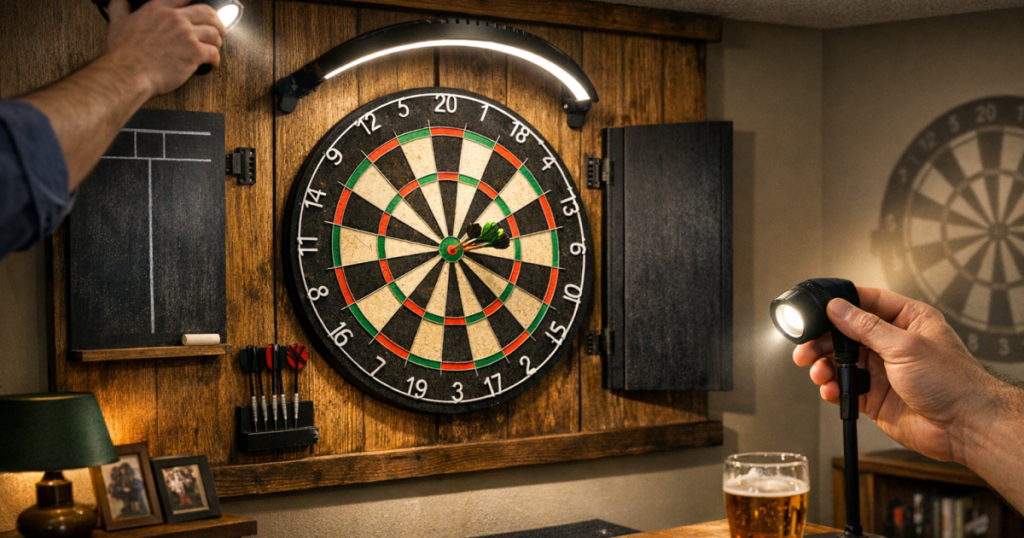
There are three common ways to light a home dartboard: a purpose-made ring or surround light, two angled side lights, or an adjusted room light supported by a board-focused lamp. Each can work, but they behave differently.
Ring or surround-style light
A board-mounted or surround-mounted ring-style light is usually the simplest route to even coverage. Because the light wraps around the board area, it reduces the strong one-sided shadows that come from a single lamp. It is especially useful in spare bedrooms, garages and multi-use rooms where the ceiling light is not in the right place.
Examples include products such as the Mission Torus 270 and Unicorn Solar Flare. Treat these as recognisable examples of the product type rather than automatic answers for every setup. Before using any light, verify board compatibility, wall clearance, how it fits around a cabinet or surround, and whether the power lead can be routed neatly.
Two angled side lights
A pair of wall-mounted or clip-on lamps can work well if they are balanced. Place them to the left and right of the board, slightly forward of the board face if the room allows, and aim them across the surface rather than straight at the centre. The goal is overlap: each lamp should soften the shadow made by the other.
This approach needs more tweaking than a ring light. If one lamp is brighter or closer than the other, the board can look uneven. It can also be awkward with cabinets, shelves or curtains near the board.
Adjusted room lighting
A normal ceiling light can help with general visibility, but it rarely solves board shadows on its own. If the light sits behind the thrower, your arm and dart can interrupt the beam. If it is directly over the board, it may create glare on the number ring or wires. Use room lighting as background support, then add board-focused light if the target still looks patchy.
Step 3: Remove glare before chasing more brightness
Glare is not just “too much light”. It is usually light in the wrong place, at the wrong angle, or reflecting off the wrong surface. A brighter lamp can make the problem worse if it shines towards the player rather than onto the board.
Start with these checks:
- From the oche, can you see the bare bulb or LED strip directly? If yes, shield it, move it, or change the angle.
- Does the number ring look shiny or distracting? Reduce direct front-on light and try a shallower angle.
- Are nearby picture frames, mirrors, gloss paint or glass cabinet doors reflecting light back at you? Cover or reposition the reflective surface during practice and see if the view improves.
- Does glare appear only from one side? That often points to a side lamp that is aimed too far towards the thrower.
Do not judge glare while standing close to the board. Always step back to the throwing position and check again. A light source that feels hidden from the board can be very obvious from the oche.
Step 4: Deal with shadows at their source
Shadows usually come from one of four places: the player, the dart, the board surround, or the room itself. The fix depends on which one is causing the dark patch.
- Player shadow: the main light is behind you or too central in the room. Add board-focused light or reduce reliance on the rear ceiling light.
- Dart and hand shadow: the beam is too narrow or too strongly angled from one side. Use wider coverage or balance it with a second source.
- Surround or cabinet shadow: the light is hitting the outer frame before it reaches the board. Move the lamp forward, raise it slightly, or use a light designed to sit around the board face.
- Wall or alcove shadow: the board sits in a recess or tight corner. Side clearance is limited, so a surround-style light may be easier than wall lamps.
If you are struggling to identify the pattern, compare what you see with these common dartboard shadow problems. Matching the shadow shape to the likely cause is quicker than randomly moving lamps around.
Step 5: Test with a simple throw routine
Once the light looks promising, test it through an actual mini session. Throw at treble 20, treble 19, bull, double 16 and double 10. These targets make you look at the top, side, centre and lower part of the board, so they reveal uneven light quickly.
After each round, ask three questions:
- Can I read the segment clearly without leaning or squinting?
- Does my hand shadow pass across the target during the throw?
- Is any part of the board noticeably brighter or darker than the rest?
Then try one adjustment at a time. Move a lamp slightly, change the angle, or add a shade, then test again. Changing several things at once makes it harder to know what actually improved the view.
Step 6: Make it neat, repeatable and comfortable
A good setup should not need rebuilding every time you play. Once you find the right position, mark where movable lamps sit, secure loose leads away from the oche, and keep switches easy to reach. If you use a spare bedroom or shared space, choose a setup that can be left safe and tidy between sessions.
Board surrounds and cabinets can change where lights fit, how shadows fall, and whether a ring-style unit has enough clearance. If you are planning the full wall area rather than just the lamp, it is worth checking how cabinets and surrounds affect your lighting choices before fixing anything permanently.
Good dartboard lighting is less about creating a bright display and more about making practice feel natural. If your eye goes straight to the target rather than the lamp, you are close.
Common mistakes to avoid
- Using one harsh spotlight: it can make the board look dramatic, but it often creates hard shadows and glare.
- Mounting lights too low: low lamps are more likely to sit in the thrower’s eye line.
- Ignoring the number ring: a board face may look fine while the numbers reflect light awkwardly.
- Forgetting the cabinet doors: open or glossy doors can alter reflections, particularly in narrow rooms.
- Testing in daylight only: evening practice can feel very different once curtains are closed and the room light is on.
FAQ
Is a ring light better than side lamps for a dartboard?
For many home setups, a ring-style light is easier because it gives more even coverage with less adjustment. Side lamps can still work well, but they need careful balancing to avoid one-sided shadows.
Can I use a normal ceiling light for darts?
You can use it as background light, but it is rarely enough on its own. If the ceiling light is behind the player, your arm and dart are likely to cast shadows across the board.
Where should the light sit to avoid glare?
The light should illuminate the board without being directly visible from your throwing position. If you can see the bright source from the oche, adjust the angle, add shielding, or move the fitting.
Why does my board still have shadows with a bright lamp?
Brightness does not guarantee even coverage. A narrow or badly angled beam can still create strong shadows, so widen the coverage or add balanced light from another direction.
Should I light the wall around the dartboard too?
A little spill onto the surround or wall is fine and can make the area feel more comfortable. The priority is still even light on the scoring surface, not lighting the whole wall as brightly as possible.
Final thoughts
The cleanest home setup is the one where the board is easy to read, the lamp disappears from your attention, and your throw feels unchanged. Start at the oche, remove glare first, then soften shadows with better position and wider coverage. Once the board looks consistent from top to bottom, stop tweaking and play a proper session to confirm it works in real practice.