A good darts mat is not just something to stand on. The right darts mat and oche setup gives you a repeatable throwing position, protects the floor, keeps the room tidier and makes home practice feel more like a proper match environment.
The main aim is consistency. If your mat creeps, curls, marks the floor or leaves you guessing where your toes should go, it will quietly undermine every session.
Main points
- A good setup marks the correct throwing distance clearly and stays aligned with the centre of the board.
- The surface should feel stable underfoot, with enough grip for your flooring and throwing style.
- Floor protection matters most in front of the board, where bounce-outs and dropped darts usually land.
- A raised oche improves consistency, but it needs to be secure and not become a trip point.
- Storage, noise and room layout are just as important as the mat itself in a normal UK home.
The basics that need to be right
For standard steel-tip darts, the bullseye is normally set 1.73 m from the floor, measured to the centre of the bull. The throwing line is 2.37 m from the face of the dartboard, not from the wall. That distinction matters because cabinet depth, board bracket position and surrounds can all change where the board face sits.
A mat should help you hold that distance without needing to remeasure every time. Printed oche lines are useful, but only if the mat is laid straight and the line matches your board position. If you move the board, add a thicker surround or change cabinet depth, check the measurement again from the board face to the throw line.
For extra confirmation, the diagonal distance from the centre of the bull to the oche line is commonly used as a cross-check. In a home room, this can be easier than trying to measure perfectly along the floor if skirting boards, furniture or carpet edges get in the way.
What a mat should do under your feet
A good mat needs to feel settled. If it slides on laminate, bunches on carpet or lifts at the corners, your stance changes without you noticing. That is particularly annoying if you practise short daily sessions, because you spend more time fiddling with the mat than throwing.
Rubber-backed mats usually feel more planted on hard floors, while lighter roll-out mats can be easier to store in a hallway, spare room or garage. Heavier mats tend to sit flatter, but they are less convenient if the darts area has to disappear after practice. Neither approach is automatically better; the right choice depends on how permanent your setup is.
Thickness is another trade-off. A thicker mat can feel more cushioned and protective, but a very soft surface may not suit players who like a firm stance. A thinner mat is easier to roll away and may feel closer to standing on a pub floor, but it offers less protection from darts hitting point-first.
The oche line: printed mark or raised bar?
A printed line is the simplest option. It is flat, easy to store and less likely to annoy other people using the room. The downside is that your front foot can creep over it, especially during longer practice games or casual matches.
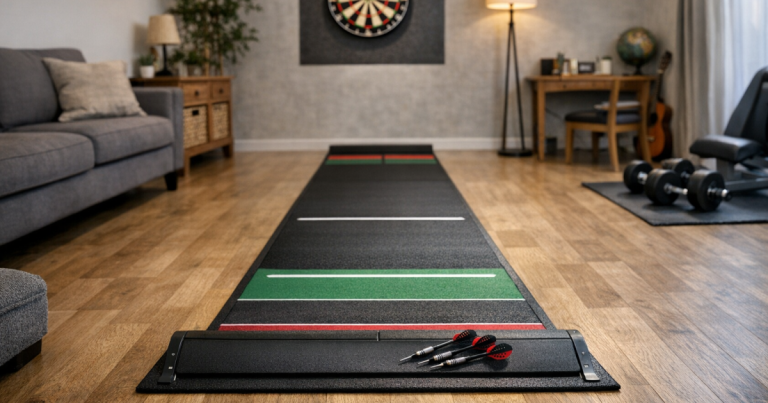
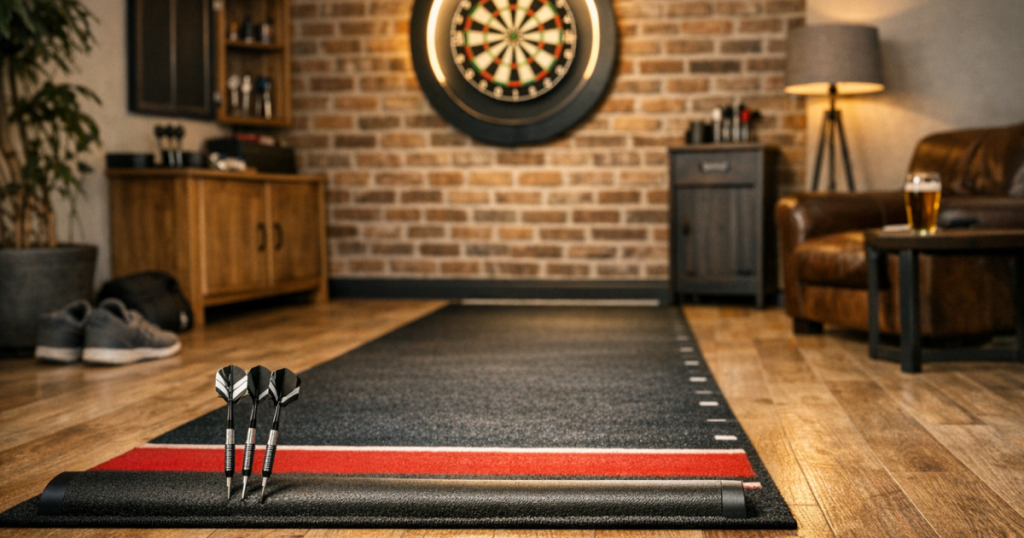
A raised oche gives a physical stop for your toe. That makes your throw more repeatable because you can feel the position without looking down. It also helps when different players are taking turns, as everyone has the same obvious reference point.
The raised section should be firm, straight and secure. If it moves when you nudge it, it defeats the point. In a shared room, also think about whether people will walk across the mat. A permanent raised oche can be excellent in a dedicated darts corner, but awkward in a lounge or multi-use garage.
Floor protection is not only about bounce-outs
The area most at risk is directly below and in front of the board. Newer players may drop darts short, while experienced players still get bounce-outs from wires, staples, crowded trebles or unlucky angles. A mat helps, but it does not protect the wall or the full surrounding area on its own.
If your board is near plasterboard, brick, painted walls or fitted furniture, think about the whole landing zone rather than just the throwing line. A mat protects the floor; a surround or backing panel protects the wall. The two work together, especially in rented homes or freshly decorated rooms.
Players setting up in a garage often have more freedom, but concrete floors can be harsh on dart points. A mat can reduce impact and make the area more comfortable, though it still needs to lie flat on an uneven surface. If the wider room needs planning, the guide to planning a darts corner in a garage covers spacing, walls and practical layout decisions.
Getting the alignment right
A mat can only guide your stance if it lines up with the board. Start by identifying the centre line from the bullseye down to the floor, then extend that line back to the oche. The mat should sit square to that line, not merely parallel with a wall, rug edge or floorboard.
This is where many home setups go slightly wrong. UK rooms are rarely perfect rectangles, and skirting boards, alcoves and furniture can trick the eye. If the mat looks straight to the room but not to the board, trust the board. Your throwing line should belong to the dartboard, not the carpet pattern.
Once aligned, use discreet reference points if the mat has to be moved. Small floor-safe markers, furniture positions or a measured note kept inside a cabinet can save time. Avoid anything that damages flooring, especially on rented property or finished timber.
Comfort, grip and room feel
A good setup should encourage you to throw more often. If standing on the mat feels awkward, cold, slippery or cramped, it becomes a barrier. The mat should give you enough width to take your natural stance without feeling as though your back foot is half off the edge.
Width matters more than many players expect. A narrow strip may mark the distance, but it may not cover the way you actually stand. If you angle your feet, shift stance between doubles practice and scoring practice, or have several players using the same board, a slightly broader mat area can feel more forgiving.
Also consider the room around the oche. There should be enough space behind the thrower for a relaxed setup, and enough side clearance that players are not brushing furniture. In a home, the best darts area is often the one that feels easy to use repeatedly, not the one squeezed into the only technically available gap.
Noise and neighbours
Mats can help soften foot movement, dropped darts and the general feel of play, but they do not solve every noise problem. The main thud usually comes from darts hitting the board and travelling through the wall or mounting surface. A mat helps more with floor impact and oche noise than wall vibration.
If you live in a flat, terrace or semi-detached house, think about the full sound path: board mounting, cabinet, wall type, floor covering and the oche. A heavier mat, quieter footwear and a secure raised oche can reduce some sharp noises. For a deeper look at this side of the setup, see how to make a darts mat and oche setup quieter.
Lighting still affects the mat and oche
Lighting is normally discussed around the dartboard, but it also affects your stance. If the oche area is dim, cluttered or crossed by shadows, players look down more often and reset less naturally. Good lighting helps you see both the board and the throw line without glare.
The ideal arrangement gives clear board visibility while leaving the standing area comfortable. If your light source sits behind the thrower, it can cast a distracting shadow towards the board. If it is too low or too bright from one side, it can make the mat edge harder to judge. The guide to dartboard shadows and lighting setups is a useful next step if your board looks right but your throw still feels visually awkward.
Storage and day-to-day use
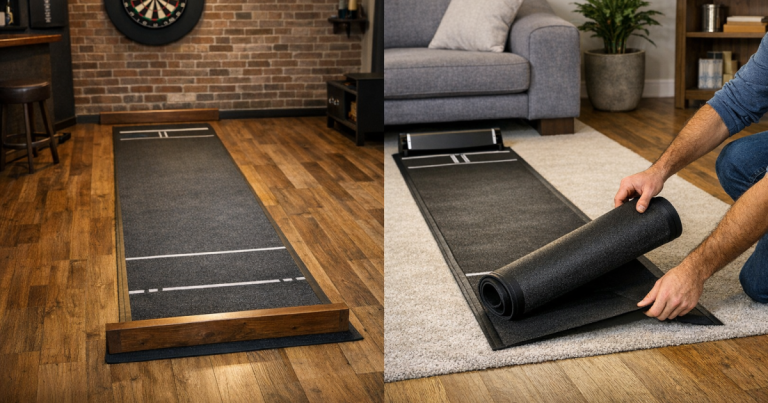
A permanent darts area can take a heavier mat and fixed oche because nothing needs to be packed away. A shared room needs a different mindset. The mat should roll or lift without curling permanently, and the oche should not become a loose item that gets misplaced.
If you use a cabinet, keep measuring tools, spare flights and a small note of your setup dimensions nearby. That makes it easier to reset the area after cleaning or moving furniture. For casual households, the best system is the one that can be restored accurately in under a minute.
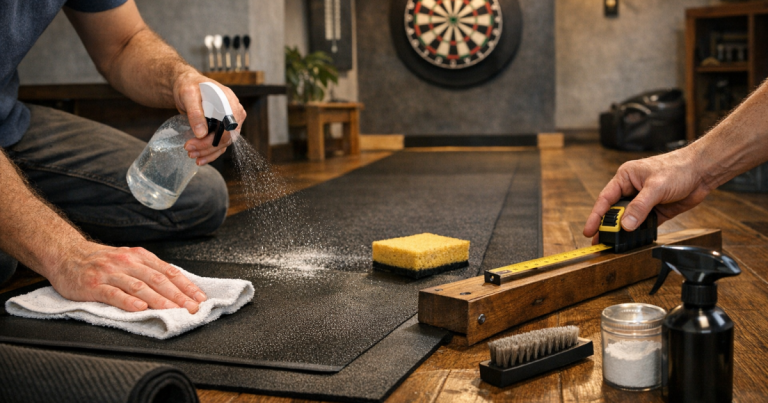
Be realistic about cleaning too. Mats near garden doors, garage floors or utility spaces collect grit. A dirty mat can scratch hard flooring underneath if it is dragged around, and grit can make the surface feel less stable. Lift and clean underneath occasionally rather than assuming the mat is protecting everything by itself.
Signs your current setup needs improving
- You keep checking the distance because the mat does not stay in one place.
- Your front foot drifts forward during practice because the oche is only lightly marked.
- The mat curls at the ends or creates a lip where people walk.
- Darts regularly land outside the protected floor area.
- The throw line is square to the room but not centred on the board.
- You avoid practising because setting up the mat is a nuisance.
If several of these sound familiar, the issue may not be your throw at all. Small setup faults can make practice feel inconsistent, particularly when you are working on grouping, finishing routines or match rhythm.
Where a dedicated mat makes the biggest difference
A dedicated mat is most valuable when the board is used often, the floor needs protecting or the oche position has to be reset regularly. It also helps when more than one person plays, because everyone can see and feel the same throwing position.
If your setup is occasional and the floor is already robust, a simple marked throw line may be enough for now. But once you start practising seriously, playing legs at home or inviting friends round, the mat becomes part of the playing environment rather than just an accessory.
For readers weighing up a real-world example, the Target Darts Dartboard Mat review looks at how a branded mat fits into a home setup without treating it as a magic fix for every room.
Questions people ask
Does a darts mat need a raised oche?
No. A printed line can work well if the mat stays put and you are disciplined with foot position. A raised oche is better when you want a physical toe stop and a more match-like feel.
Can I put a darts mat on carpet?
Yes, but check that it lies flat and does not creep as you throw. Thicker carpet can make some mats feel less stable, so alignment may need checking more often.
How long should a home darts mat be?
It needs to cover the distance from the board area to the throwing line, with enough extra length to sit securely. Always measure from the face of the board to the oche line, not from the wall.
Will a mat stop darts damaging my floor?
It reduces the risk, especially in the main landing zone, but it is not complete protection. Sharp bounce-outs can still land beyond the mat or hit at an awkward angle.
Is a darts mat worth using in a garage?
Usually, yes. It makes the standing area more comfortable, helps mark the distance and gives dart points a less brutal landing surface than bare concrete.
Main lessons
A good darts mat and oche arrangement gives you accuracy, comfort and repeatability. The essentials are simple: correct distance, straight alignment, stable footing, suitable floor protection and a throw line that does not move between sessions.
Once those are right, the setup starts to disappear in the best possible way. You stop thinking about the floor, the line and the room, and you can focus on the next visit to the board.