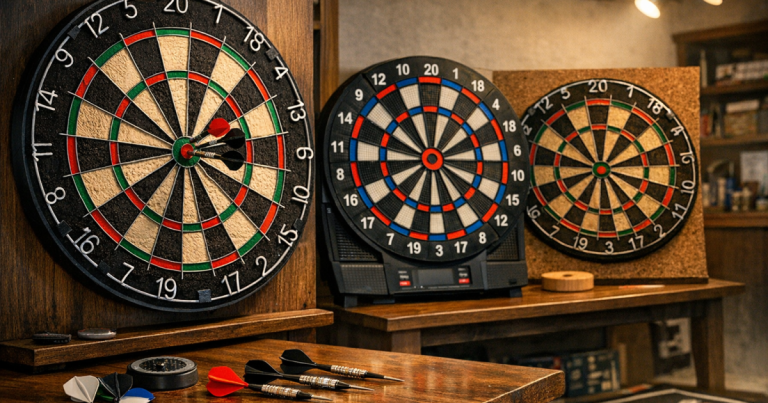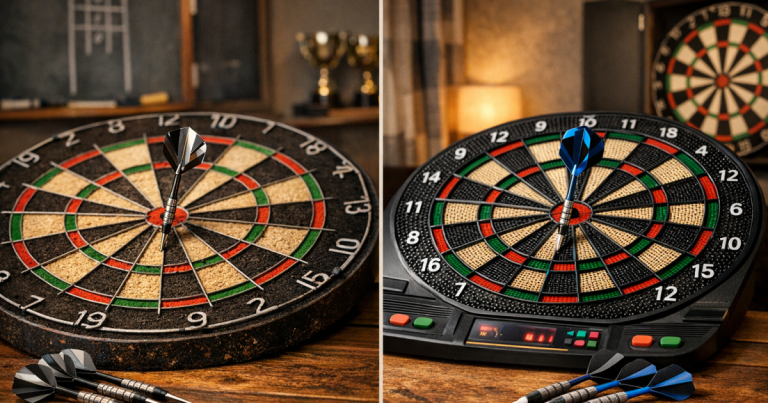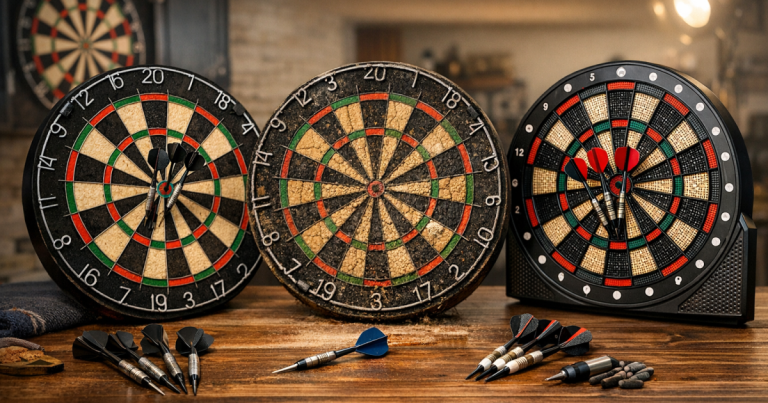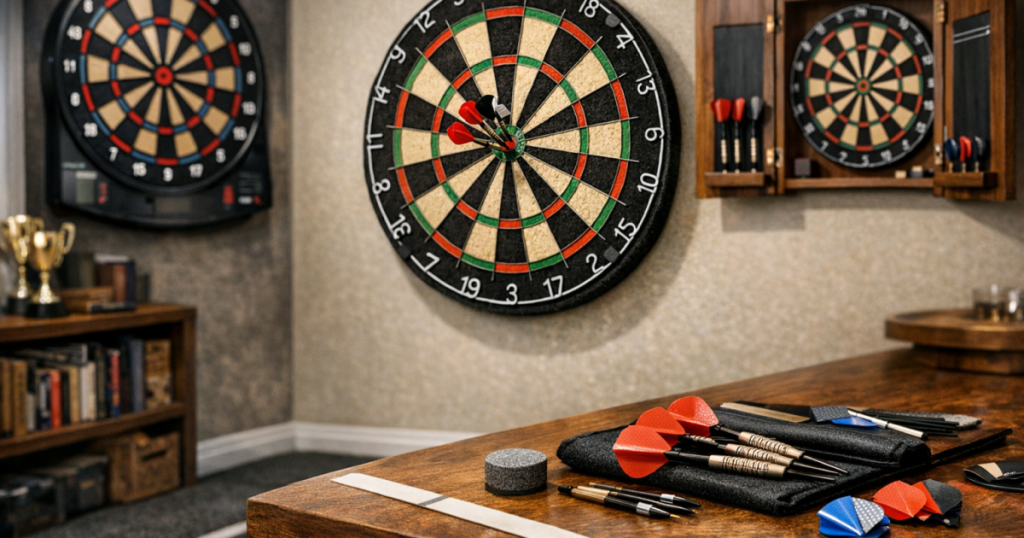
A good dartboard for home practice is one that feels consistent, holds darts reliably and fits the space you actually play in. For most UK home players, that usually means a well-made bristle board, mounted securely at the correct height, with enough wall protection and lighting to make daily practice comfortable.
The board itself matters, but it is only part of the setup. A premium board in a noisy, cramped or poorly lit corner can be less useful than a solid mid-range board installed properly.
At a glance
- Best general type: a quality sisal bristle board for steel-tip darts.
- Most important feel factor: consistent dart hold across the scoring area.
- Biggest home setup issue: wall protection, noise and safe throwing space.
- Maintenance habit that pays off: regular rotation to spread wear.
- Worth checking before buying: wiring style, mounting system, number ring, cabinet or surround compatibility, and whether the board suits your darts.
The board should suit the way you practise
Home practice is different from an occasional pub throw. You may be throwing short, repetitive routines at trebles, doubles and setup shots, which means the same areas of the board take a lot of punishment. A good dartboard needs to handle that regular use without becoming badly chewed up in one favourite segment after a few sessions.
For steel-tip home darts, bristle boards made from sisal are the normal standard because the fibres can close around dart holes better than paper-wound or very basic boards. That does not make every bristle board equal. The density of the sisal, the way the playing surface is finished, and the quality of the wiring all affect how cleanly darts enter and how well the board ages.
If you practise mainly for league-style steel-tip darts, stay close to a standard bristle setup rather than drifting towards novelty boards or lightweight decorative sets. If you play soft-tip darts, an electronic or soft-tip board may make more sense, but it will not feel the same as a bristle board with steel tips.
What the playing surface should feel like
A useful home board should feel firm but not dead. If the surface is too soft, darts can sit loosely or cause visible damage quickly. If it is too hard, you may notice more bounce-outs or darts landing awkwardly. You cannot always judge this perfectly from a product page, so user feedback about dart hold and long-term wear is worth reading carefully.
Look for clear segment definition, clean printing and an even surface. The treble 20, double 16, bull and other high-traffic areas should not look raised, lumpy or poorly finished. On arrival, the board should sit flat against the wall or cabinet backing rather than rocking or leaning.
Premium boards such as the Winmau Blade 6 Triple Core show the kind of features serious home players often look for: refined wiring, a robust bristle playing area and a design intended for regular practice. That does not mean every player needs the most expensive board, but it gives a useful reference point for what higher-end home boards are trying to achieve.
Wiring makes a real difference
The wire system is one of the biggest differences between a basic board and a better practice board. Thicker, rounder wires can make deflections more likely when a dart lands near a segment divider. Thinner angled wiring is designed to guide darts into the scoring bed more cleanly, which can reduce frustrating bounce-outs.
A staple-free bullseye and cleaner spider design are also helpful for practice. If you spend time on checkout routes, bull finishes or grouping around trebles, fewer metal obstructions make the board feel more forgiving without changing the challenge of the game.
Do not judge a board only by how professional it looks in photos. Check whether the wiring style is described clearly, whether the number ring can be moved, and whether the board is designed for rotation. Those details affect how the board performs over months of home use.
Single-core, dual-core and triple-core boards
Core construction affects how the board receives darts and how it wears. A single-core bristle board can be perfectly adequate for casual home sessions, especially if you rotate it and use sensible darts. Dual-core and triple-core designs are aimed at players who want a more refined feel and better long-term performance under regular throwing.
The key point is not to chase terminology for its own sake. A well-made standard bristle board can beat a poor board with impressive wording. However, if you practise most days, throw heavier steel-tip darts, or share the board with family and friends, a more advanced core design may be worth considering.
For a deeper explanation of the differences, see dual-core and triple-core dartboards for home setups.
Size, setup and throwing space
A standard steel-tip setup uses a board with the bullseye at 1.73 m from the floor, with the throwing line 2.37 m from the face of the board. That measurement is from the board face, not the wall, which matters if the board sits inside a cabinet or on a thick backing panel.
Before upgrading, measure the room rather than just the wall. You need room for the board, player stance, a safe throwing lane and a comfortable retrieval path. Garages, spare rooms and garden offices can all work well, but cramped corners often lead to rushed practice and scuffed walls.
If the board is going into a shared living space, consider how it will look when not in use. A cabinet can hide the board, hold chalks or markers and help the area feel tidier. For more on that choice, read dartboard cabinets and surrounds explained for home players.
Wall protection is part of the board decision
Even accurate players miss. A quality board with no surround can still leave marks on plaster, wallpaper or painted brickwork. For home practice, the area around the board should be planned at the same time as the board itself.
A foam surround is the simplest option for many bristle boards because it fits around the board and protects the most common miss zone. A cabinet gives a more traditional look and can add storage, but it does not always protect as wide an area. Cork tiles or a larger backing panel can work in garages or utility spaces where appearance is less important than coverage.
Protection also affects confidence. If you are worried about damaging the wall, you are less likely to practise properly. A forgiving surround lets you focus on grouping, rhythm and finishing rather than every stray dart.
Noise matters in UK homes
A board fixed directly to a party wall can sound much louder next door than it does in the room. The impact of darts, the thud through the mounting and the noise of retrieving darts can all carry through walls and floors.
A good home practice setup reduces vibration as well as visible damage. A solid backing board, sensible mounting, a mat underfoot and avoiding late-night sessions on shared walls can all help. The dartboard itself can play a part too: a board that holds darts cleanly tends to feel calmer than one that causes frequent clattering bounce-outs.
If noise is a major issue, think about the whole area rather than expecting the board alone to solve it. The wall type, floor surface and room position all make a difference.
Number ring and rotation
Regular rotation is one of the simplest ways to extend a bristle board’s useful life. Because players hit certain numbers far more often than others, the 20, 19 and popular doubles can wear quickly if the board never moves.
A proper bristle board should have a removable number ring so you can rotate the board while keeping the numbers correctly aligned. The aim is to move worn segments away from high-traffic positions without making the layout confusing.
If you are not sure how to do it cleanly, follow this guide on rotating a bristle dartboard without misaligning the numbers.
Dart compatibility and bounce-outs
Your darts and board work together. Very blunt points, damaged tips or unusual point profiles can affect how well darts enter the sisal. Heavy use with worn points can also make the board look tired faster than expected.
If you already own quality steel-tip darts, make sure the board is intended for steel-tip play. If several people will use the board, keep an eye on the condition of their darts too. A board that seems poor may actually be dealing with bent points, rough burrs or darts that have not been maintained.
Named darts such as Target Darts Phil Taylor Power 9Five or Red Dragon Darts The Legend are examples of recognisable steel-tip sets, but the same principle applies to any darts: clean, suitable points help the board perform as intended.
Useful checks before committing to a board
- Is it a bristle board? For steel-tip practice, sisal bristle is usually the sensible starting point.
- Can the number ring be removed? Rotation is much easier when the ring moves separately from the board.
- How is the wiring designed? Thinner, angled wiring is generally better for reducing deflections than bulky round wiring.
- Will it fit your setup? Check cabinet depth, surround fit and how far the board face will sit from the wall.
- How often will you play? Occasional players may not need a top-tier board; daily players will notice durability and dart hold more.
- What is the room like? Shared walls, hard floors and narrow spaces can affect noise, safety and comfort.
- Is the print clear? Crisp numbers and segment colours make practice easier under normal home lighting.
Common questions
Is a cheap dartboard fine for beginners?
It can be fine for occasional throwing, but very cheap boards often wear faster and may produce more bounce-outs. A solid bristle board is usually a better starting point if you plan to practise regularly.
Do I need a professional-level board at home?
Not necessarily. You need a board that matches your playing frequency. Daily practice justifies spending more on durability, wiring and feel; casual weekend use may not.
How long should a home dartboard last?
It depends on how often you play, how well you rotate it and the condition of your dart points. Regular rotation and sensible wall mounting can make a noticeable difference.
Should I choose a cabinet or a surround?
A surround gives simple miss protection around the board. A cabinet looks tidier and adds storage, but may protect less wall area unless combined with backing or side protection.
Why do my darts keep bouncing out?
Possible causes include thick wiring, a tired board, blunt or damaged dart points, poor mounting or hitting segment dividers. Check the darts and board condition before blaming your throw.
What stands out
The best home practice dartboard is not simply the most expensive one. It is the board that gives you reliable dart hold, clean scoring areas, sensible durability and a setup that suits your room. For most home players, that means a quality bristle board with a movable number ring, decent wiring, proper wall protection and enough space to throw at the correct distance.
Get those basics right and practice becomes easier to repeat. Your board lasts longer, your wall survives more missed doubles, and your sessions feel closer to the darts you actually want to play.