Keeping score is part of darts, but it can also be the bit that slows a good session down. An electronic dart scorer is worth considering when mistakes, mental arithmetic or messy multiplayer games are getting in the way of enjoyable practice at home.
The right answer depends less on novelty and more on how you actually play: solo drills, family games, league-style legs, soft-tip sessions or casual nights where nobody wants to do the maths.
What to know first
A digital scoring unit is not automatically an upgrade for every home board. It makes most sense when it solves a real problem: poor visibility, frequent counting errors, lots of players, or a household where beginners and stronger players share the same setup.
- Worth buying: you play regularly, scorekeeping interrupts the rhythm, or several people use the board.
- Probably not worth it: you mostly throw quick solo practice legs and are happy using a whiteboard, chalkboard or phone.
- Check before buying: supported games, number of players, display readability, mounting options, power requirements and whether it suits steel-tip, soft-tip or both.
- Best use case: a dedicated home oche where the scorer can stay in place and be seen clearly from the throwing area.
What a digital scorer actually changes
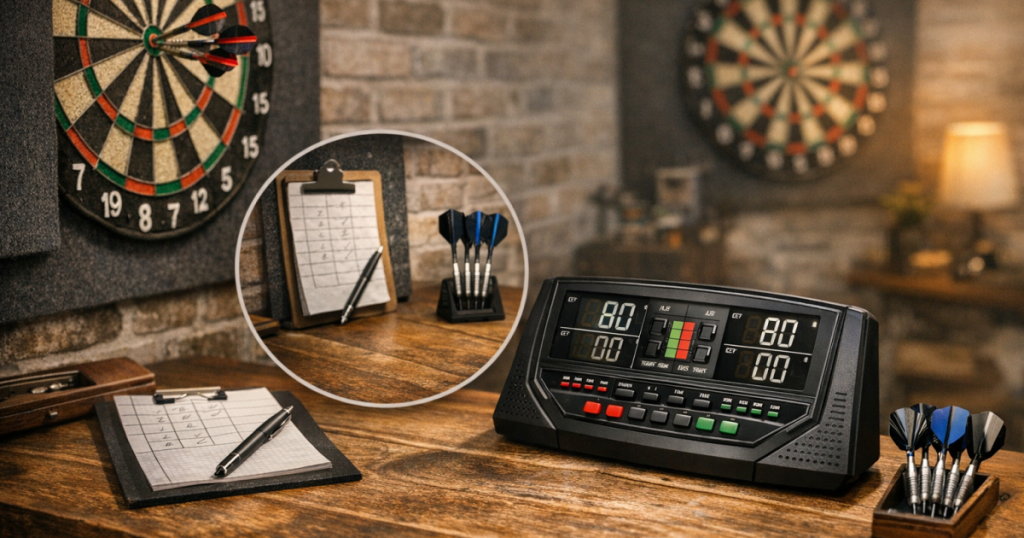
A standalone scorer does not throw the darts for you, and most still rely on someone entering the score after each visit. The benefit is that it handles totals, finishes, turn order and game structure, so players spend less time checking subtraction and more time throwing.
That is useful if you often play 501, 301, round-the-board variations or party-style games with mixed abilities. It is also handy when newer players are still learning outs, because the scoring process becomes less intimidating. For some groups, though, the social act of writing scores on a board is part of the fun. If that is your household, a wall scoreboard may be a better fit, particularly for games like Killer; our guide to scoring Killer darts on a wall scoreboard shows how simple a manual setup can be.
The main thing is to separate convenience from genuine improvement. A scoring device can tidy up the session, but it will not fix a cramped throw line, bad lighting or a board that is mounted at the wrong height.
Step 1: identify the scoring problem you are trying to solve
Before looking at models, be honest about the annoyance you want to remove. This stops you paying for features that look clever but never get used.
- Mental arithmetic slows the game down: a digital unit can help keep 501 legs moving, especially when players are tired or distracted.
- Beginners lose track: automated totals and turn prompts can make mixed-ability games less stop-start.
- Several people play at once: look for clear player handling and easy correction when someone enters the wrong score.
- You practise alone: check whether the unit supports the exact routines you use, rather than assuming it will suit training sessions.
- Your wall looks cluttered: a compact scorer may be neater than paper sheets, but only if it has a sensible permanent position.
If you cannot name the problem, hold off. A good home darts setup improves because every addition has a job.
Step 2: compare it with the realistic alternatives
An electronic dart scorer is only one way to manage scores at home. The better choice may be simpler, depending on your room, habits and budget.
Chalkboard or whiteboard
This is still the most flexible option. It is cheap, visible and easy to use for odd games, practice notes and custom challenges. It also teaches players the maths, which some people see as part of the game. The downside is that handwriting, rubbing out and incorrect subtraction can still cause arguments.
Phone or tablet scoring
A scoring app can be very capable, but it brings its own compromises. The screen has to sit somewhere safe and visible, and players may not want a phone passed around with sharp darts nearby. It can work well for occasional sessions, but it is not always the neatest answer for a permanent darts corner.
Standalone digital scorer
This sits between manual scoring and a fully electronic board. Examples such as the Dartsmate Chalkie and Viper ProScore Digital Dart Scorer are worth looking at if you want a dedicated scoring device without changing your steel-tip board. Before choosing any unit, verify the games, player limits, display style, correction controls and mounting method from the current product information.
Electronic dartboard or soft-tip system
If you are already thinking about soft-tip darts, an electronic board may make more sense than adding a separate scorer to a steel-tip setup. That changes the whole playing experience, not just the scoring. For a deeper look at that route, see our Target Nexus electronic dartboard review, which covers the bigger decision around home soft-tip play.
Step 3: check whether it fits your room
A scorer that is awkward to see or reach will quickly become annoying. Think about the scorer as part of the whole oche area, not as a gadget sitting on its own.
- Visibility: can the thrower and the chalker see it without stepping across the line or blocking the board?
- Height: avoid placing it so low that players have to bend down after every visit.
- Side of the board: right-handed and left-handed players should both be able to enter scores without standing in the flight path.
- Lighting: glare, shadows and dim corners can make small displays frustrating. If the board itself is not well lit, sort that first with the help of our guide on how to light a dartboard properly at home.
- Power and cables: check how the unit is powered and whether any lead would cross a walkway or oche area.
- Mounting: if you rent or avoid drilling, confirm whether the scorer can sit on a shelf, cabinet side or freestanding arrangement.
For small UK spare rooms, garages and converted corners, placement often matters more than features. A basic scorer in the right position is usually more useful than a more complex one that lives in a drawer.
Step 4: decide which features are genuinely useful
Product pages can make every feature sound essential. For a home player, the best electronic dart scorer is the one that matches your common games and is simple enough for everyone in the house to use.
- Game modes: confirm support for the formats you actually play, such as x01 games, cricket-style games or party formats.
- Player capacity: family nights need different handling from solo practice or two-player legs.
- Score correction: mistakes happen. Look for clear undo or correction controls rather than awkward menu steps.
- Display size: check whether the numbers are readable from your normal standing and seating positions.
- Input style: some players prefer dedicated buttons; others are comfortable with touch-style controls. The important point is speed and reliability during play.
- Finish prompts: useful if you play 501 seriously, but only valuable if the prompts are easy to understand at a glance.
- Sound options: be careful with noisy alerts if the board is in a flat, shared house or late-night practice space.
Do not assume a pricier unit is automatically easier to live with. The best purchase is often the one that removes friction, not the one with the longest feature list.
Step 5: put it in the right place in your upgrade list
A scorer is a comfort and convenience upgrade. That means it should normally come after the basics: a correctly mounted board, safe throw area, decent lighting, usable oche and darts that suit your grip.
If you are currently playing on a tired board, squinting through shadows or guessing the throw distance, spend there first. A digital scorer will not make a poor layout feel match-ready. Once the core setup is sorted, scoring becomes a more sensible place to upgrade because it improves the flow of every game.
For regular home throwers, the value is cumulative. Saving a minute or two per leg, avoiding repeated maths disputes and keeping guests involved can make a modest accessory feel worthwhile over months of use. For occasional players, the same unit may feel like an unnecessary extra.
Common buying mistakes
- Buying for features instead of habits: if you never play a certain format, do not pay mainly for it.
- Ignoring where it will live: a scorer with no convenient position is likely to be unplugged, moved and forgotten.
- Assuming it automatically scores steel-tip darts: standalone scorers usually need manual input unless paired with a suitable electronic board or system.
- Forgetting the rest of the room: a cluttered oche, poor lighting or cramped side wall can spoil the benefit.
- Choosing something too fiddly for guests: if visitors cannot work it out after one explanation, it may slow the night down rather than speed it up.
A simple decision route
Use this quick route before spending money:
- Play once a month or less? Stay with a whiteboard or app unless you particularly enjoy dedicated gadgets.
- Play weekly with the same two or three people? A simple standalone scorer can be worthwhile if scorekeeping regularly interrupts play.
- Host family or group games? Prioritise readability, player handling and easy corrections over advanced practice data.
- Want automatic scoring? Look at electronic dartboards or soft-tip systems instead of assuming a standalone unit will do it.
- Have a permanent darts space? A scorer is easier to justify because it can be positioned neatly and used every session.
If you are still undecided, try a low-cost manual or app-based scoring period first. Note what actually annoys you over several sessions, then buy to solve that specific issue.
FAQ
Does an electronic scorer make you better at darts?
Not directly. It can improve the pace and structure of practice, but your improvement still comes from throwing, tracking useful routines and playing with purpose.
Is a scorer worth it for solo practice?
It can be if you practise structured x01 legs or dislike stopping to calculate. If you mainly throw at trebles or doubles without formal scoring, it is less important.
Will it work with any steel-tip dartboard?
A standalone scorer can usually be used alongside any normal steel-tip board because scores are entered manually. Always check the product instructions before buying.
Should I buy a scorer or an electronic dartboard?
Buy a scorer if you like steel-tip darts and only want help with totals. Consider an electronic board if you want soft-tip play and a more automated scoring experience.
Where should I mount or place it?
Put it where players can read and operate it without crossing the throw line or standing close to the board during a visit. Side-wall placement is common, but visibility matters most.
Final thoughts
An electronic dart scorer is worth buying when it removes a regular frustration from a setup that already works well. It is not a must-have accessory, and it should not jump ahead of board height, oche distance, lighting or a safe throwing area.
For frequent home play, group nights and anyone who dislikes constant subtraction, it can be a neat upgrade that keeps games moving. For occasional throwers, a simple scoreboard may still be the better value. Decide from your habits first, then choose the simplest unit that fits your room and the games you actually play.