A dartboard can be brilliant fun in the evening and still look a bit out of place by breakfast. The simplest way to hide a dartboard is to decide whether you want it concealed, softened, or simply made to look intentional within the room.
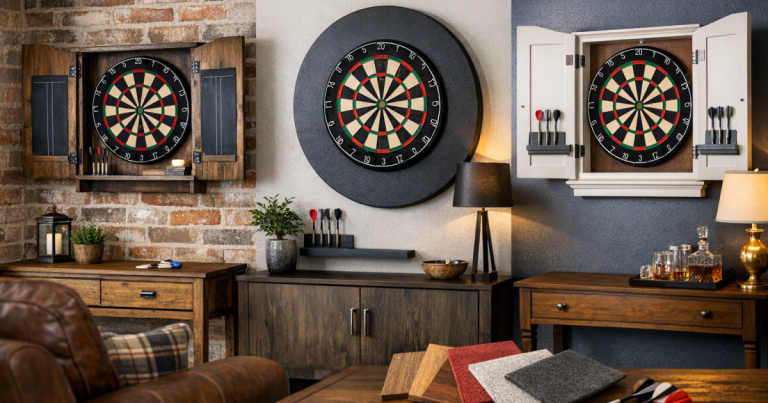
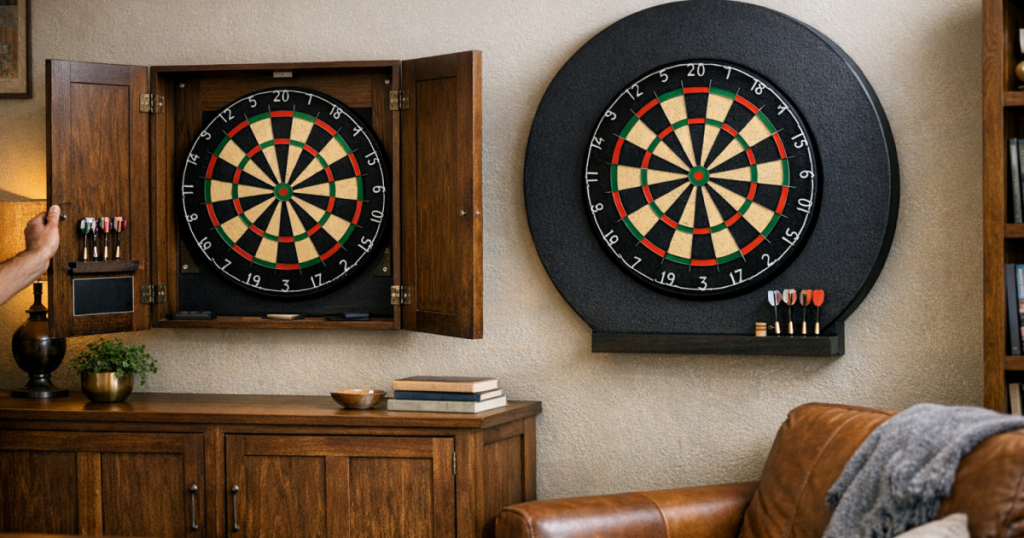
Cabinets and surrounds do different jobs. A cabinet can close over the board when play stops, while a surround frames the board and protects the wall, making the whole setup feel neater rather than fully hidden.
In brief
- A cabinet is the better choice if you want the board covered when it is not being used.
- A surround is better if your main problem is wall marks, stray darts, or a board that looks too bare on the wall.
- Cabinets add storage for darts, chalk, flights and small accessories, but need door clearance.
- Surrounds are quicker to remove and usually feel less bulky, but the board remains visible.
- Combining a cabinet and surround can work in some setups, but you need to check the fit carefully before committing.
First decide what “hidden” really means in your room
Not every home setup needs the board to disappear. In a garage, games room or spare room, a visible board may be fine as long as the wall is tidy. In a lounge, dining room or shared family space, the goal is often different: you want the darts area to stop dominating the wall when nobody is playing.
There are three levels of hiding to think about. The first is full visual concealment, where cabinet doors cover the board. The second is softening, where a surround makes the board look more finished and protects the wall. The third is integration, where the board, cabinet, mat, lighting and nearby furniture all look planned rather than added as an afterthought.
If the board is in a living room, it is worth weighing up the visual benefit against the extra depth and wall presence of a cabinet. For a deeper look at that specific trade-off, see our guide on whether dartboard cabinets are worth it in a living room.
How a cabinet changes the look of a dartboard
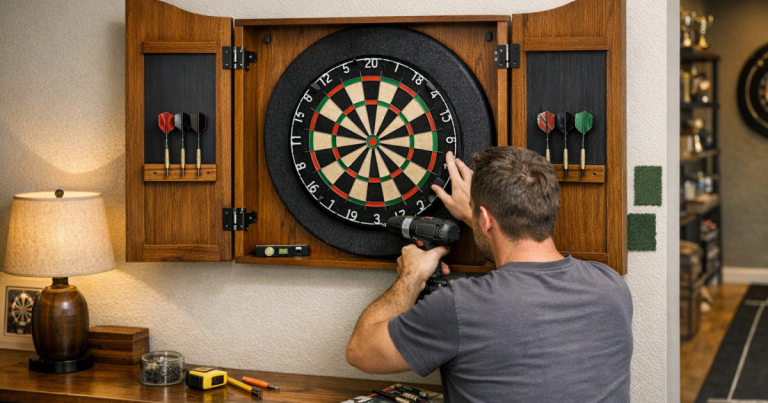
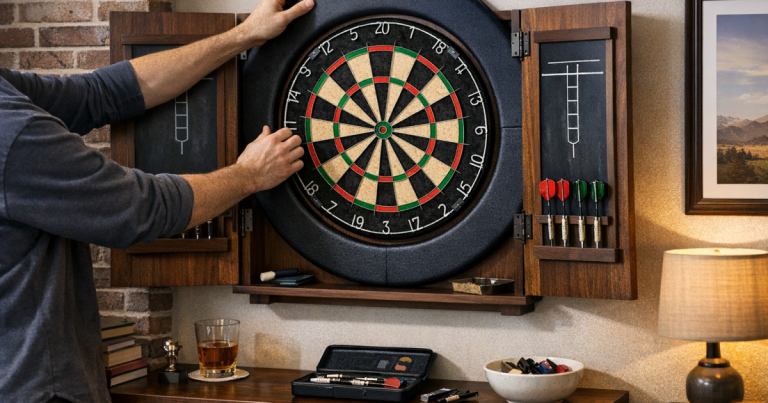
A dartboard cabinet is the most obvious way to cover a board because it gives you doors. Closed, it can look like a wall cabinet, noticeboard or simple piece of furniture depending on the finish. Open, it frames the board and often gives you space inside the doors for scoring panels or small storage.
The biggest advantage is visual control. If you have guests round, use the room for work, or simply do not want a dartboard staring back at you all day, the doors make a noticeable difference. A cabinet also helps keep darts, spare flights and chalk in one place instead of scattered across a shelf or sideboard.
The trade-off is bulk. Even a tidy cabinet makes the setup wider and deeper than a bare board. Door swing matters too. If the cabinet sits close to curtains, a door frame, shelves or a picture rail, the doors may not open comfortably. Check the wall from the side as well as from the front, because a cabinet that looks neat head-on can feel awkward in a narrow walkway.
When a surround is the neater answer
A surround does not conceal the board, but it can make a surprisingly big difference to how tidy the area feels. A bare dartboard on a painted wall can look temporary, and every small scuff around it draws the eye. A surround creates a defined playing zone and gives stray darts a forgiving area to hit before they reach the wall.
Surrounds suit homes where the board is allowed to be visible but needs to look less stark. They are also useful where a cabinet would feel too heavy, such as a narrow hallway end, a compact office wall, or a multipurpose room where furniture already makes the space feel busy.
The other appeal is simplicity. Most foam-style surrounds sit around the board rather than needing a large fitted unit. That makes them easier to take down if you want the room to look plainer for a while. If you are weighing up coverage and fit, our Mission dartboard surround review shows the sort of practical details that matter with this type of accessory.
Cabinet, surround, or both?
The right choice depends on what annoys you most about the current setup. If it is the board being visible, choose a cabinet. If it is the marks around the board, choose a surround. If it is general clutter, a cabinet may be more useful because it gives you somewhere to keep accessories. If the issue is that the darts area feels unfinished, either can help, but in different ways.
Choose a cabinet when:
- The board is in a shared room and you want it covered between games.
- You want storage for darts, flights, stems, chalk or a small scoreboard.
- The wall has enough clear width for open doors.
- You prefer a furniture-like finish rather than a sporty look.
Choose a surround when:
- You want wall protection without making the setup look bulky.
- The board can stay visible, but the surrounding wall needs tidying up.
- You need something easy to remove or reposition.
- The room is small and cabinet doors would get in the way.
Use both only when the fit makes sense
A cabinet and surround can look excellent together, but compatibility is not automatic. Some surrounds are too wide or too deep to sit neatly inside a cabinet. Others may stop the doors closing properly or make the board sit too proud of the wall. Before pairing them, check the internal space around the mounted board, the depth of the doors when closed, and whether the surround can be removed easily for maintenance.
Make the setup blend with the room
Hiding a board is not only about covering the sisal. The surrounding details matter just as much. A smart cabinet can still look odd if it is squeezed between a radiator and a bookshelf, or if the oche mat blocks a cupboard every time you play.
Start with the wall finish. Darker cabinets tend to stand out less against darker walls, while lighter timber or white finishes can work better in rooms with pale furniture. If you already have shelves, picture frames or a sideboard nearby, try to line the cabinet up visually with existing edges rather than leaving it floating in the middle of the wall.
Then think about the play zone. Cabinet doors need room to open, and players need a clear throw line. Doors, windows and curtains can all interfere with a neat setup, especially in older UK homes where alcoves and chimney breasts shape the room. Before fixing anything permanently, read our advice on planning a darts area around doors and windows.
Storage details that keep the board hidden properly
A cabinet only works well if it closes cleanly. That sounds obvious, but it is easy to overload the inside with darts, wallets, spare stems and scorekeeping bits until the doors no longer sit flush. Keep the contents slim and deliberate.
Store darts point-down or in a case rather than loose on a shelf. Keep spare flights in a small pouch or divider so they do not spill out when the doors open. If the inside of the cabinet has scoring panels, avoid taping bulky accessories over them, as this quickly makes the whole unit look messy.
For a surround-led setup, storage has to be handled nearby instead. A small drawer, wall shelf or dart case on a sideboard can work, as long as it does not creep into the throwing area. The goal is to avoid the common “visible board plus visible clutter” problem, where the wall is protected but the space still feels untidy.
Rented homes and low-commitment setups
In rented homes, the challenge is usually less about style and more about reversibility. A cabinet may need a secure wall fixing because of its weight and the movement of opening doors. A surround may be easier to live with because it changes the look without adding a large hinged unit.
Always check your tenancy agreement and keep the setup sensible for the wall type. If drilling is not suitable, a freestanding darts stand may be a better route than trying to make a heavy wall cabinet work. You can still use a surround with some stand-based setups, provided the board is stable and the surround is supported as intended.
Small mistakes that make a hidden setup look worse
- Mounting the cabinet too close to a corner, so one door cannot open fully.
- Choosing a finish that clashes with every other piece of furniture in the room.
- Forgetting that a cabinet adds depth, which can matter in a narrow room.
- Using a surround to solve a concealment problem, then being disappointed that the board is still visible.
- Letting accessories pile up inside the cabinet until it no longer closes neatly.
- Ignoring lighting, so the setup looks tidy when closed but awkward or shadowy when open.
FAQ
Can a surround hide a dartboard completely?
No. A surround frames the board and protects the wall, but the dartboard remains visible. If you want the board covered between games, a cabinet is the more suitable option.
Will a cabinet protect the wall from missed darts?
Only partly. A cabinet protects the area it covers, especially to the sides when the doors are open, but it does not give the same all-round protection as a surround. Beginners and casual players may still benefit from extra wall protection.
Can I put a surround inside a dartboard cabinet?
Sometimes, but not always. You need to check the cabinet’s internal clearance, the surround’s thickness, and whether the doors can close without pressing against the surround.
Is a cabinet too bulky for a living room?
Not necessarily. A slim, well-positioned cabinet can look tidy, but it needs enough wall space and a finish that suits the room. In a tight space, a surround may feel lighter.
What is the neatest option for a multipurpose room?
A cabinet is usually neatest when the board must disappear visually. If the board can stay on show, a clean surround plus separate storage can look less bulky.
Why it matters
A well-hidden darts setup is not about pretending the board is not there. It is about making the room work before, during and after a game. Cabinets give you concealment and storage; surrounds give you protection and a cleaner frame. The best home setups use the accessory that solves the real problem, rather than adding bulk for the sake of it.
If your board is in a main living space, start with concealment. If it is in a games area, start with wall protection and tidiness. Once the board, storage and throw area all feel intentional, the darts corner stops looking like sports kit on the wall and starts feeling like part of the home.