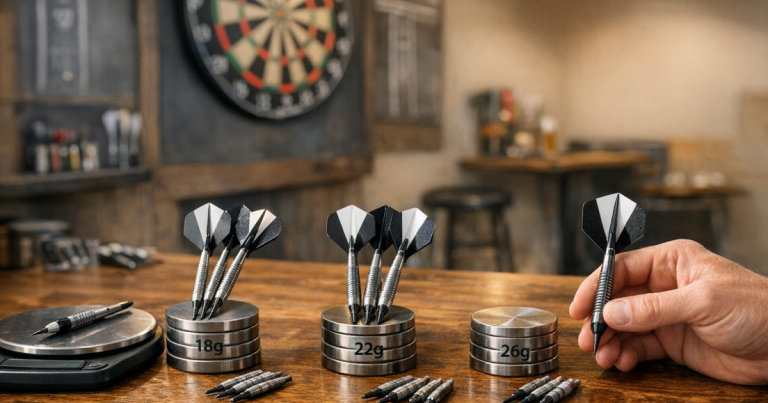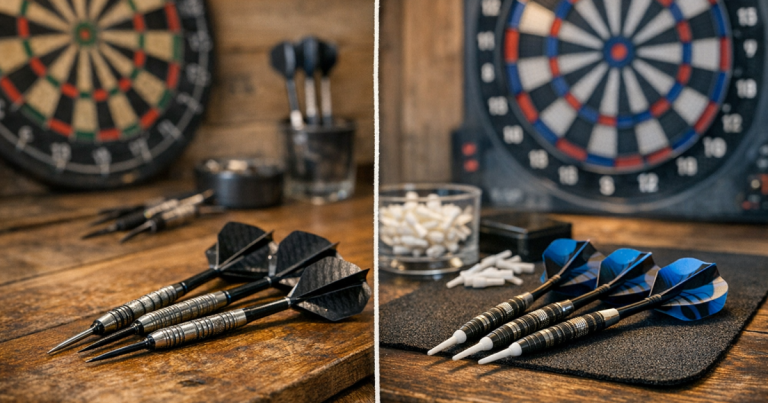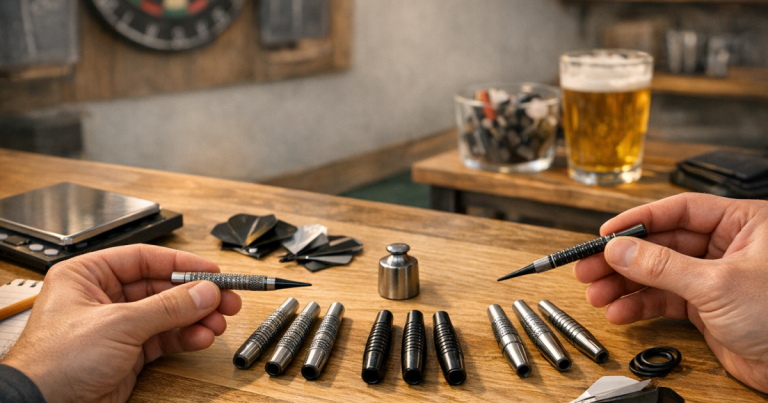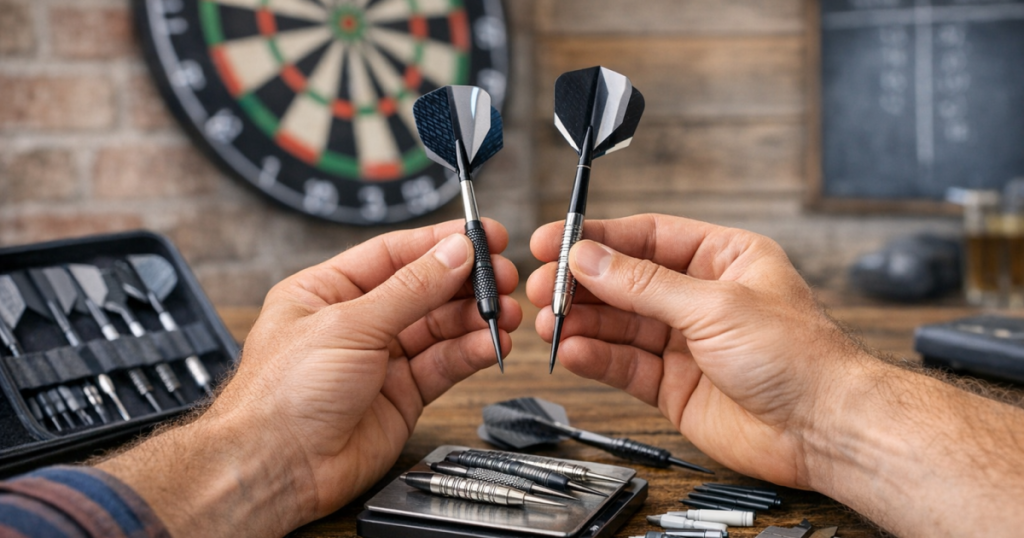
The easiest way to buy darts by weight is to start with what your throw already does: dropping short, floating high, or drifting sideways. Weight, grip and barrel shape work together, so a dart that feels brilliant for one player can feel awkward for another. Use the steps below to narrow the choice before you spend money on a set that never quite settles in your hand.
The short version
Choose dart weight first, then use grip and barrel shape to fine-tune the release. A heavier dart can feel steadier in the hand, while a lighter dart often rewards a cleaner, quicker throw. Grip should help the dart leave your fingers cleanly, not lock it in place. Barrel shape should match where you naturally hold the dart: front, middle or rear.
- Start with a sensible middle weight: many home players are comfortable trying steel-tip darts around the low-to-mid 20g range before moving lighter or heavier.
- Match grip to release: smooth or light grip suits a relaxed throw; sharper grip can help if your fingers slip, but can punish a sticky release.
- Match shape to finger position: straight barrels are flexible, torpedo barrels favour a more defined hold, and scalloped barrels give a clear finger reference point.
- Test one change at a time: changing weight, barrel shape, stems and flights together makes it hard to know what actually improved.
Step 1: Work out whether you need lighter or heavier darts
Dart weight is not about strength. It is about timing, arc and how much feedback you want in the hand. Two players can throw the same weight and get completely different results because their release speed, wrist action and follow-through are different.
If your darts regularly land low in the board even when your aim feels right, a slightly heavier dart can sometimes help the point carry through the line. If your darts float high, kick up too much, or feel late leaving the fingers, a lighter dart may feel cleaner. Do not jump dramatically between weights. Moving by 1g or 2g at a time is usually more useful than making a big leap and then trying to rebuild your throw around it.
For a home setup, consistency matters more than chasing what a professional player uses. A dart that groups well after 20 minutes of practice is usually a better choice than one that feels exciting for the first three visits and then becomes tiring or unpredictable.
Step 2: Judge grip by release, not by how aggressive it looks
Grip is where many buying mistakes happen. A dart can look impressive with deep cuts, shark grip or heavy machining, but the real question is simple: does it leave your hand the same way every time?
A low-grip barrel can suit players with a relaxed, flowing release. It lets the dart slide away without much interruption, but it may feel too vague if your fingers get dry or you need a stronger reference point. Medium grip is the safe starting point for many players because it gives feedback without feeling trapped. High-grip barrels can be excellent if you struggle with slipping, but they can also hang on the fingers and pull the dart sideways if your release is not tidy.
Pay attention to where the grip sits. Some darts have grip along most of the barrel, while others concentrate texture at the front, middle or rear. If you hold the dart near the point, a rear-heavy grip pattern will not help much. If you grip at the back, a heavily cut front section may add visual appeal without solving your actual problem.
Step 3: Choose a barrel shape that matches your hold
Barrel shape affects balance, finger placement and how easy the dart is to repeat. The right shape should make your hold feel obvious without forcing your fingers somewhere unnatural.
Straight barrels
Straight barrels are the most adaptable. They suit a wide range of grips because there is no dramatic swelling or taper telling your fingers where to go. If you are still working out your natural hold, a straight barrel is often the easiest shape to learn from. The trade-off is that some players find them less guided, especially if they like a clear stop point for the thumb or index finger.
Torpedo and bomber-style barrels
Torpedo-style barrels place more mass into a shorter or more rounded profile. They can feel stable and positive in the fingers, particularly for players who like a compact hold. The shape can help the dart sit in the same place each visit, but it is less flexible if you move your grip around during a match.
Scalloped barrels
Scalloped barrels have a shaped recess that acts as a finger locator. They can be very useful if you want the same thumb position every time. The catch is that the scallop needs to match your hand. If it sits in the wrong place, it can make the dart feel awkward rather than consistent.
Tapered barrels
Tapered barrels narrow towards one end and can suit players who like the dart to roll out from a particular finger position. They are worth trying if straight darts feel too plain or if your grip naturally sits towards the front or rear.
Step 4: Use real examples as reference points, not automatic answers
Named darts are useful because they give you something concrete to compare, but they should not replace testing the basics. A set such as Target Darts Phil Taylor Power 9Five is best treated as a reference for how a premium, player-associated dart might feel in the hand rather than a guarantee that it will suit your throw. Likewise, Red Dragon Darts – The Legend can help you compare barrel style, grip layout and balance against other steel-tip options.
When looking at any real product, check the stated weight, barrel profile, grip pattern, point type and what is included in the pack. Do not assume a dart will feel heavier or grippier just because it looks chunkier in photos. Product images can make machining look more dramatic than it feels in play.
Step 5: Check balance with your full setup
A dart is not only the barrel. Stems and flights change the way the dart sits in the air, and they can make a set feel calmer or livelier. If a barrel feels close but not quite right, you may not need a completely different set. A stem or flight change can sometimes tidy the entry angle without changing the weight in your fingers.
Keep this controlled. If you change to a new barrel, new stem length and new flight shape at the same time, you will not know which part helped. For more detail on how stems can affect feel and value, the Harrows Supergrip Shafts review is a useful next step before you start buying lots of small accessories.
Step 6: Test darts in a way that reflects home practice
A quick throw in a shop or at a mate’s board can tell you whether a dart feels completely wrong, but it rarely tells the whole story. At home, use a simple repeatable test: throw at 20s for a few visits, then 19s, then bull, then a few common checkouts or doubles. You are looking for grouping, comfort and repeatable release, not one impressive treble.
Make notes if you are comparing more than one set. Record the weight, grip level, barrel shape and what happened after ten minutes. Did the dart start to slip? Did your fingers feel cramped? Did the barrel encourage the same hold each time? Small observations are more useful than vague impressions like “felt good”.
Also think about your playing space. If you are setting up around a sofa, cabinet or narrow walkway, give yourself enough room to stand and reset comfortably. The advice on how to plan a darts mat zone around everyday furniture can help you make testing feel more like a normal game rather than a cramped trial.
Common buying mistakes to avoid
- Copying a professional setup exactly: pro darts can be brilliant, but they are built around that player’s release, rhythm and preferences.
- Buying the most aggressive grip available: more grip is not always more control. Too much texture can delay the release.
- Ignoring where you hold the barrel: a great grip pattern in the wrong place will not help your throw.
- Changing too many parts at once: keep flights, stems and points familiar when you are judging a new barrel.
- Choosing only by appearance: colour and finish are nice, but comfort and grouping should decide the purchase.
- Giving up too quickly: allow a short settling-in period, but do not force a dart that keeps fighting your natural throw.
A simple decision route
If you are unsure where to start, use this route rather than browsing randomly. First, choose a middle weight that does not feel extreme. Second, pick a barrel shape that matches your hold: straight if you are undecided, scalloped if you want a fixed reference, compact if you like a shorter grip. Third, choose a medium grip unless you already know you prefer smooth or aggressive texture. Finally, test the darts with your usual stem and flight style before making further changes.
Once you find a set that works, protect it properly. Spare stems, flights, points and match darts can become messy in a pocket or loose box, so the guide on choosing a dart case for league nights is useful even if most of your throwing happens at home.
FAQ
Is a heavier dart better for beginners?
Not automatically. A moderately weighted dart can feel stable, but the best choice is the one that leaves your hand cleanly and groups consistently. Avoid very large weight changes while you are still learning your throw.
How much grip should my first set of darts have?
Medium grip is the safest starting point for most players. It gives enough feedback without making the dart stick to the fingers. Move smoother or sharper only when you know what problem you are trying to solve.
Does barrel shape matter more than weight?
They matter in different ways. Weight affects timing and flight, while barrel shape affects finger placement and repeatability. If the shape does not suit your hold, even the right weight can feel wrong.
Should I buy darts online without trying them first?
You can, but be disciplined. Check the weight, barrel length impression, grip placement, shape and included accessories carefully. Compare them with darts you have already thrown rather than buying from photos alone.
When should I replace a set that feels nearly right?
If small changes to stems, flights or grip position do not improve consistency after several practice sessions, the barrel may not suit your release. Do not keep forcing a set that causes the same miss repeatedly.
Final thoughts
The best dart is not the one with the most grip, the most famous name or the boldest design. It is the set that makes your throw repeatable. Start with weight, refine the grip, choose a barrel shape that fits your fingers, and test changes one at a time. That approach gives you a much better chance of buying darts that feel right on a home board, during practice, and when the pressure of a proper leg starts to creep in.