The safest wall for a dartboard is not simply the biggest blank wall in the room. It is the wall that gives you a clear throw, keeps missed darts away from people and breakable items, and can hold the board securely without damaging the surrounding space. A few minutes spent checking the wall, floor and walking routes will prevent most home setup problems.
Drilling or fixing into a wall where concealed wiring, pipework or structural supports may be present should be checked and carried out by a qualified professional to comply with UK safety requirements and building standards.
The short version
- Choose a wall away from doors, walkways, windows, TVs, mirrors and fragile furniture.
- Make sure there is enough straight-line space for the throwing distance, your stance and safe movement behind the oche.
- Use a wall that can take secure fixings, or add a suitable mounting board or cabinet if the surface is weak.
- Protect the surrounding wall with a surround, cabinet or backboard, especially in rented homes.
- Think about lighting, noise, floor surface and how the room is used by other people.
Start with the flight path, not the wall
A safe darts wall is really about the whole route from hand to board. Stand where the oche will be and imagine a straight corridor from your throwing hand to the treble twenty. That corridor should not cross a doorway, the edge of a sofa, a kitchen walkway, a pet bed or a route children use to move through the room.
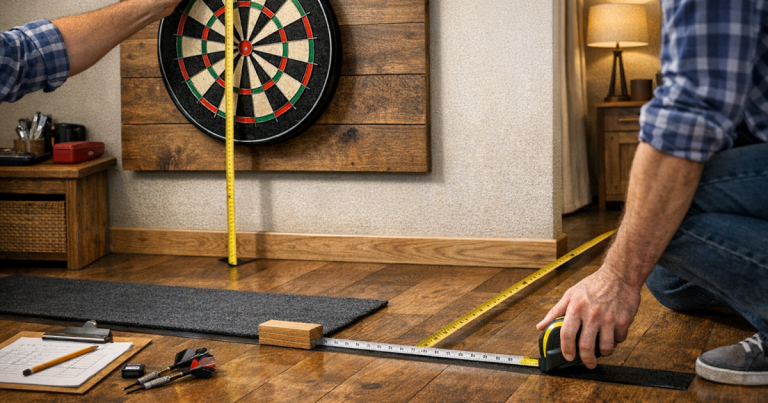
For a standard steel-tip setup, the centre of the bull is normally set 1.73 m from the floor, with the throwing line 2.37 m from the face of the board. The important safety point is that this measurement needs usable room, not just theoretical floor length. You need space to stand, step back, retrieve darts and let another player wait without drifting into the throwing lane.
If the board is going into a living room, kitchen-diner or games area rather than a spare room, treat traffic flow as the first decision. In a shared space, it is often better to choose a slightly less visually neat wall if it keeps the darts lane away from doors and seating. For more room-layout thinking, the guide to planning a darts area in an open-plan room is a useful next step.
Walls to avoid first
Before picking the best wall, rule out the obvious risky ones. Some walls look convenient until you consider what happens when a dart bounces out, misses wide, or someone walks through at the wrong moment.
- Behind or beside doors: avoid any wall where a person could enter suddenly near the board or throw line.
- Near windows and glazed doors: even careful throwers miss, and glass is not forgiving.
- Above radiators or heaters: heat and awkward retrieval positions make this a poor long-term setup.
- Next to TVs, monitors or framed glass: a surround protects a small area, not the whole room.
- Across a main walkway: if people need to pause every time someone throws, the wall is in the wrong place.
- Directly above hard, slippery flooring with no mat: fallen darts can chip points, mark floors or become a trip hazard during retrieval.
Check the wall surface and fixing strength
A dartboard is not extremely heavy, but it is handled repeatedly. Darts are pulled out, the board may be rotated, and occasional knocks happen. The safest wall is one where the bracket can stay secure without wobbling, spinning or slowly loosening.
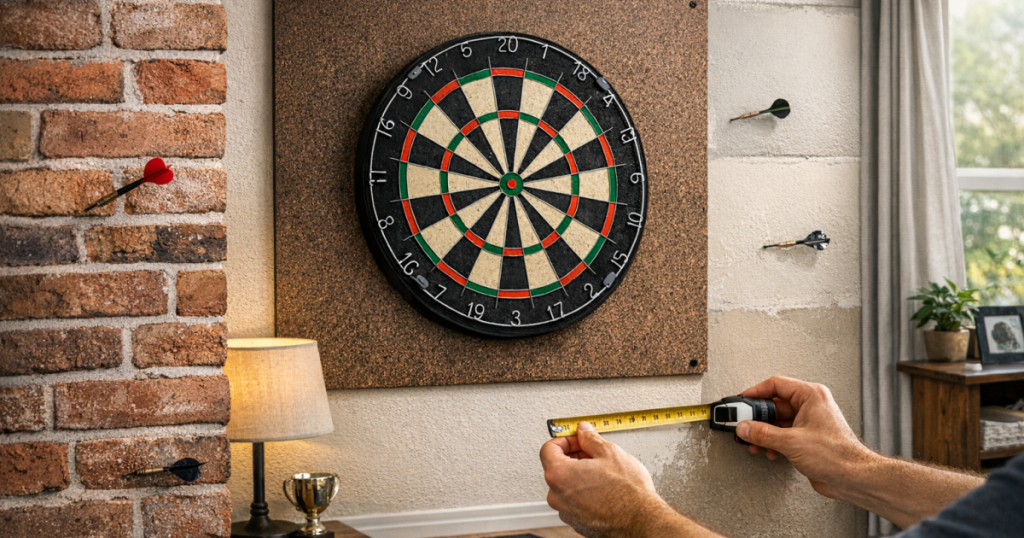
Masonry walls are usually straightforward with suitable fixings, provided you avoid hidden services. Stud walls and plasterboard need more thought. Fixing only into weak plasterboard can lead to movement or damage, especially if several people use the board regularly. If the best location is a lighter internal wall, consider fixing into a stud, using a properly sized mounting board, or fitting a cabinet that spreads the load over a larger area.
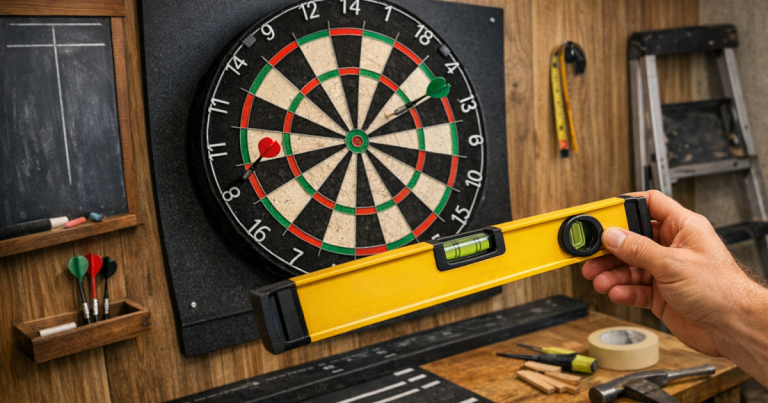
After mounting, press gently around the board and check that the bracket does not shift. Rotate the board as part of normal maintenance and recheck the fixings. If the number ring or board moves during play, sort that out before blaming your darts. A loose board changes the target angle and encourages people to tug harder when removing darts.
Give missed darts somewhere safe to go
Even good players miss the board. Beginners, guests and children are more likely to miss wide, but bounce-outs can happen to anyone. A safe wall choice includes a realistic protection zone around the board, not just the board itself.
A foam surround is a simple option for many home setups, while a cabinet can look tidier and protect a wider rectangular area when closed. A larger DIY backboard can also work well in garages, utility rooms or practice corners. The aim is to protect the wall and reduce the chance of sharp tips striking plaster, timber trim or nearby furniture.
Rented homes need extra care because the safest playing location might still be a wall you cannot mark freely. If you are working around deposit concerns, wall finish and limited fixing options, read the advice on dartboard cabinets and surrounds for rented homes before committing to a permanent-looking setup.
Look at the floor and oche position
The wall can be perfect and the setup can still feel unsafe if the floor area is wrong. Avoid placing the oche where players stand half on a rug and half on laminate, or where the back foot is close to a step, threshold or furniture leg. A consistent stance area reduces slips and makes the throw feel repeatable.
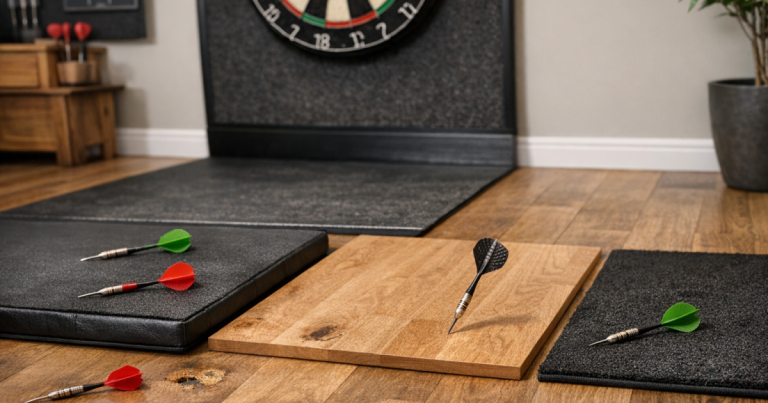
A dart mat can help protect flooring and mark the throw line clearly. If you use a loose mat, check that it lies flat and does not curl at the edges. If you are fitting a fixed oche or planning a more permanent darts corner, the permanent oche installation and mat planning guide explains how to think through position, alignment and floor protection.
Leave a sensible waiting area outside the throw lane. In a small room, that might mean players wait to the side of the oche rather than behind the thrower. The key rule is simple: nobody should need to cross between the thrower and the board while darts are in hand.
Consider lighting and sight lines
Good lighting makes a wall safer because players can see the segments clearly and spot darts on the floor during retrieval. Avoid walls where the thrower’s body casts a heavy shadow over the board. Also be wary of bright windows directly behind or beside the board, as glare can make the target harder to read at certain times of day.
If you cannot add dedicated dartboard lighting, choose the wall with the most even existing light. Ceiling spotlights, wall lights and lamps can all create awkward shadows depending on their position. Test the wall in the evening, not just during daylight, because most home darts sessions happen after work or at weekends when lighting conditions vary.
Think about noise, neighbours and room use
Safety is not only about dart tips. A wall that causes constant noise complaints or clashes with everyday room use will not remain a good setup for long. Dartboards make a noticeable thud, particularly on lightweight internal walls, cupboard walls and shared party walls.
In a UK terrace, semi-detached house or flat, avoid mounting the board on a wall directly adjoining a neighbour’s bedroom or living area if another suitable wall is available. A garage wall, utility wall or internal wall away from sleeping areas can be a better choice. If noise is unavoidable, a mounting board, cabinet or backing panel may help reduce vibration, but it will not make a board silent.
Real-world examples
Spare room or home office
This is often the easiest choice because you can control access. Pick the wall that lets the throw line run away from the door rather than across it. Move office chairs, cables and storage boxes away from the retrieval path so players are not stepping around clutter with darts in hand.
Garage setup
A garage can be excellent if it is dry, well lit and not too cramped. Avoid mounting the board above tools, bikes, freezers or stored boxes. Concrete or brick walls can take solid fixings, but check for pipes, wiring and uneven surfaces before drilling. Add floor protection if the surface is rough or slippery.
Living room corner
Choose the corner that keeps darts away from the TV, windows and main seating. A cabinet or surround is usually worth using here, not as decoration but as damage control. Make sure guests have an obvious place to stand while someone is throwing.
A final wall-safety checklist
- Can the board be mounted at the correct height without hitting shelves, coving or picture rails?
- Is the throwing distance clear from the board face to the oche?
- Does the throw line avoid doors, stairs, kitchen routes and seating?
- Is there a safe waiting area for other players?
- Can the wall hold secure fixings without loosening?
- Are windows, mirrors, screens and fragile items outside the likely miss zone?
- Is the board evenly lit at the time you normally play?
- Will the setup annoy neighbours or disturb bedrooms nearby?
- Can you protect the wall and floor without creating trip hazards?
Questions people ask
Can I put a dartboard on plasterboard?
Yes, but do not rely on weak plasterboard alone for a busy setup. Fix into a stud, use suitable heavy-duty fixings, or mount a backing board that spreads the load. The board should not wobble when darts are removed.
How much space should I leave around a dartboard?
There is no single domestic safety rule, but leaving generous clear space around the board is sensible. Aim to keep at least the immediate area to both sides free from glass, screens, ornaments and anything people might stand beside during play.
Is a hallway a safe place for a dartboard?
Usually not. Hallways tend to be walk-through spaces, and someone can enter the throwing lane without warning. Only consider it if access can be fully controlled while darts are being thrown.
Should the board go on an external wall?
An external wall can be a good choice if it gives you a clear throw and solid fixings. It may also reduce noise transfer to neighbouring rooms, but lighting, damp and available floor space still matter.
Do I need a surround if I am an experienced player?
It is still a good idea in most homes. Bounce-outs, guests and tired practice sessions can all lead to marks outside the board. A surround is less about skill and more about protecting the room.
Main lessons
The best dartboard wall is the one that makes safe play feel natural. It gives you a clear throw, a secure mounting point, a protected miss zone and enough room for people to move without crossing the lane. If two walls seem possible, choose the one that keeps darts furthest from doors, glass, screens and everyday foot traffic.
Once the wall is chosen, mark the height and throw line before drilling anything. Stand in the space, walk the retrieval route, check the lighting and imagine how the room will work when two or three people are playing. That small rehearsal usually reveals whether the wall is genuinely safe or merely convenient.