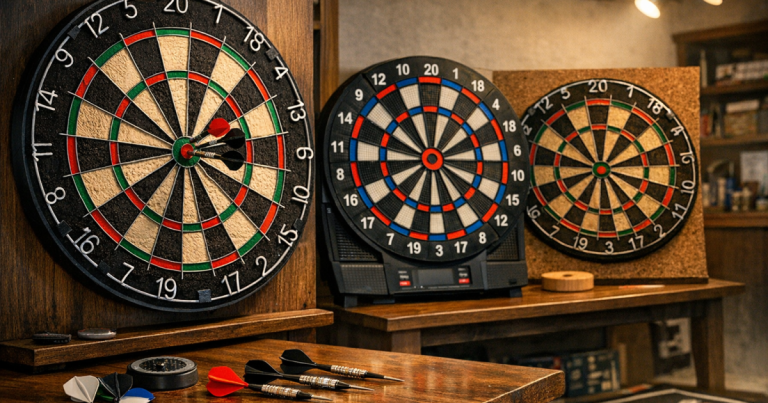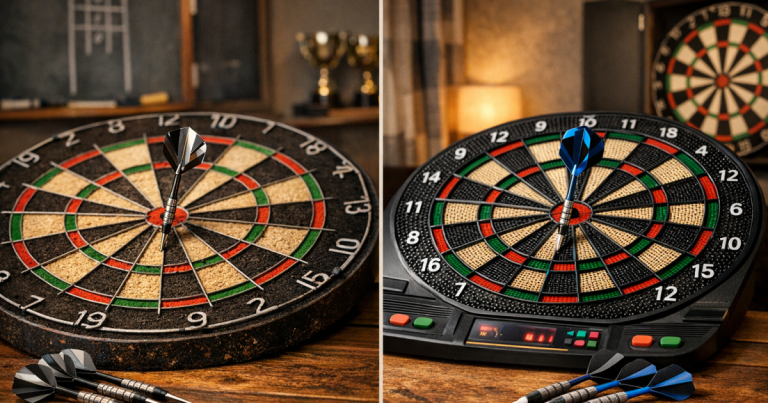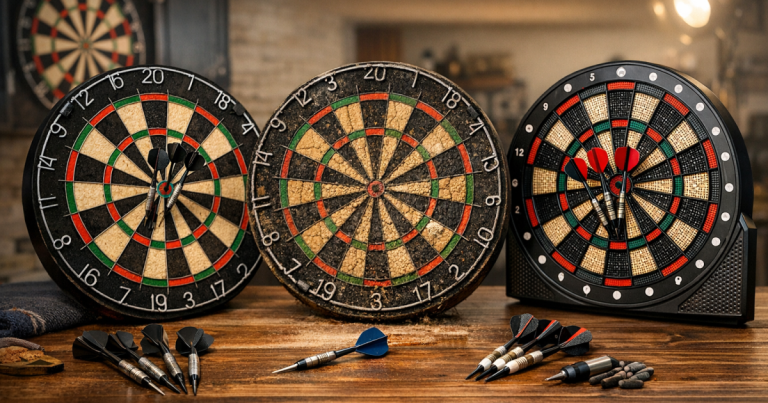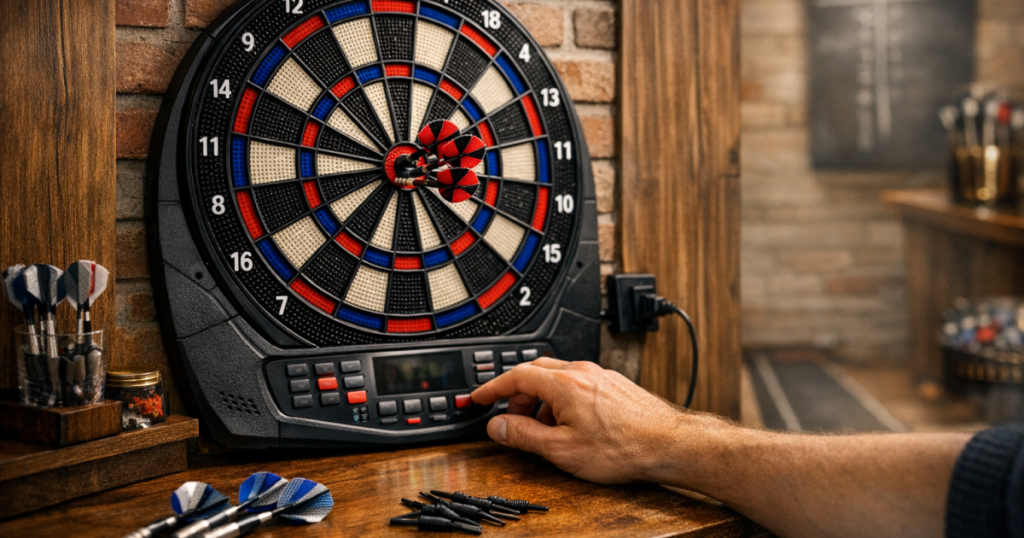
An electronic board can make home darts easier to run, especially when several players are rotating through 501, cricket or practice games. The main difference with electronic dartboards is not just automatic scoring; it is the way the board detects hits, handles missed darts, manages power and keeps games moving without a separate marker.
Any new mains socket, fixed cabling or electrical alteration for a darts area should be carried out by a qualified electrician to meet UK electrical safety requirements and applicable wiring standards. For ordinary use, stick to the manufacturer’s supplied or approved power adaptor and do not modify plugs, leads or connectors.
What to know first
Electronic boards are usually soft-tip boards. Instead of sisal fibres and steel points, they use a moulded playing surface with small holes and a sensor system behind it. When a soft-tip dart lands, the point pushes into a segment and the board registers the score.
That makes them convenient for shared spaces, family games and quick practice sessions, but it also changes the feel of play. The sound is different, the darts are lighter, and bounce-outs can happen in a different way from a bristle board. The board may also have built-in limits, such as supported game types, player numbers, display style, sound options and how it treats missed darts. These details vary by model, so they are worth checking in the manual rather than assuming every board behaves the same.
For a home setup, the biggest questions are simple: will the board score reliably, can it be powered neatly, and do the built-in games suit how you actually play?
How the scoring works
Electronic dartboards use a segmented target face linked to sensors. Each scoring area corresponds to a value: singles, doubles, trebles, outer bull and inner bull, depending on the rules selected. The board detects which segment has been pressed and adds, subtracts or records the score according to the game mode.
The familiar numbering and scoring logic still matters. A treble 20 is still the high-value target in 501, doubles still matter for finishing, and the bullseye still carries a special role in many games. If you want a refresher on why the numbers sit where they do, the dartboard layout explained guide breaks down the doubles, trebles and bullseye in plain terms.
Why the board sometimes records the wrong thing
Most scoring issues come from the physical way a dart meets the board. If a dart does not push far enough into a segment, the hit may not register. If it hits at an awkward angle, it may drop out or briefly press a neighbouring area. If the tip is bent, blunt or poorly seated, it may not enter the holes cleanly.
Players moving from steel-tip darts often expect the board to feel more forgiving than it is. In reality, soft-tip scoring rewards a tidy, level throw and suitable points. Heavier-handed throwing is not always better; it can increase noise, damage tips and lead to more rebounds. A steady throw that places the dart squarely into the segment usually gives the board the best chance of recording correctly.
Manual corrections still matter
Even a good board can misread an occasional dart. That is why useful controls matter: missed-dart buttons, score correction, bounce-out handling and clear turn prompts all make a difference during a real match. Some players count a bounce-out if the board has registered it; others only count darts that remain in the board. Agreeing that rule before you start avoids arguments later.
Power: batteries, adaptors and cable tidiness
Power arrangements vary. Some boards run from batteries, some use a mains adaptor, and some support both. Battery power can make placement simpler, particularly in a rented room or shared space, but it also means checking battery condition if scoring becomes erratic. Mains power is more consistent, provided the cable can be routed safely and the adaptor is the correct one for that board.
Never assume that any similar-looking adaptor is suitable. Voltage, polarity and connector type need to match the manufacturer’s requirements. Using the wrong adaptor can damage the board or create an unsafe setup. If the original adaptor is missing, verify the exact replacement guidance from the board maker or manual.
Cable placement is a practical issue in UK homes, where the best throwing area is often a spare room, garage, dining space or garden room rather than a purpose-built games room. Keep leads away from the oche, avoid stretching cables across walkways, and do not trap them behind furniture. If you use an extension lead, keep it sensibly positioned and avoid creating a trip hazard.
Game modes that actually get used
Electronic dartboards often include a long list of games, but most home players return to a smaller set. The useful modes are the ones that match your group’s habits: quick practice, casual family games, or structured match play.
- 501 and 301: The core countdown games. Check whether the board supports double-in, double-out or master-out settings if your group uses those rules.
- Cricket: Popular for casual competition because players can chase numbers rather than constantly doing checkout maths.
- Count up: A simple practice mode where players aim to build the highest total over a set number of darts or rounds.
- Around the clock: Useful for accuracy practice because it forces you to move around the board instead of living on 20s.
- Shanghai: A good party-style mode because one big round can overturn the whole game.
- Practice and solo modes: Some boards include computer opponents, target drills or scoring challenges. Treat these as model-specific extras and check how they work before relying on them.
The main limitation is not the number printed on the box; it is how easy the mode is to start, follow and reset. A board with fewer modes but clearer controls can be more enjoyable than one with a huge game list and awkward menus.
Where electronic dartboards fit in a home setup
Electronic dartboards make most sense when automatic scoring is the priority. They suit mixed-ability groups, younger players using soft tips, and homes where nobody wants to keep score every leg. They can also reduce the barrier for guests, because the board prompts turns and handles arithmetic.
They are less like traditional pub darts. The playing surface, dart weight and impact sound are different from a bristle board. If your goal is to practise for steel-tip league play, a quality bristle board and a separate scoring method may feel more relevant. If your goal is easy, sociable home darts, an electronic board can be the more convenient choice.
There is also a middle ground. Some players use a bristle board for serious throwing and a separate electronic scorer or app-style device for match management. If you are weighing scoring setups rather than changing the whole board, the guide to chalk, dry-wipe and electronic scoreboards is the more relevant next step.
Practical examples and real-world checks
Named boards such as the Unicorn Smartboard and Winmau Ton Machine show how varied the category can be, from connected-style boards to more self-contained home units. Rather than assuming one format is automatically better, check the details that affect day-to-day use.
- Scoring display: Can everyone at the oche see whose turn it is and what score remains?
- Controls: Are missed darts, corrections and game selection easy enough for guests to use?
- Sound level: Can you adjust or mute prompts if the board is in a shared living space?
- Power position: Does the cable reach safely without crossing the throwing area?
- Mounting: Is the board secure at the correct height, with enough wall protection around it?
- Tip compatibility: Does the manual recommend a particular soft-tip type or weight range?
Throwing distance is worth checking too. Many soft-tip setups use a longer throw than standard steel-tip darts. In practice, that often means measuring carefully rather than copying the mark from an existing bristle board area. If the space is shared or rented, removable oche ideas can help you mark the line without making permanent changes.
Different views: convenience versus feel
The strongest argument for an electronic board is convenience. It removes mental arithmetic, speeds up casual games, and keeps groups engaged. That matters more than people admit. A darts night can lose momentum quickly when nobody wants to mark, scores are disputed, or a new player is unsure what to aim for.
The strongest argument against one is playing feel. Bristle boards are quieter in some rooms, more familiar to steel-tip players, and closer to pub and competition conditions. They also let players use their preferred steel-tip darts. For serious practice, that consistency can matter.
Neither view is wrong. The right interpretation depends on the room and the people using it. A garage practice lane for one committed player is a different setup from a family-friendly games corner in a spare room. The best board format is the one that gets used regularly without making the space awkward.
Things readers ask
Do electronic boards use steel-tip darts?
Most are designed for soft-tip darts, not steel tips. Using steel-tip darts on a soft-tip board can damage the playing surface and sensors, so follow the board’s stated dart type.
Are electronic boards accurate enough for proper games?
They are accurate enough for casual and practice use when the darts register cleanly. Occasional misreads can happen, so clear correction controls are useful.
Can I put one in a garage?
Yes, if the space is dry, stable and has safe power access. Damp conditions are not ideal for electronics, dart tips or accessories, so storage and ventilation matter.
What height should an electronic board be mounted at?
Use the height specified by the manufacturer. Many players expect the bullseye to sit around standard dartboard height, but soft-tip throw distances and setup instructions can vary.
Is a big list of game modes worth it?
Only if the games are easy to select and understand. For most homes, clear 501, cricket, count up and practice modes are more useful than a long menu nobody uses.
Why it matters
An electronic board is not just a bristle board with a calculator attached. It changes the darts, the scoring process, the power setup and the rhythm of play. Get those details right and it can make home darts more accessible, especially for groups who want quick games with fewer pauses.
The most reliable setup is simple: mount the board securely, measure the oche properly, use suitable soft-tip darts, keep the power arrangement tidy and learn the correction buttons before the first match gets competitive. Do that, and the technology stays in the background where it belongs.