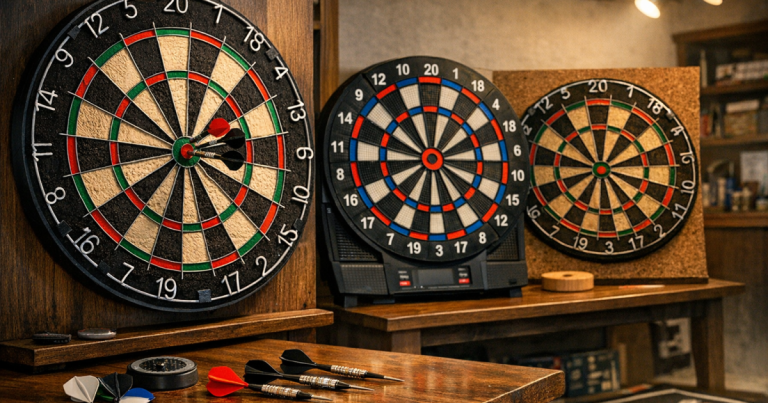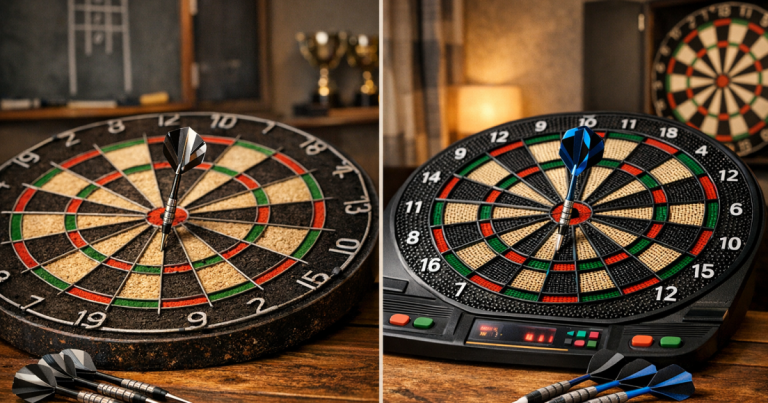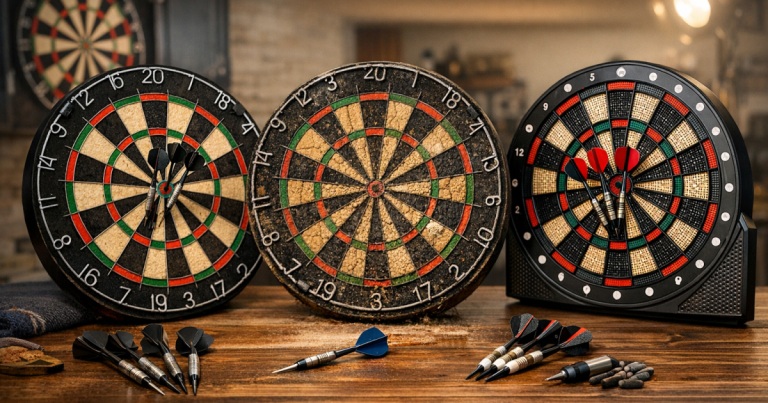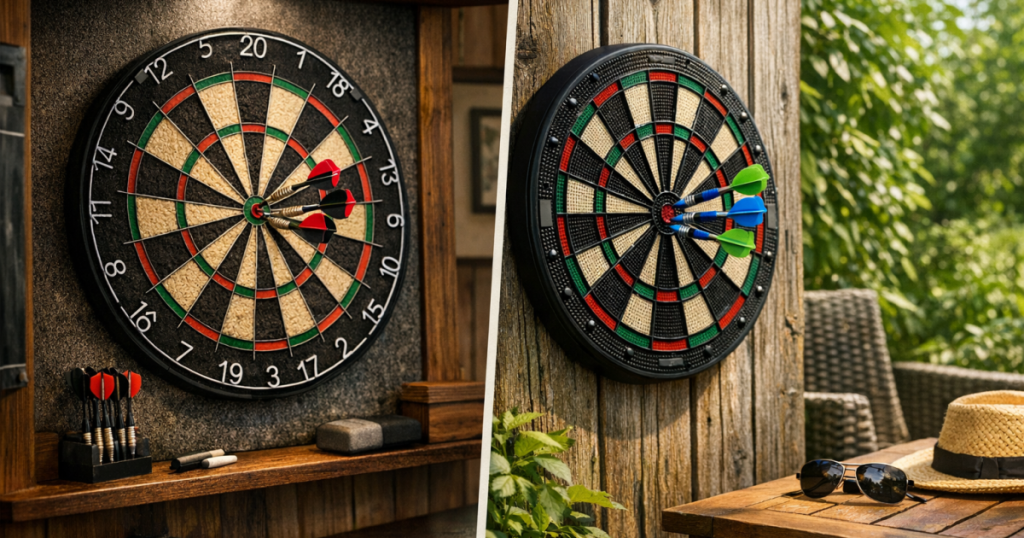
Choosing between indoor and outdoor dartboards is less about where you prefer to throw and more about what the board has to survive. A spare room, garage, shed and garden wall all create different problems: moisture, light, fixing strength, wall damage, bounce-outs and how quickly you can pack everything away.
For a reliable home setup, a dry indoor wall still gives the most consistent playing conditions. Outdoor darts can work brilliantly for casual sessions, but the board, mounting point and storage routine need more thought if you want to avoid swelling sisal, rusty fittings or a wonky target.
The short version
- Indoor bristle boards are the standard choice for steel-tip darts because they stay drier, flatter and more predictable.
- Outdoor boards should usually be treated as temporary setups, not permanent garden fixtures.
- Sisal and compressed-fibre boards dislike moisture, direct rain and long damp exposure.
- Electronic soft-tip boards are best kept indoors or in a dry covered space that matches the manufacturer’s guidance.
- Mounting matters as much as the board: a solid, vertical, vibration-free surface makes throwing safer and more consistent.
Where indoor and outdoor dartboards differ most
Indoor and outdoor dartboards may look similar when they are hanging up, but they are working in very different conditions. Indoors, the board mainly has to cope with dart impact, room temperature changes and ordinary wear. Outdoors, it may face damp air, condensation, wind-blown dust, sunlight and uneven mounting surfaces.
A proper indoor darts space also makes measurements easier. The bull should sit at the correct height and the throwing line needs to be measured from the face of the board, not the wall behind it. If you are planning a room, garage or outbuilding layout, it is worth checking the basics before drilling anything; our guide to measuring oche space before setting up a dartboard explains the distances and clearance points in more detail.
Outdoor setups are less forgiving. A fence panel can flex, a brick wall can be uneven, and a shed door can move slightly when struck. Those small movements can affect grouping, increase noise and make bounce-outs feel more random. For a casual barbecue throw, that may be fine. For serious practice, it gets frustrating quickly.
Materials: what survives best?
Bristle and sisal boards
Most serious steel-tip players use a bristle board made from tightly packed sisal fibres. A premium example such as the Winmau Blade 6 Triple Core belongs in a dry indoor environment where the fibres can recover properly after dart impact. Moisture is the main enemy. If a bristle board absorbs damp, it can soften, swell or lose its crisp surface over time.
That does not mean a bristle board can never be used outside. It means it should be carried out for the session, hung securely, then brought back in afterwards. Leaving it in a shed, gazebo or on an outside wall between sessions is the point where problems often start, especially in typical British weather where damp evenings and overnight condensation are common.
Paper-wound and budget fibre boards
Lower-cost boards can be useful for light family play or as a board you do not mind wearing out more quickly. A simple bristle-style board such as the Viper Shot King is the sort of recognisable example people may use for casual practice, but the same care rules still apply: keep it dry, avoid leaving it in direct rain, and do not expect outdoor storage to be kind to the playing surface.
Electronic and soft-tip boards
Electronic boards add another layer of caution. They are generally intended for indoor play unless the product information clearly says otherwise. Moisture, extension leads, outdoor sockets and uneven shelter can create obvious practical problems. For a covered games room or dry garage, they can be a fun option; for a garden fence or open patio, they are usually the wrong fit.
Mounting indoors: stability first
An indoor board should be mounted to something firm enough to hold the weight and absorb impact without wobbling. A masonry wall, a well-fixed backboard, a cabinet or a purpose-made stand can all work, provided the board sits flat and vertical.
Wall protection is worth thinking about before the first session. Missed darts happen, even with experienced players, and fresh plasterboard or painted walls mark easily. A removable surround is the simplest fix for many home setups, while a cabinet or backing panel can suit rooms where you want the board to look tidier between games. If you are already fitting a board, use the steps in our guide to fitting a dartboard surround for better wall protection so the surround sits snugly and does not interfere with rotation.
Also think about what sits around the throwing lane. Radiators, doorways, low shelves and furniture can all make a technically correct setup feel awkward. A good indoor board is not only about the target; it is about giving your throw a clear, repeatable space.
Mounting outdoors: treat it as temporary
The safest assumption for outdoor darts is that the board comes down when the session ends. A temporary board bracket on a solid post, a removable backboard or a freestanding darts stand gives you more control than hanging the board permanently on a fence.
Fences are tempting because they are convenient, but they can flex and rattle. That movement changes the way darts land and can make the board feel lively under impact. Brick or blockwork is usually steadier, but the surface still needs to be flat enough for the board to sit square. If the board leans back, forward or sideways, the target will not play as intended.
Wind is another outdoor issue people underestimate. It will not usually move a steel-tip dart much over a short indoor-style throw, but it can move lightweight scoreboards, loose surrounds, paper markers and anything not properly fixed. If the setup feels makeshift, slow down and make it secure before throwing.
Care routine for indoor boards
Indoor care is mostly about even wear and keeping the area clean. Rotate the number ring regularly so the treble 20 bed is not taking the majority of impact every week. Pull darts straight out rather than twisting aggressively, and avoid storing the board in a damp utility room or unheated space where condensation forms.
Do not soak, steam or spray a bristle board to revive it. That old habit can damage the fibres and shorten its life. A dry board, rotated often, will usually stay playable for far longer than one that is constantly being interfered with.
Care routine for outdoor sessions
Outdoor care is more active because the conditions change quickly. Before play, check that the board is dry, the bracket is tight, and the surface behind it is secure. After play, remove the board, wipe any surface moisture from the metalwork and store it indoors in a dry place.
Avoid leaving darts stuck in the board outside between turns or between games. Damp can affect flights, shafts and barrels too, and steel points can mark or corrode if neglected. If you use a mat, oche strip or temporary marker outside, bring that in as well rather than letting it sit on damp paving.
Lighting also deserves attention if evening play is part of the plan. Outdoor extension leads and improvised lamps are not worth the risk for a casual throw. For permanent or semi-permanent lighting ideas, read the dartboard lighting safety guide before deciding how to illuminate the board.
Examples that make sense in real homes
- Spare room: A bristle board, surround, clear oche and simple scoring area give the most consistent practice setup.
- Garage: Works well if the space is dry, ventilated and free from stored items in the throwing lane. Watch for cold surfaces that attract condensation.
- Shed: Fine for occasional play if it stays dry, but poor insulation can make boards and accessories feel damp over time.
- Patio or garden: Best treated as a temporary social setup. Hang the board, play, then take everything back inside.
- Covered outbuilding: Can be close to an indoor setup if it is genuinely weatherproof, stable and measured correctly.
Things readers ask
Can I leave a bristle dartboard outside overnight?
No, not if you want it to last. Overnight damp and condensation can affect the sisal fibres, metal wiring and fixing points, even if it has not rained directly on the board.
Is a garage an indoor or outdoor darts space?
It depends on the conditions. A dry, insulated garage behaves more like an indoor room. A cold, damp garage with condensation should be treated more like an outbuilding and managed carefully.
What is the biggest mistake with outdoor dartboards?
Leaving the board mounted permanently. Most damage comes from storage conditions rather than the actual throwing session, especially in damp British weather.
Can I use a normal dartboard surround outside?
Yes for a temporary session, provided it fits securely and stays dry. Bring it indoors afterwards, because foam and rubber surrounds can collect grime and moisture outside.
Are electronic dartboards suitable for garden play?
Only use one outdoors if the manufacturer’s instructions clearly support that kind of use. Most are better suited to dry indoor rooms, garages or covered games areas.
In brief
For serious practice, an indoor bristle board on a solid wall remains the most dependable setup. Outdoor darts is best kept temporary: choose a stable mounting point, protect the board from damp, and pack everything away after play. The board itself matters, but the real difference is the environment you ask it to live in.