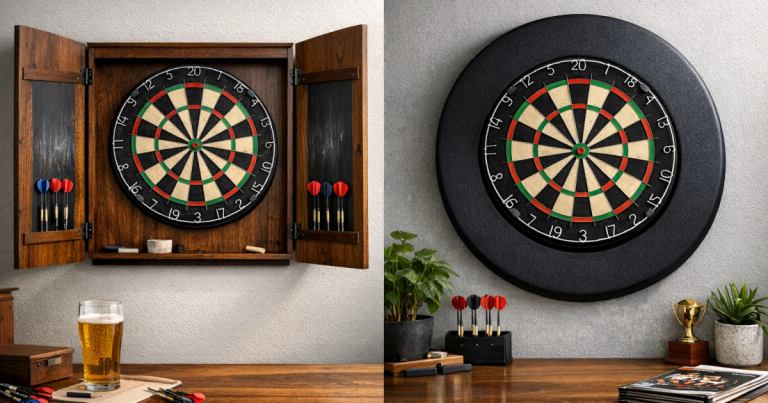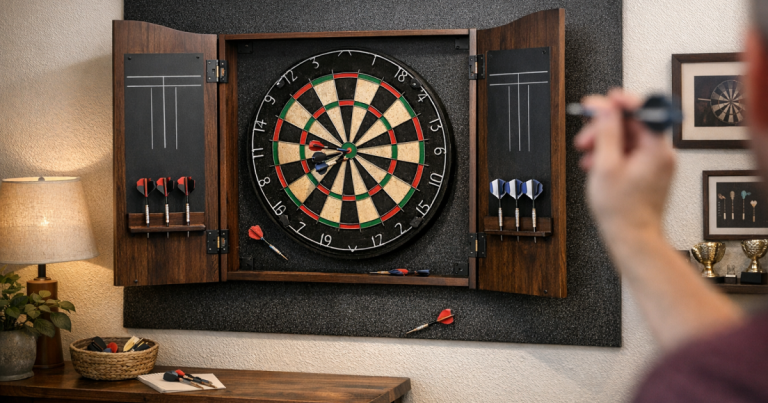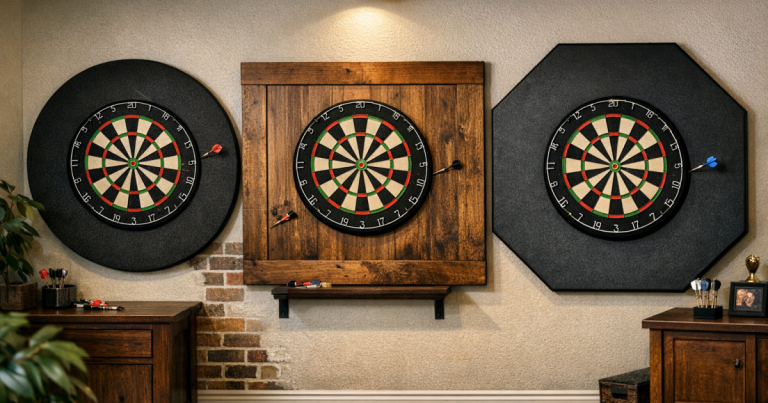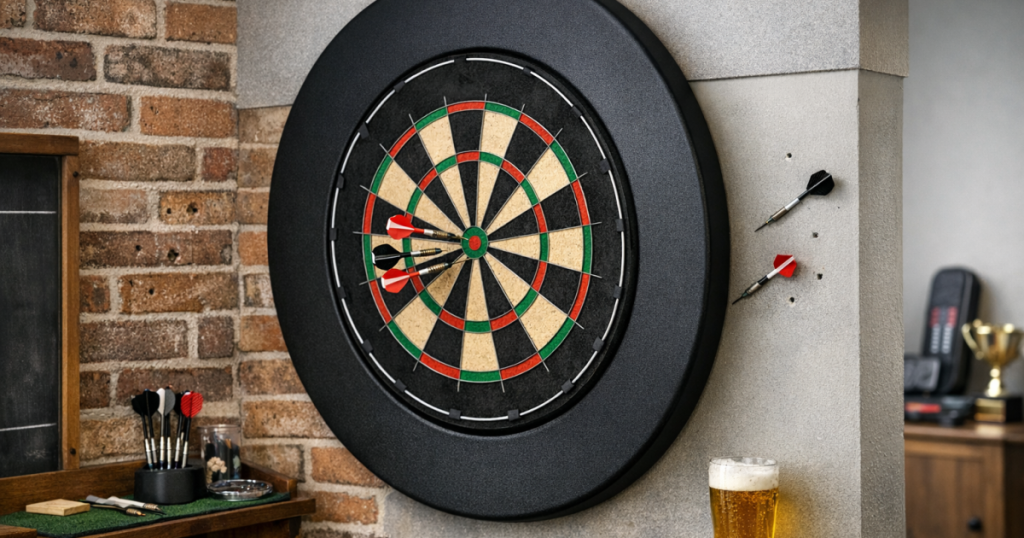
Misses around treble 20 and the outer doubles are part of home practice, but they do not need to leave peppered plaster behind the board. This Bull’s Dartboard Surround review looks at whether a simple foam-style ring gives enough wall coverage, how easy it is to fit, and where it makes sense compared with cabinets, mats and larger backboards.
Bull’s Dartboard Surround is a sensible shortlist option if you want quick wall protection without committing to a permanent cabinet or DIY panel. The main appeal is simplicity: it sits around the dartboard, softens the visual edge of the setup, and catches many of the near-miss darts that would otherwise mark the wall.
The quick verdict: it is a good, low-fuss upgrade for a standard home steel-tip board, provided you check the exact version, colour, inner fit and board compatibility before buying. It is not a magic shield for wild misses well outside the board area, but for normal practice scatter it does the job neatly.
Product overview
The Bull’s Dartboard Surround is designed for players who already have a steel-tip bristle dartboard on the wall and want to protect the immediate area around it. Rather than enclosing the board behind doors like a cabinet, it creates a protective ring around the board face. That makes it useful in spare rooms, garages, utility spaces and living areas where a full cabinet would feel too bulky.
Its biggest strength is that it keeps the setup clean and uncomplicated. There is no scoring surface, no doors to swing open, and no need to redesign the whole darts corner. For many homes, especially rented or shared spaces where visible wall damage is a concern, that matters more than extra features.
It also suits players who prefer the open-board look. A surround keeps the board visible and ready to throw at, which encourages short practice sessions. If you are building a more styled setup, it can sit between a plain board and a more furniture-like cabinet. For ideas on making the surrounding area look intentional rather than improvised, see our guide to matching dartboard cabinets and surrounds to your decor.
Key specs
- Product type: Protective dartboard surround for home steel-tip setups.
- Main purpose: Protects the wall immediately around the dartboard from common near misses.
- Typical fitting style: Surrounds in this category usually press around the board without complex fitting; verify the exact Bull’s version from the retailer before ordering.
- Board compatibility: Intended for standard round bristle dartboards; check fit if your board, mounting depth or wall bracket is unusual.
- Material: Commonly listed by retailers as a foam or PU-style protective material; confirm the exact listing details for the version you choose.
- Use case: Best for indoor home practice areas where neat wall coverage matters.
- Colour and finish: Availability can vary, so check the current colour options against your room and dartboard setup.
Pros and cons
Pros
- Quick way to reduce visible wall damage around a dartboard.
- Keeps the setup more compact than a large backboard or cabinet.
- Works well for casual practice, league-style home practice and family games.
- Can make a plain wall-mounted board look more finished.
- No need to add doors, shelves or a permanent wooden surround.
Cons
- Coverage is limited to the area close to the board, so very wide misses can still hit the wall.
- Fit depends on the board and the exact surround version, so measuring first matters.
- It will not replace a proper oche mat if you also need floor protection.
- Some rooms may still look better with a cabinet or larger decorative backboard.
- Colour choice may affect how discreet it looks in a living space.
Performance in real use
Wall coverage
For ordinary home play, the Bull’s surround is most useful around the doubles and just beyond the board edge. That is where a lot of accidental damage happens: a dart drifts outside double 20, pulls left of double 5, or drops low when someone is warming up. In those situations, a surround can save the wall from repeated small holes.
The important limitation is width. A ring-style surround is not designed to catch darts thrown far off line, nor will it protect nearby shelves, picture frames or plaster beyond its footprint. If beginners, children or occasional party players will use the board, think carefully about whether you need a larger backing panel as well.
Fit around the board
Fit is the make-or-break detail. A good surround should sit snugly enough to look tidy and remain in place during normal play, without pressing awkwardly against the board face. Before ordering, check whether your dartboard is a standard round bristle board and whether anything around the mounting area could interfere with the surround.
If your dartboard is set into a cabinet, recessed into a custom panel, or mounted unusually close to a corner, do not assume any surround will fit cleanly. Measure the space around the board and look at the retailer’s product photos carefully. The surround also needs enough clear wall around the board, not just enough room across the board itself.
Finish and room feel
A surround changes the look of a darts area more than people expect. A bare dartboard on a pale wall can look temporary; a fitted ring makes the board feel more deliberate. In a garage or games room, that is mostly about neatness. In a lounge or multipurpose room, colour and finish become more important.
Black is usually the safest visual choice because it frames the board and hides small marks well, but always check the current Bull’s colour options before deciding. If the board sits near furniture, framed prints or a painted feature wall, choose the surround as part of the room rather than as an afterthought.
Durability and maintenance
A dartboard surround is a sacrificial protective accessory, so the right expectation is “absorbs mistakes” rather than “stays perfect forever”. Over time, repeated hits can leave visible pin marks, especially in the most common miss zones around the top and lower sides of the board.
That is not necessarily a fault; it means the wall is being spared. Rotate the surround if its design allows and the fit remains correct, and keep the area clean with a dry cloth rather than soaking the material. Also check that the board itself remains correctly mounted, because a loose board can make any surround look untidy or uneven.
Set-up accuracy still matters
A surround helps with wall protection, but it should not be used to compensate for a poorly positioned board. If the height or throwing distance is wrong, practice becomes less useful and misses can become more frequent. Before judging any surround, make sure the playing area is properly set using the correct dartboard height and oche distance.
Once the board is at the right height and the oche is fixed, the surround becomes part of a more reliable practice setup rather than a patch for a rushed installation.
Who it’s best for / who should skip it
The Bull’s surround is best for players who want a neat, simple layer of protection around a standard steel-tip board. It is a particularly good fit for spare bedrooms, garages, studies and compact games corners where there is not much appetite for a bulky cabinet.
It also suits players who already like their dartboard and do not want to replace the full setup. If you have a quality bristle board such as a Winmau Blade 6 Triple Core or similar standard-sized board, a surround can be an easy supporting upgrade, as long as the fit is verified before purchase.
You should skip it, or at least add extra protection, if the board will be used mainly by absolute beginners with very wide misses. It is also not the right solution if you want hidden storage for darts, chalk, flights or accessories. In that case, a cabinet or custom backboard may make more sense.
It is also worth skipping if your board is mounted in a very narrow alcove, close to a door frame, or above delicate furniture. A surround protects the board perimeter, not the whole playing environment.
Alternatives
If the Bull’s option is not the right fit or finish, two straightforward alternatives are worth considering without turning the decision into a full equipment overhaul.
- Winmau Dartboard Surround is a familiar option for players who already use Winmau boards or want a widely available surround style. Check the exact listing for colour, fit and whether it suits your board depth.
- Target Pro Tour Dartboard Surround is another recognised choice if you prefer Target accessories or want to match other Target darts-room kit. Again, verify dimensions and compatibility rather than assuming a universal fit.
A larger DIY backboard is the better alternative when the wall needs broader protection. A cabinet is the better choice when you also want storage and a more traditional pub-style look. A surround sits in the middle: cleaner than bare wall, simpler than cabinetry.
Questions people ask
Will the Bull’s surround stop every missed dart?
No. It protects the area immediately around the board, which covers many near misses, but it will not catch darts that land far outside the surround.
Can I use it with any dartboard?
It is intended for standard steel-tip bristle dartboards, but you should still check the exact fit, board depth and mounting arrangement before buying.
Is a surround better than a cabinet?
It depends on the room. A surround is simpler and more compact; a cabinet gives a more enclosed look and can add storage.
Do I still need a darts mat?
Possibly. A surround protects the wall around the board, while a mat helps define the oche and can protect the floor from bounce-outs.
Will it look too bulky in a living room?
Usually not if the colour suits the room and the board area is kept tidy. In a more formal space, a cabinet or styled backing panel may blend in better.
Verdict + score
The Bull’s Dartboard Surround is a strong, sensible wall-protection upgrade for home players who want better coverage without overcomplicating the setup. Its value comes from being simple: it frames the board, catches common near misses, and keeps a home darts corner looking more deliberate. The main checks are fit, colour and whether its coverage is wide enough for the people using the board. For a standard home steel-tip setup, it earns 8.2/10.
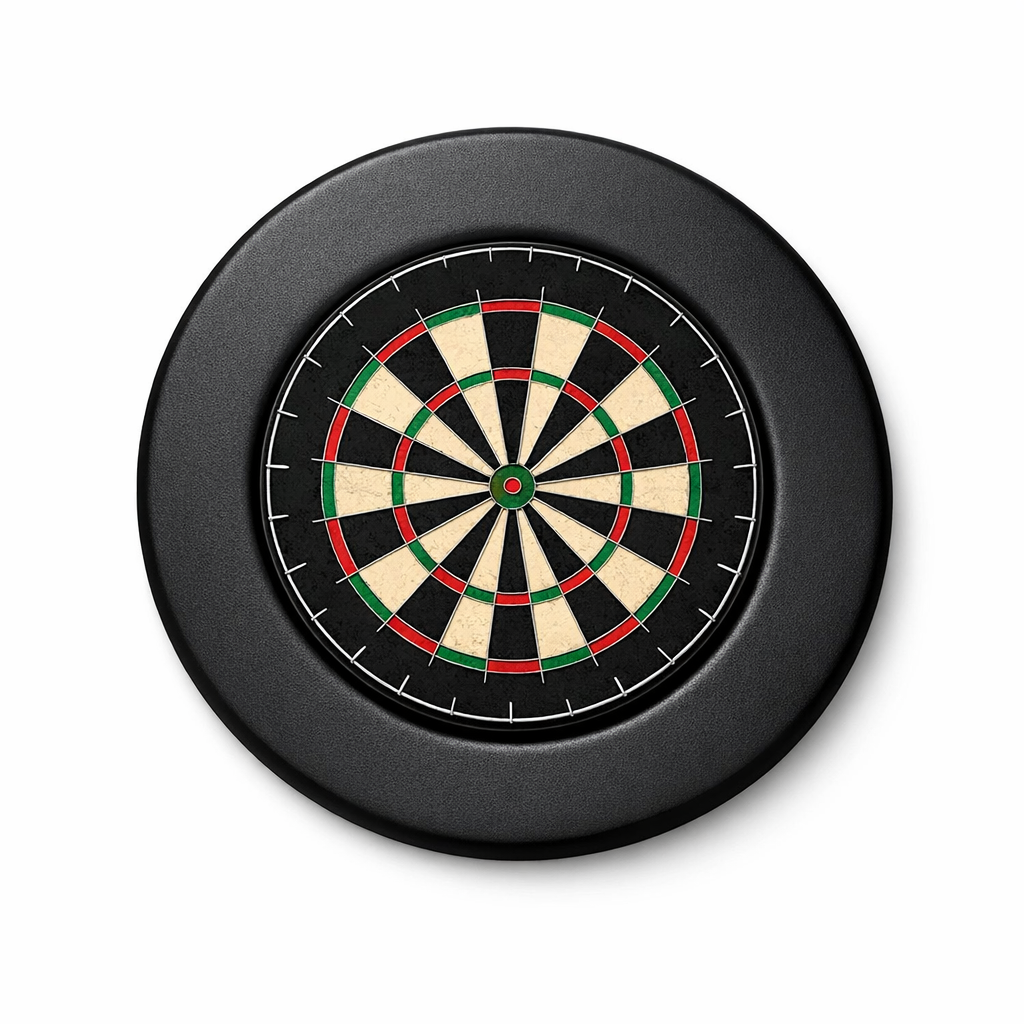
Bull's Dartboard Surround
Trus
You might also like: How to Fit a Dartboard Cabinet Without Rattles.