Choosing between steel tip vs soft tip darts is really about where you play, what board you use and how you want your home setup to feel. The wrong format can leave you with bounce-outs, board incompatibility or a room that is less practical than you hoped. Get the format right first, then narrow down weight, grip and accessories.
What to know first
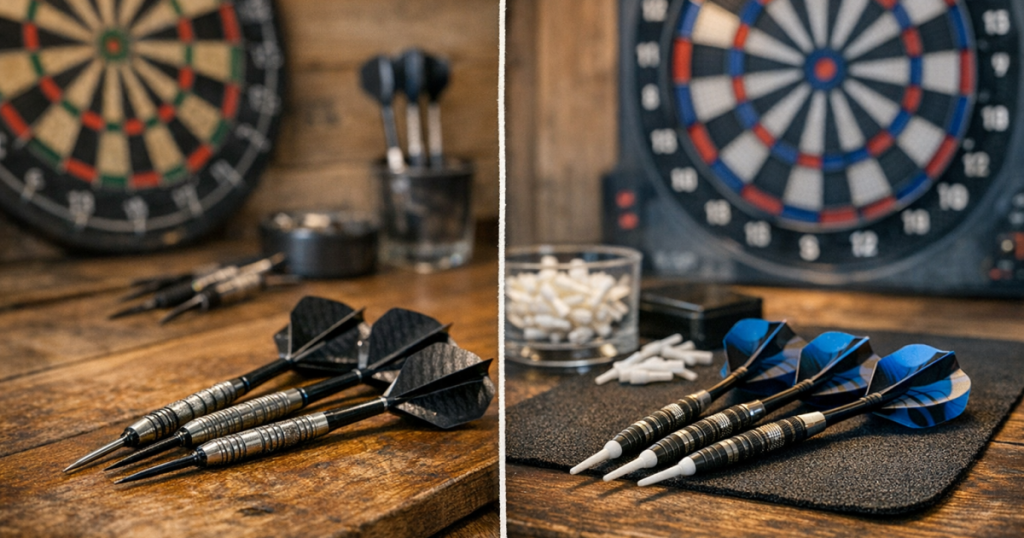
Pick steel-pointed darts if you want the traditional pub-style setup with a bristle dartboard, manual scoring and the familiar feel of metal tips landing in sisal. Pick plastic-tipped darts if you use an electronic board, want automatic scoring, or need a softer, more casual setup for a shared family space.
Neither format is automatically “better”. A good home setup depends on the board, the throw line distance, the players using it and the room around it. Many players enjoy both: a bristle board for serious practice and an electronic board for quick games with guests.
- Choose steel tip for traditional practice, league-style play and bristle dartboards.
- Choose soft tip for electronic scoring, casual multiplayer games and plastic segment boards.
- Do not mix them blindly: steel points can damage electronic boards, while plastic tips are not designed for standard bristle-board play.
Step 1: Start with the board you already have
The board decides more than the darts. A bristle dartboard is built for metal points. An electronic dartboard is built for plastic points that press into small holes or segments. If you already have one type of board mounted at home, the simplest answer is usually to match your darts to that board.
For a bristle board, look for a steel-point set with barrels that feel comfortable in your hand and a point that enters the board cleanly. The quality of the board matters too: a dense, well-made bristle board can reduce frustrating bounce-outs and wear more evenly. If you are upgrading the board as well as the darts, it is worth reading how dartboard quality affects scoring, wear and practice before buying.
For an electronic board, use soft-tip darts only unless the manufacturer clearly says otherwise. Plastic tips are consumable, so keep spares in your kit. Boards vary in segment shape, sensitivity and scoring layout, so check the manual for compatible tip size and any dart weight limits before ordering a new set.
Step 2: Think about scoring and game style
Steel-pointed play gives you the classic darts routine: throw, retrieve, mark the score, repeat. That is part of the appeal for many home players because it slows the game down and encourages deliberate scoring. It also mirrors the traditional pub and league experience in the UK.
Soft-tip play is more automated. Electronic boards usually register the throw and calculate the score, which is handy for beginners, families and social evenings. It can also make games like Cricket easier to run without someone constantly checking marks and totals.
If you enjoy 501, doubles practice and accuracy drills, a bristle setup feels more direct. If you mainly want fast games, party play or simple scoring for mixed abilities, a soft-tip setup can be less demanding. For a real home-board example of casual electronic play, the Winmau Sabre electronic dartboard review is a useful next read.
Step 3: Compare the feel in the hand
The tip format is only one part of the dart. Barrel shape, grip level, balance and overall weight have a bigger effect on how the dart leaves your hand. That said, the two formats can feel different because soft-tip darts are commonly used with plastic points and electronic boards, while steel-pointed darts land with a firmer, more traditional impact.
If you are moving from one format to the other, do not assume the same barrel will behave identically. A similar-looking dart may balance differently depending on the point and setup. Check the listed weight carefully and confirm whether the weight refers to the barrel only or the fully assembled dart, because retailers and brands do not always present this in the same way.
As a reference point, a named steel-point option such as Target Phil Taylor Power 9Five Steel Tip Darts shows how product listings usually describe barrel style, grip and weight options. For soft-tip shopping, a set such as Target Bolide 03 Soft Tip Darts is the sort of listing where you should check tip compatibility, included accessories and stated dart weight before buying. Treat these as examples of what to inspect, not automatic picks for every player.
Step 4: Check your room before choosing
A steel setup needs sensible wall protection, a clear throwing lane and enough space behind the oche for people to move safely. Missed darts can mark plaster, skirting boards or nearby furniture, so plan the whole throwing area rather than just hanging a board.
A soft-tip setup can feel more forgiving in a family room, but it still needs space. Darts can bounce out, players still step forward to collect them, and people should not walk across the throw line during a visit to the board. Electronic boards also need to be positioned where scoring is easy to see and the board can be used comfortably without stretching or twisting.
Throwing distance can differ by format and board type. Traditional steel-point home setups commonly use 2.37 m from the board face to the oche, while many soft-tip setups use 2.44 m. Always check the rules or instructions for your board, especially if you plan to practise for a specific venue or league.
Before you commit to a cabinet, mat or permanent oche, walk the space as if a game is already in progress. The guide to planning safe walkways around your dartboard is especially useful if your board is in a garage, spare room, hallway end or shared living area.
Step 5: Factor in wear, maintenance and running costs
Steel points are durable, but they can become burred or blunt. A rough point can pull fibres from a bristle board and make retrieval harder, so inspect points regularly and smooth or replace them when needed. Flights and shafts wear too, particularly if your grouping improves and darts start contacting each other in the board.
Soft tips break more often than steel points, especially during bounce-outs or when they hit hard surfaces. That is normal rather than a sign that you bought the wrong darts. Keep a small pack of replacement tips nearby, and check that the thread matches your barrels before buying spares.
Electronic boards also have segments and sensors to look after. Avoid throwing overly hard or using darts outside the board maker’s recommended weight range. For bristle boards, rotate the number ring regularly if the board allows it, so the treble 20 area does not take all the wear.
Step 6: Match the format to the players
For a solo player trying to improve consistency, steel-pointed darts on a bristle board make sense. You get a traditional target, a clear sound on impact and the same style of practice used in many pubs and clubs. Scoring by hand also helps with arithmetic and checkout awareness.
For a mixed household, soft-tip darts may be easier to live with. Automatic scoring reduces arguments, beginners can join in quickly, and casual games move along without someone acting as chalker. It can be a good choice where the board shares space with other hobbies or family activities.
For younger players, supervision and room layout matter more than the dart format. Plastic tips can reduce some wall and furniture damage, but they are still thrown objects. Keep the playing area clear, set simple house rules and store darts properly when the board is not in use.
Step 7: Use a simple buying checklist
Once you know the format, narrow your options with a practical checklist rather than buying purely by looks. The best darts are the ones you can release cleanly and repeatedly.
- Board compatibility: match metal points with bristle boards and plastic points with electronic boards.
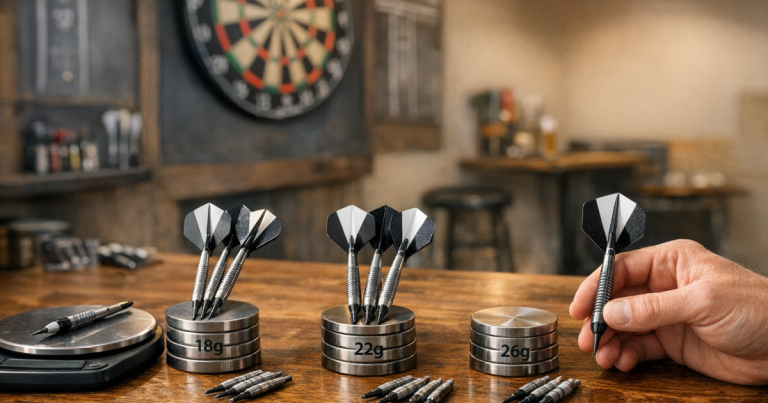
- Weight: choose a weight you can control without forcing the throw; compare like-for-like listing details.
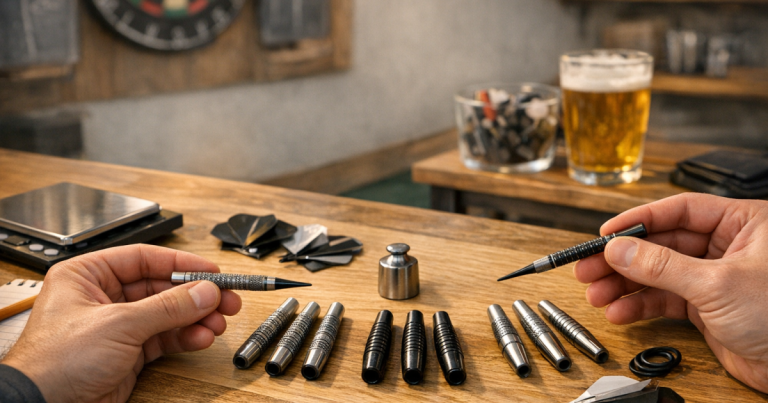
- Grip: heavy grip can help if the dart slips, but it may catch on release if you grip lightly.
- Balance: front-weighted, centre-balanced and rear-weighted barrels suit different throwing actions.
- Spare parts: check that flights, shafts, points or tips are easy to replace in the UK.
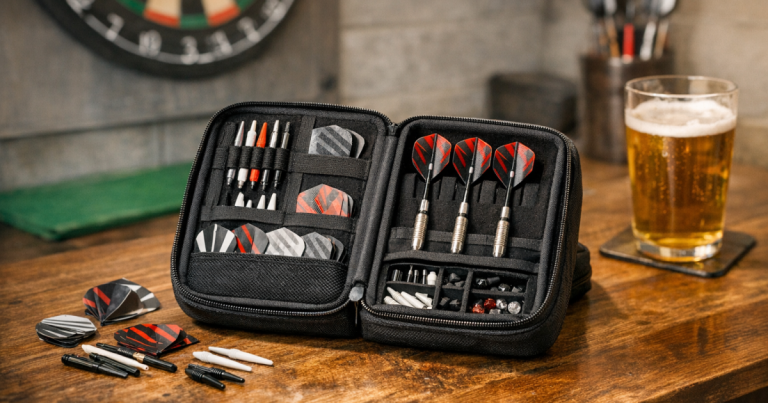
- Storage: use a case, drawer divider or cabinet so tips, flights and shafts do not get damaged between games.
- Room fit: confirm oche distance, headroom, wall protection and walkway space before making the setup permanent.
If you are buying your first serious set, avoid jumping straight to a highly specialised barrel. A straightforward tungsten or brass set in a sensible weight range is often easier to learn with. Once your throw becomes repeatable, you can make more confident decisions about grip pattern, balance and point style.
Common questions
Can I use soft-tip darts on a bristle dartboard?
You can physically throw them, but it is not the ideal setup. Plastic points do not enter sisal like steel points, so bounce-outs and poor sticking are likely unless you are using a board designed for both formats.
Can I put steel points into soft-tip barrels?
Some barrels can be converted with suitable conversion points, but compatibility depends on the thread and barrel design. Check the manufacturer’s guidance and remember that converted darts should not be used on electronic boards.
Are soft-tip darts safer for a home setup?
They can be more forgiving for walls and casual play, but they still need supervision, a clear throw area and sensible storage. Do not treat plastic tips as harmless, especially around children or pets.
Which format is better for serious practice?
For traditional UK pub and league-style practice, steel-pointed darts on a bristle board are usually the closer match. For electronic tournaments or casual scoring practice, soft-tip darts make more sense.
Do I need different oche distances?
Often, yes. Steel setups commonly use 2.37 m, while many soft-tip setups use 2.44 m. Check the rules for your board or the venue you are practising for before marking the floor.
Key takeaways
Choose the dart format from the board and room first, then fine-tune the barrel. Steel-pointed darts suit bristle boards, traditional scoring and focused practice. Soft-tip darts suit electronic boards, automatic scoring and casual multiplayer games.
If you are building a home setup from scratch, decide how the space will be used on a normal weeknight, not just how it looks when everything is new. A format that fits your room, players and scoring style will get used more often — and that matters more than chasing the most expensive set on the shelf.