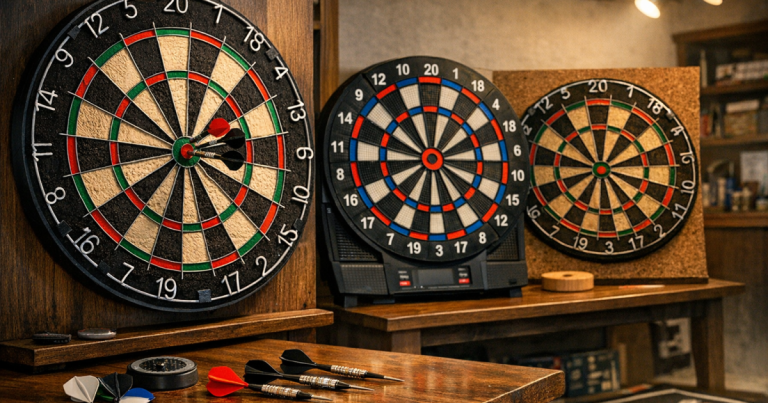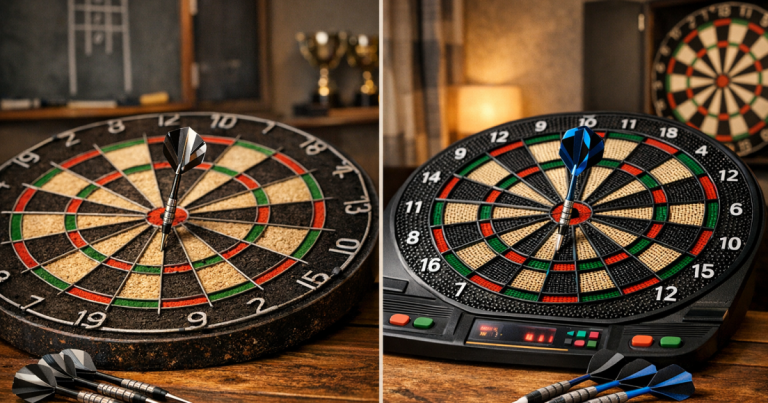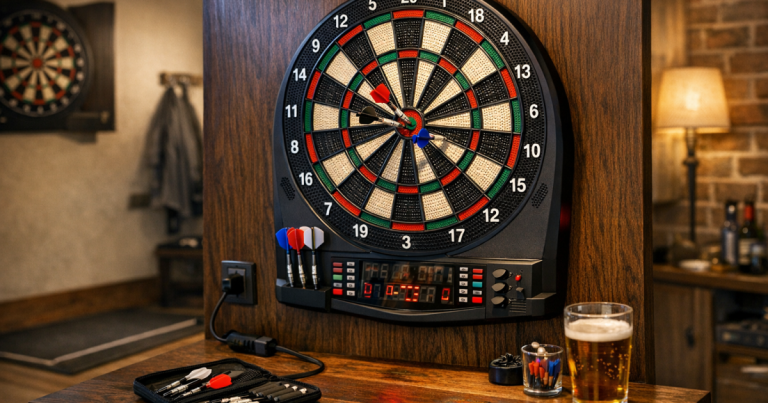
A board can look perfectly serviceable from the oche, yet still make practice feel harder than it should. Dartboard quality affects how darts enter the surface, how clearly segments are divided, how often bounce-outs interrupt a leg, and how long the playing area stays consistent. For a home setup, that matters because most players are trying to build rhythm, repeatable grouping and confidence, not fight the equipment.
The biggest differences are not always dramatic at first. They tend to show up over weeks of use: more marks around the treble 20, darts sitting at odd angles, soft patches, loose wires, or scoring that feels slightly less trustworthy than it did when the board was new.
The big picture
- A well-made bristle board usually gives cleaner dart entry, fewer deflections and more even wear across the scoring surface.
- Poor fibre recovery can make heavily used beds look tired quickly, especially around popular targets such as treble 20, treble 19 and bull.
- Thin, stable dividing wires help the dart reach the scoring bed; proud or damaged wires can increase bounce-outs and awkward deflections.
- Electronic boards have a different quality test: segment response, hole design, missed registrations and suitability for soft-tip darts matter more than fibre recovery.
- Board care still matters. Rotation, a dry indoor position and sensible lighting can make a decent board feel better for longer.
Why the board surface changes scoring
On a bristle board, the surface is usually made from compressed sisal fibres. When a dart enters, the fibres part and then close back together after the dart is removed. Better boards tend to feel more even across the face, so the dart does not move from firm areas into noticeably soft or ragged patches. That consistency helps your throw give you more honest feedback.
If the surface is too hard, darts may fail to hold cleanly or can sit shallow. If it is too soft, darts may bury deeply, lean heavily, or leave the area around common targets looking chewed up sooner. Neither problem is ideal for practice because it becomes harder to judge whether a poor result came from your release or from the board.
Wire design also affects scoring. Older or more basic boards can have rounder, more prominent wire dividers. When a dart hits those wires, it is more likely to bounce away or deflect into a neighbouring bed. Modern bristle boards vary in how slim and embedded those dividers are, so it is worth checking close-up photos and real user feedback rather than relying on marketing terms alone.
Where quality shows up during a leg
Scoring is not only about whether the dart sticks. It is about whether the board gives a clear, repeatable outcome for the dart you threw. A board with clean segment boundaries and a flat face makes it easier to trust the result. That matters when you are practising finishing, switching around the board, or tracking average scores over a session.
- Treble and double beds: Narrow targets expose poor wire alignment and damaged fibres quickly. If those areas become ragged, grouping becomes less meaningful.
- The bull area: Bull practice punishes weaker construction because the same small area is hit repeatedly. Loose or uneven centres can spoil drills.
- Deflections: A single wire deflection can be normal; regular bounce-outs from clean throws suggest the board, dart point or mounting angle deserves attention.
- Visibility: Faded colours and harsh shadows can make aiming less precise. If the board is decent but hard to read, review your dartboard lighting layout before blaming your throw.
For electronic boards, scoring quality is more about whether the board registers soft-tip darts reliably. Missed scores, double registrations and dead segments can ruin practice data. Before relying on one for routine tracking, check how it handles repeated throws into common targets and whether the segments respond consistently across the face.
Wear is about more than age
A board does not wear evenly unless you help it. Most home players throw disproportionately at treble 20, then treble 19, doubles and bull. A good board copes with that better, but even a strong surface will deteriorate if it is never rotated.
Rotation spreads impact across different fibre sections. On a removable number-ring bristle board, rotate the board regularly so your most-used targets move to fresher areas. The exact timing depends on how often you play, but visible flattening, darkening or loosening around your favourite targets is a clear sign to rotate sooner.
Room conditions also matter in UK homes. A board kept in a dry spare room or living-room setup will usually have an easier life than one in a damp garage or shed. Moisture can affect fibres, fittings and backing materials, while very changeable temperatures can make the board feel less consistent. If your setup is in a multipurpose room, it is worth planning the surrounding area properly rather than treating the board as an isolated item; a clean wall arrangement can protect the room and make the board easier to use. For layout ideas, see how to build a tidy dartboard wall with cabinets and surrounds.
Practice feel: the hidden reason quality matters
Good practice depends on rhythm. You step up, throw three darts, read the result and adjust. When a board causes regular interruptions, that rhythm breaks. Picking darts off the floor, questioning a deflection, or re-throwing because a segment did not register can make a session feel less focused.
This is where dartboard quality becomes more than a durability issue. It affects how confidently you interpret your own performance. If three darts land tightly around treble 20, you want to know the grouping reflects your throw. If one kicks out from a wire, the board has changed the story of that visit.
Dart choice plays a part too. Point condition, barrel weight, grip position and balance can all alter entry angle. A good board cannot fix an inconsistent release, but it can make equipment issues easier to spot. If your darts are landing tail-up, tail-down or at very mixed angles, it may help to review how you choose darts barrels by grip and balance alongside the board itself.
Bristle and electronic boards age differently
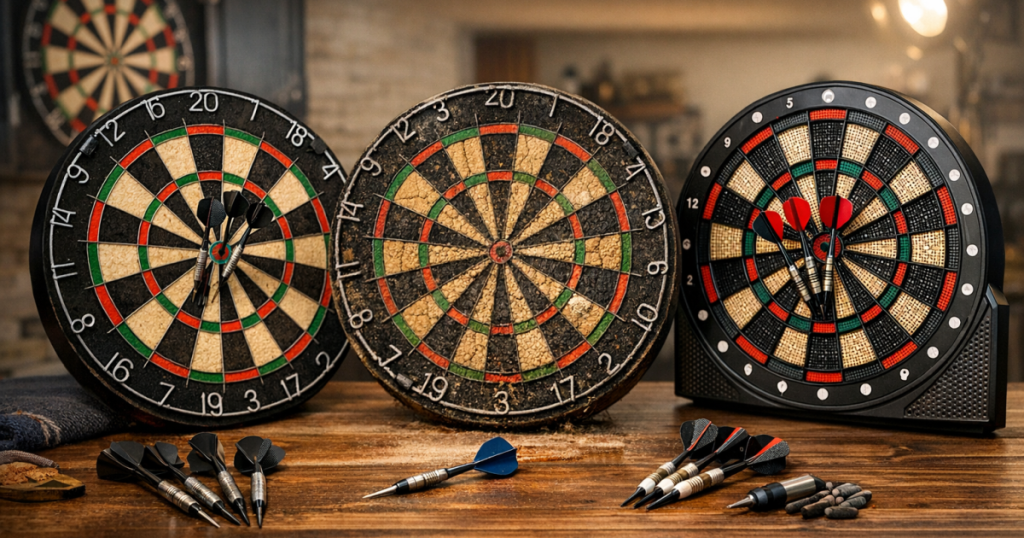
Bristle boards tend to show wear visually. You will see compressed fibres, pale patches, darkened scoring beds, raised areas, loose wires, or a tired bull. The decline can be gradual, so many players keep using a board long after it has stopped giving clean feedback.
Electronic boards can look tidy while still becoming frustrating. The issue may be missed scoring, worn holes, loose segments or inconsistent response from heavily used areas. Because electronic boards are designed for soft-tip darts, they should not be judged by the same standards as a traditional steel-tip bristle setup. They are often useful for casual scoring, family play and compact indoor setups, but serious steel-tip practice needs the right board type.
A recognised premium bristle board such as the Winmau Blade 6 Triple Core is a useful example of the direction many serious home players look in: dense sisal, a refined wiring system and a competition-style feel. Before choosing any board, though, verify the current version, mounting hardware, room suitability and whether it matches your darts and playing style.
Signs your board is holding back practice
- Darts that used to stick cleanly now fall out from normal scoring areas.
- The treble 20 bed looks flattened, torn or heavily compressed even after rotation.
- Wires sit proud, move when touched, or cause frequent deflections from clean hits.
- The bull area feels loose, uneven or less responsive than the rest of the board.
- Scores are hard to read because colours have faded or the surface is badly marked.
- Electronic segments miss scores regularly even when soft-tip darts hit clearly.
- You find yourself adapting your throw to the board rather than trusting your normal action.
One or two bounce-outs do not prove the board is poor. Dull points, unlucky wire hits and a shallow throw can all cause problems. The key is pattern. If the same issue appears in the same areas across several sessions, the board is probably part of the problem.
Simple care habits that preserve consistency
Care cannot turn a weak board into a top-tier one, but it can protect a good board from needless early wear. The aim is to keep the surface even, the board secure and the playing area comfortable.
- Rotate a bristle board before the favourite targets become visibly exhausted.
- Remove darts by pulling straight out with a slight twist rather than yanking sideways.
- Keep the board indoors in a dry, stable position rather than in a damp outbuilding.
- Check that the board is mounted flat and secure, with no wobble during impact.
- Use suitable darts for the board type: steel-tip for bristle, soft-tip for electronic boards.
- Avoid soaking, spraying or aggressively cleaning the playing surface unless the manufacturer specifically says otherwise.
Questions people ask
Does a better board actually improve scoring?
It will not improve your throw by itself, but it can make scoring more reliable. Fewer deflections, clearer segments and a more even surface help your practice results reflect your technique more accurately.
How often should a home dartboard be rotated?
Rotate it when the most-used areas begin to show wear, not only on a fixed calendar. Frequent players may need to rotate far more often than someone throwing casually once a week.
Are bounce-outs always caused by a poor board?
No. Wire hits, blunt points, dart angle and throw speed can all cause bounce-outs. Regular bounce-outs from several clean throws in the same board area are a stronger warning sign.
Is an electronic board good enough for serious practice?
It can be useful for casual scoring and soft-tip play, but it is a different experience from steel-tip practice on a bristle board. Choose based on the darts you use and the type of practice you want.
When is it time to replace rather than rotate?
Replace the board when rotation no longer restores a clean playing surface, wires are unstable, darts fall out regularly, or key scoring areas have lost their shape.
Key takeaways
A dartboard is not just a target on the wall. Its surface, wiring, mounting and condition all affect scoring confidence, wear rate and the usefulness of practice. For most home players, the right approach is simple: start with a board suited to your darts, mount it properly, light it well, rotate it regularly and pay attention when the same problems keep appearing.
Quality matters most because it removes doubt. When the board is consistent, you can focus on release, grouping, finishing and rhythm. That is when home practice starts to feel productive rather than random.