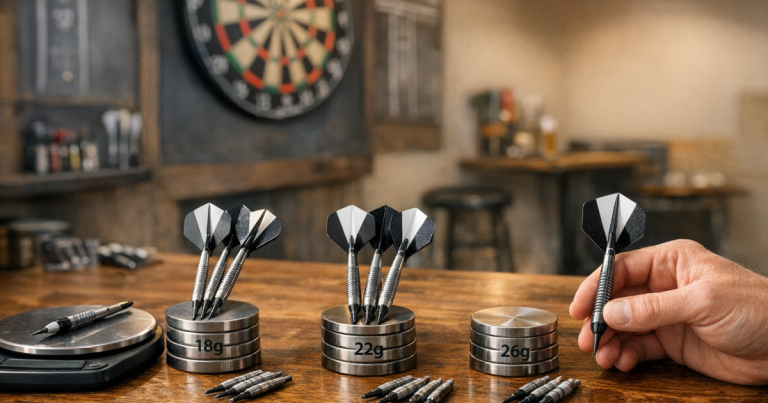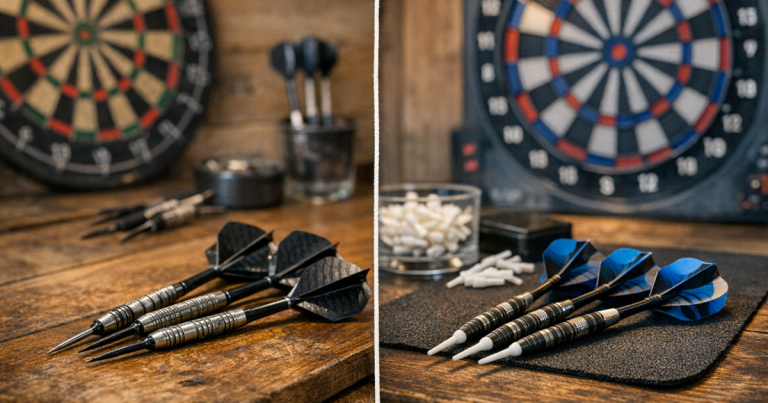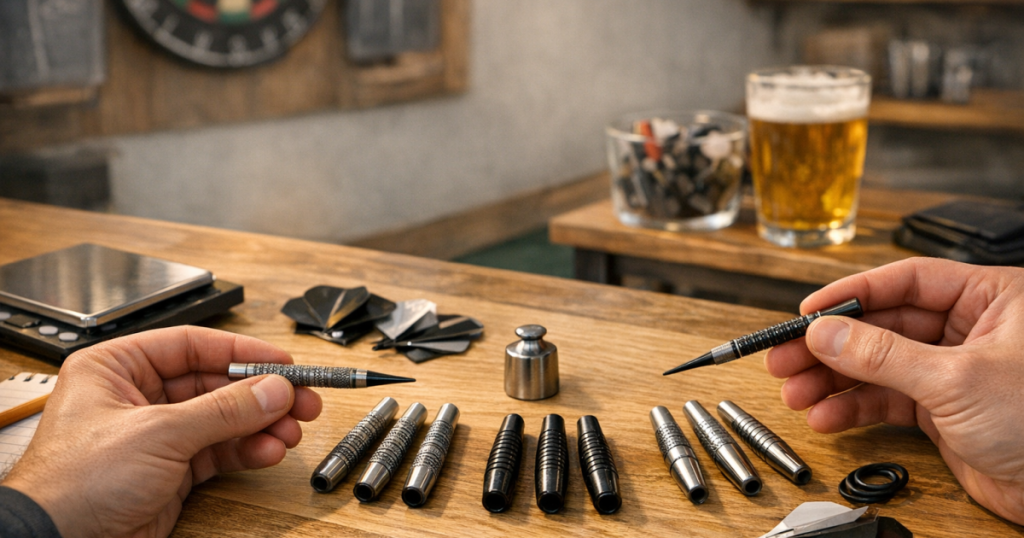
Choosing darts barrels by grip and balance is less about chasing the most aggressive pattern and more about matching the metal to the way your hand already throws. The right barrel should settle into your fingers quickly, leave cleanly at release, and feel repeatable over a full evening at the board.
For a home setup, that repeatability matters more than impressing anyone with a complicated profile. A barrel that suits your grip can make practice feel calmer, reduce small release errors, and help you build confidence before changing other parts of your setup.
The quick way to narrow your choice
- Front grippers usually benefit from a clear grip zone near the point end and a shape that does not push the fingers backwards.
- Middle grippers often suit straight or gently tapered profiles because the barrel sits evenly between thumb and fingers.
- Rear grippers may prefer grip towards the stem end, with enough texture to stop the dart slipping during the draw back.
- Strong grip patterns can help if your fingers slide, but they can also catch on release if you squeeze hard.
- Balance point should support your natural throw rather than forcing you to aim, lift or release differently.
Step 1: Work out where you actually hold the dart
Before comparing darts barrels, pick up your current darts and pause just before throwing. Look at where your thumb sits and where the main pressure from your index finger lands. That contact point tells you more than the product description will.
If your thumb is close to the point, you are likely a front gripper. If it sits around the centre, you are a middle gripper. If it rests closer to the stem, you are a rear gripper. Some players also use a supporting finger on the point or stem, but the thumb position is still the most useful starting point.
Do not judge this from one throw. Watch your hand over a short practice visit to the board. A grip that moves around from dart to dart can make any barrel feel inconsistent, so your first aim is to notice the pattern you naturally return to when you are not overthinking.
Step 2: Match the grip texture to your release
Barrel grip is not simply mild versus aggressive. It is about how the texture behaves as the dart leaves your hand. Ring grip, shark grip, micro grip, knurling, scallops and smooth sections all create different amounts of contact and resistance.
If your dart slips
Choose a defined grip pattern where your fingers sit. This does not automatically mean the roughest barrel on the rack. A medium ring grip or fine machined texture can be enough if the location is right. Slipping often comes from holding a smooth section rather than from needing an extreme grip.
If your dart sticks on release
Look for a cleaner profile with less bite. A very sharp or deep pattern can delay the dart leaving your fingers, especially if you grip firmly. That delay can drag the dart low, pull it sideways, or make the follow-through feel jerky.
If you change grip during longer sessions
A barrel with several usable grip zones can help. This suits home players who practise in short bursts, then play matches with family or friends later. However, too many raised sections can become distracting, so check whether the layout guides your fingers or simply gives them too many options.
Flights and stems can also change how a dart feels through the air. Once the barrel feels right, it is worth checking whether your rear setup is helping or fighting the throw; our Target Darts flights review explains how flight choice can affect stability and feel.
Step 3: Choose a barrel shape that supports your hand
Shape is just as important as texture. Two darts with similar grip can feel completely different if one is straight and the other is tapered, torpedo-shaped or scalloped.
- Straight barrels are popular because they offer a predictable feel along most of the length. They suit many middle grippers and players who like a simple reference point.
- Front-tapered barrels can suit players who guide the dart from nearer the point, as the front section may feel more natural in the fingers.
- Rear-tapered barrels can help some rear grippers settle the dart without feeling crowded by the stem.
- Scalloped barrels give a very obvious finger location. They can be excellent when the scallop matches your hand, but awkward when it does not.
- Shorter, chunkier barrels can feel secure in the hand, but may be less comfortable if you use a stretched or multi-finger grip.
The key check is whether your fingers land in the same place without looking. If you need to rotate the dart repeatedly to find the right section, it may not be the easiest choice for relaxed home play.
Step 4: Understand balance without overcomplicating it
Balance affects how the dart sits in the hand and how it wants to travel. You do not need lab measurements to assess it. Balance the dart gently across a finger and notice whether the weight feels central, forward or rearward.
A front-weighted feel can help some players who throw with a positive, direct action. A more central balance often feels neutral and easy to adapt to. A rear-weighted feel may suit players who hold further back, but it can feel strange if your release naturally drives the point first.
Grip position and balance should agree with each other. A front gripper using a dart that feels heavy at the rear may find the point lifts or wanders. A rear gripper using a very front-biased barrel may feel as though the dart wants to leave before the fingers are ready.
Examples can help when you are handling real sets. Target Darts Phil Taylor Power 9Five and Red Dragon Darts The Legend are recognisable options many players use as comparison points for grip placement, profile and overall feel. Treat named sets as reference points rather than guaranteed solutions, because the right match still depends on your hand and throw.
Step 5: Test with your normal home setup
Try potential barrels in conditions that resemble how you actually play. Stand at your usual oche distance, use your normal stance, and throw enough darts to get past the novelty of a new feel. A set that feels exciting for three visits may not feel as convincing after twenty minutes.
Pay attention to these signs:
- Grouping: Are misses similar, or is the dart spraying in different directions?
- Release: Does the dart leave cleanly, or do you feel it dragging from one finger?
- Landing angle: Are the darts sitting in a way that suits your next dart, or blocking the bed awkwardly?
- Finger comfort: Does the grip feel secure without making your fingertips sore?
- Repeatability: Can you pick up the dart and find the same hold without hesitation?
If your board is in a shared room, keep the test realistic. Moving furniture, standing slightly off line, or using an inconsistent oche can make a good barrel look worse than it is. For a more reliable practice area, see our advice on planning a darts setup in a shared living room.
Step 6: Avoid common buying mistakes
The most common mistake is buying the sharpest-looking grip because it feels secure in the shop or during the first few throws. Security is useful, but release quality matters more. If the grip is so aggressive that you have to consciously let go, it is probably working against you.
Another mistake is copying a professional player’s darts without considering grip position. Professional-style darts can be excellent, but they are built around a player’s technique, preference and long-term rhythm. Use them for comparison, not imitation.
Do not change too many parts at once. If you buy new barrels, keep your familiar stems and flights for the first practice session. Then adjust one part at a time. This makes it far easier to tell whether the improvement came from the barrel or from another accessory.
Finally, check practical details before buying: steel-tip or soft-tip compatibility, available weights in grams, included stems and flights, spare point options, and the retailer’s returns policy. These checks matter more than small cosmetic differences.
When should you replace your current barrels?
You do not need new barrels just because your darts are marked or older. Replace them when they no longer support your grip, when the texture has worn enough to affect release, or when your throw has developed and your current balance now feels awkward.
It also makes sense to change if you have moved from casual throwing to more structured practice. Once you are grouping more consistently, small differences in shape and balance become easier to feel. At that stage, a better-matched barrel can be a sensible upgrade rather than a random experiment.
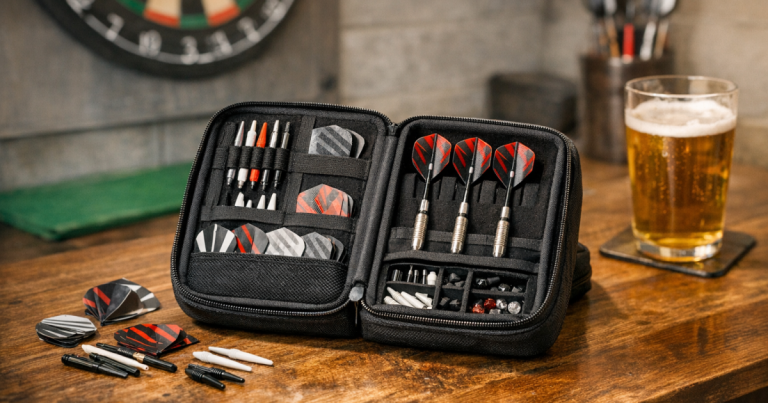
If you keep alternative stems, flights, points or a second set for practice, storage becomes part of the decision. A tidy case helps you compare setups properly rather than losing parts between sessions; our guide to what makes a dart case worth buying for spares covers the useful features to look for.
Common questions
Is a heavier barrel better for beginners?
Not automatically. A heavier dart can feel stable, but it can also hide release issues. Beginners should focus on a comfortable grip, clean release and a weight in grams that feels controllable over repeated throws.
Should I choose smooth or grippy darts?
Choose enough grip to stop slipping, but not so much that the dart catches as it leaves your hand. Most home players are better served by a controlled medium grip than by the most aggressive option available.
Does barrel balance matter more than weight?
Both matter, but balance often explains why two darts of similar weight feel different. A dart that balances near your grip point will usually feel more natural than one that pulls away from your fingers.
Can I change balance with stems and flights?
You can change the overall feel and flight behaviour, but the barrel remains the main weight and grip section. Use stems and flights for fine-tuning after you are happy with the barrel itself.
How many sets should I try before buying?
Try enough to compare at least two grip levels and two shapes. Even a short side-by-side test can show whether you prefer a straight, tapered or more shaped barrel.
Main lessons
The best darts barrels are the ones that make your natural throw easier to repeat. Start with grip position, choose a texture that releases cleanly, then check whether the balance supports the way your hand delivers the dart.
Do not buy on looks alone, and do not assume more grip means more control. A comfortable, repeatable barrel that suits your home setup will do more for your scoring than a fashionable profile that fights your release.