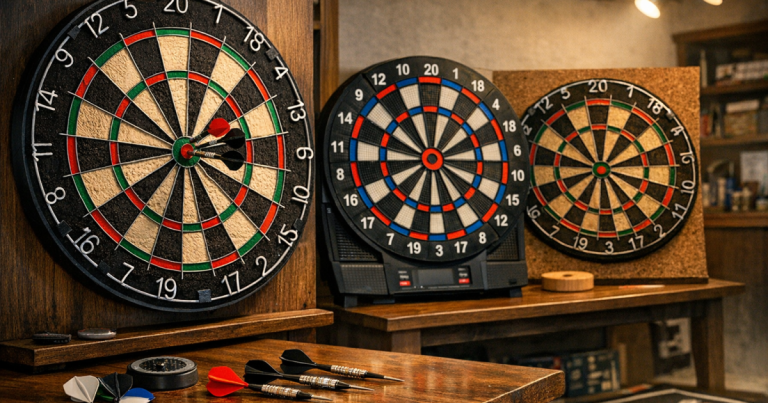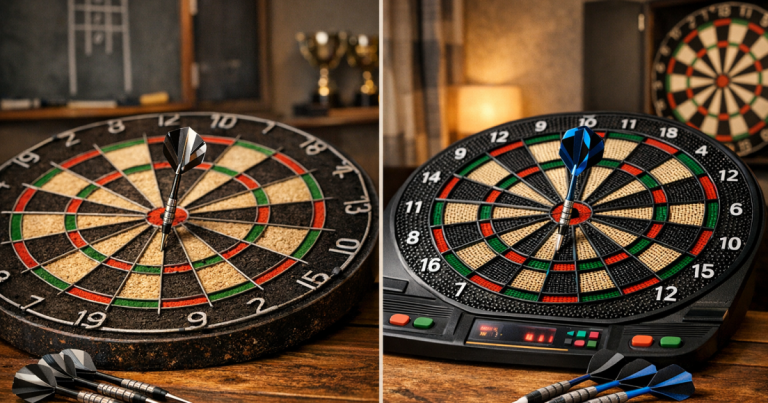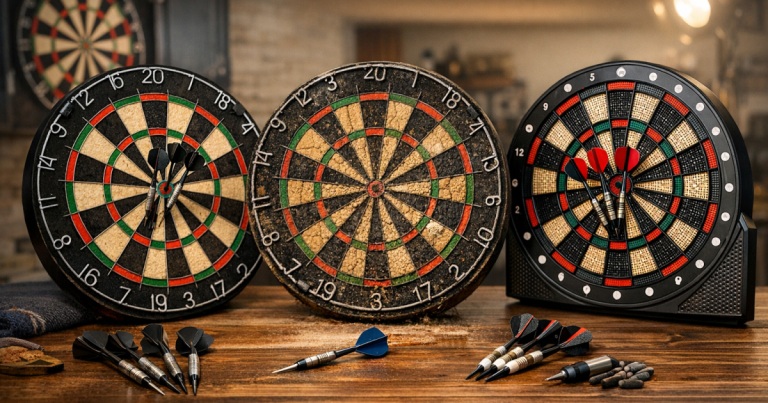
A dartboard looks simple from the oche, but every ring, wire and number has a job. Understanding dartboard anatomy helps you score faster, practise with more purpose and spot whether a board is wearing in the right places. It also makes setup decisions easier, because the way a board is built affects visibility, bounce-outs, rotation and how forgiving it feels during regular home play.
The short version
A standard steel-tip board is divided into 20 numbered wedge-shaped segments. Each segment has single scoring areas, a treble ring, a double ring and a shared centre made up of the outer bull and inner bull. The number ring sits around the outside and gives each wedge its value, while the wiring separates scoring areas and helps determine how cleanly darts land.
- The large wedge areas are singles and score the number shown on the outer ring.
- The narrow inner ring is the treble area and scores three times the segment number.
- The narrow outer ring is the double area and scores twice the segment number.
- The outer bull scores 25 and the inner bull scores 50.
- The number ring is usually removable so the board can be rotated to spread wear.
Segments: the 20 wedges that define the board
The main face of the board is split into 20 radial segments, running from the centre out towards the number ring. Each segment has the same number from the inner single area to the double ring, so a dart in the 20 wedge scores 20 unless it lands in the treble or double band.
The arrangement of numbers is deliberately unforgiving. High numbers sit next to low numbers, so a small error around the 20 bed can drop into 1 or 5. The same idea appears around other common targets: a dart drifting from treble 19 can end up in 3 or 7. That layout rewards accuracy rather than simply grouping darts near the top of the board.
The two larger single-scoring areas are easy to mix up when you are new to the board. The inner single area is between the bull and the treble ring. The outer single area is between the treble ring and the double ring. Both score the same value for that wedge; the difference is only their position.
Doubles, trebles and why the rings matter
The treble ring is the narrow band roughly halfway between the bull and the outer edge. It is the main scoring target in many legs because treble 20 scores 60, treble 19 scores 57 and treble 18 scores 54. Good grouping around a treble bed is often more valuable than chasing a single big number with no consistency.
The double ring is the narrow band at the outside of the scoring area. In common steel-tip formats such as 501, a leg is usually finished by landing a dart in a double. That is why players spend so much practice time on double 16, double 20, double 10 and double 8. These doubles appear often because they leave straightforward follow-up routes when a player misses inside or outside.
The outer edge also explains why board condition matters. If the double ring is badly worn, dried out or distorted, darts can struggle to enter cleanly. The same applies to heavily used treble beds. For a deeper look at materials, recovery and bounce-out behaviour, see our guide to comparing bristle dartboards for wear and bounce-outs.
The bullseye: two scores, one shared target
The centre of the board is not one scoring zone. It is made up of the outer bull and the inner bull. The outer bull, sometimes called the single bull, scores 25. The inner bull scores 50 and is treated as a double in many finishing situations. That is why a player on 50 can finish with the bullseye.
For casual home play, the bull is also a useful practice target because it encourages a straighter throw. Unlike treble 20, there is no neighbouring high-value wedge to save a slightly loose dart. You either hit the centre area or move into a low single. Short bull routines can therefore be useful for building control before switching back to trebles and doubles.
On some boards, the bull is held by wires or blade-style dividers. On others, the construction around the centre can feel more or less forgiving depending on how the metalwork is shaped. The important point is that the bull is both a scoring feature and a design feature: it needs to be visible, cleanly divided and not overly obstructive.
What the number ring actually does
The number ring tells you which value each segment carries, but it is not part of the scoring surface. A dart hitting the number ring itself does not score in normal steel-tip play. The scoring area ends at the outside of the double ring.
On many bristle boards, the number ring can be removed or loosened. This matters because bristle boards should be rotated periodically. When one area, usually the 20 bed, starts taking too much punishment, you rotate the board body so a fresher segment moves to the top, then replace the number ring with 20 at the top again. The numbers move back into the standard order while the physical wear is spread across the board.
Do not rotate the number ring by itself and leave the board face in the same position. That changes the scoring labels without moving the worn area, which defeats the purpose. The useful habit is simple: remove or lift the ring, rotate the board body, then refit the ring so the 20 is at the top and the black segment beneath it is correctly aligned.
Wires, blades and scoring boundaries
The thin dividers between segments and rings are what make the board readable. Traditional round wires and staple-fixed construction are more prominent, while modern blade-style wiring tends to create cleaner boundaries with less metal exposed. The shape, depth and finish of this wiring can influence whether a dart deflects, falls out or slides into the sisal.
This does not mean every bounce-out is caused by the board. Dart point condition, throw angle, worn sisal and crowded grouping can all play a part. Still, the wiring is one of the first things to inspect when a board starts feeling harsh or noisy. If you want the construction side in more detail, our explainer on dartboard wiring, staples, blades and scoring area design breaks down the differences clearly.
How the layout affects practice at home
Once you understand the board layout, practice becomes easier to structure. Instead of throwing randomly at the highest-scoring area, you can use the anatomy of the board to work on specific skills.
- Treble control: Aim at treble 20, treble 19 and treble 18 to practise small vertical and horizontal adjustments.
- Double finishing: Work around common doubles such as 20, 16, 10 and 8, then add less comfortable doubles so you are not relying on one route.
- Bull control: Use the bull for straight-line accuracy and to practise finishing on 50.
- Segment discipline: Practise moving between neighbouring segments, such as 20 to 1 to 18, so your throw does not fall apart when you adjust aim.
- Board reading: Call out scores before removing darts to build faster recognition of singles, doubles and trebles.
Lighting also changes how well you can read the board. Shadows across the treble or double ring make the boundaries harder to judge, especially in a spare room, garage or evening setup. If your board looks clear from one side but dull from the oche, the issue may be light direction rather than eyesight. Our guide to lighting a dartboard without shadows or glare covers the common fixes.
Common points of confusion
Is the bullseye worth 50 or 25?
The inner bull is worth 50. The outer bull is worth 25. People often use “bullseye” casually for the whole centre, but the scoring rules separate the two areas.
Does a dart in the outer black or cream area always score single points?
Yes, if it lands inside the scoring boundary and not in a double or treble ring, it scores the number for that segment. The colour does not change the score; the segment number and ring position do.
Why are the numbers not in order?
The numbers are arranged to punish inaccuracy. High values are placed next to low values, so a near miss can cost a lot of points. That is part of what makes darts so precise and tactical.
Does the number ring affect scoring?
No. It labels the segments but is not a scoring area. If a dart hits the number ring or lands outside the double ring, it does not count in normal steel-tip play.
FAQ
What is the most important part of a dartboard to practise on?
For scoring, the treble ring matters most. For finishing, the double ring matters most. A balanced routine should include both, with occasional bull practice for centre-line control.
Can I rotate any dartboard?
Most bristle steel-tip boards can be rotated, provided the number ring is movable. Some decorative, electronic or fixed-face boards may not rotate in the same way, so check the board design before forcing anything.
Why do my darts hit the wire so often?
It can be down to grouping, throw angle, worn points, prominent wiring or simple bad luck. If it happens constantly in one area, inspect the board face and rotate the board if the segment is heavily worn.
Is the treble 20 always the best target?
It is the highest single-dart scoring target, but it is not always the smartest choice. Depending on your ability and remaining score, treble 19, treble 18, a setup single or a preferred double route may be more sensible.
What to remember
The board is more than a circle of numbers. Singles build the base score, trebles create big visits, doubles finish legs and the bull offers a compact centre target with two different values. The number ring gives the layout its meaning, while the wiring and board material affect how cleanly darts land.
Once dartboard anatomy becomes familiar, scoring feels quicker and practice feels less random. You start to see the board as a set of useful zones rather than a flat target, which is exactly what helps a home setup become more enjoyable and more effective over time.