A dartboard can look excellent when it is new, yet still wear quickly or throw up frustrating bounce-outs once it is in regular use. Choosing between bristle dartboards is easier when you judge how the board should recover after repeated scoring, not just how neat it looks in the box.
The aim is not to find a board that never marks or never rejects a dart. It is to pick one with the right combination of sisal quality, wiring design, rotation potential and point compatibility for the way you play at home.
The quick comparison
- For wear: look at how tightly and evenly the playing surface is packed, whether the colours are cleanly defined, and how easy it is to rotate the number ring.
- For bounce-outs: compare the wire profile, bullseye construction, staple presence, and how your dart points interact with the board.
- For home use: consider how often you throw, whether several players use the same board, and whether you need extra wall and floor protection.
- For long-term value: a cheaper board may be fine for occasional practice, but heavy scoring around treble 20 usually rewards a board that recovers well and rotates easily.
Step 1: Judge the playing surface, not just the branding
The first wear check is the surface itself. A good sisal surface should look consistent across the scoring area, with no obvious soft patches, raised lumps or loose-looking fibres. Small colour variations are normal, but the board should not look patchy before it has been used.
Pressing the surface in a shop is not always possible, and online photos can be flattering. Instead, read the details carefully and look for close-up images that show the segment edges, bull area and outer doubles. If the product images only show a board from a distance, check independent photos or owner reviews before deciding.
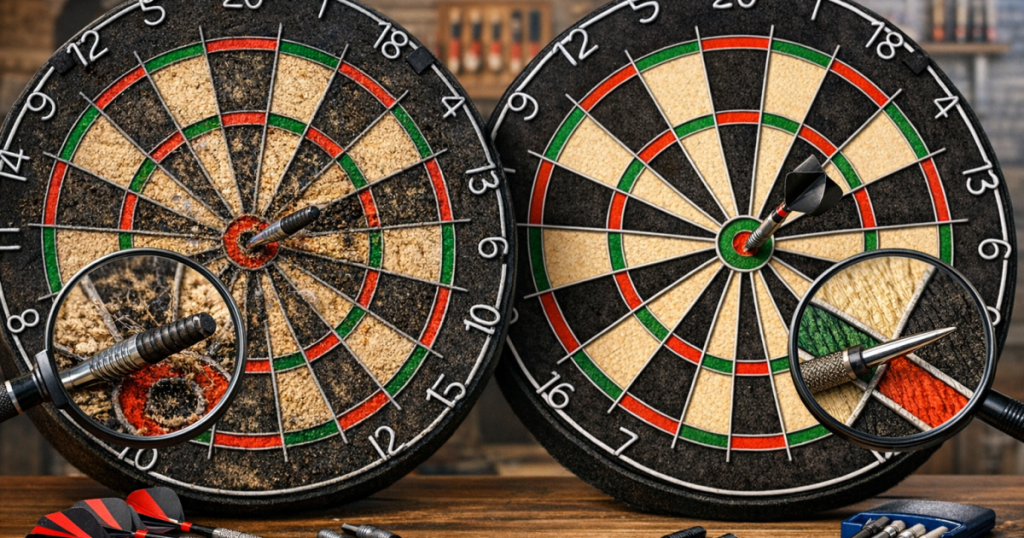
For regular home throwers, the key question is how well the board will close up after darts are removed. Every steel tip board will show wear eventually, especially around treble 20, treble 19 and the bull. Better recovery means the holes close more neatly, the surface stays playable for longer, and the dart is less likely to land in an already damaged patch.
Step 2: Compare wire design for bounce-out risk
Bounce-outs often happen when a dart strikes metal rather than sisal. That makes the wiring one of the most important comparison points. Rounder, thicker wires tend to present more metal to the dart. Slimmer or angled wiring is designed to guide darts into the scoring bed more cleanly, though no wire system can remove bounce-outs altogether.
Look closely at the main spider, the treble and double rings, and the bullseye. Some boards use visible staples to hold wiring in place, while others use staple-free or blade-style construction. If you want a deeper explanation of how those designs affect scoring space, the guide to dartboard wiring, staples and blade scoring areas is a useful next read.
When comparing real boards, treat products such as the Winmau Blade 6 Triple Core as examples of the premium end of the category and boards such as the Viper Shot King as examples of more budget-friendly options. Do not compare them by name alone; compare the wire shape, bull construction, surface finish and suitability for how often you actually play.
Step 3: Check how rotation will manage wear
Rotation is one of the simplest ways to extend dartboard life. Because most players concentrate scoring around the upper segments, the treble 20 bed usually takes the heaviest punishment. A movable number ring lets you rotate the board so a fresher section takes that workload.
When comparing boards, check whether the number ring is easy to remove and refit, whether it sits securely once moved, and whether the fixing system makes rotation awkward. If rotating the board feels fiddly, you are less likely to do it regularly, which means wear builds in one area faster than it needs to.
A good routine for a frequently used home board is to rotate before the most worn segment becomes visibly tired. Waiting until the treble bed is badly opened up is too late; rotation works best as prevention, not rescue.
Step 4: Match the board to your darts and points
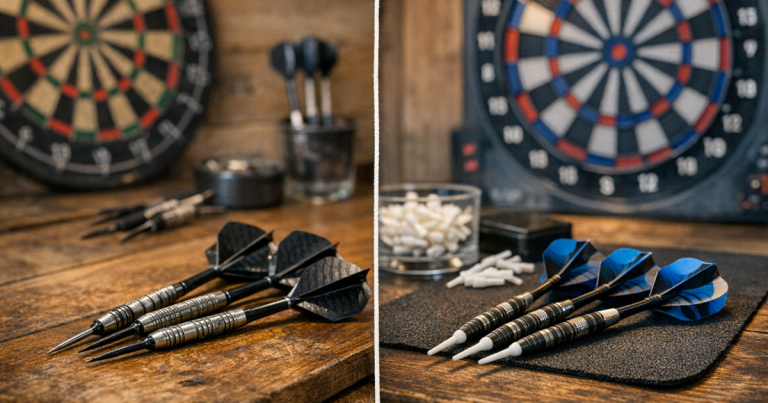
A board is only half of the bounce-out equation. Dart weight, throw angle and point condition all affect how cleanly the dart enters the sisal. Blunt, burred or damaged points can tear fibres rather than separate them, which speeds up visible wear. Very smooth points can also interact differently depending on the board surface and the player’s throw.
Before blaming the board, inspect your steel tips. Points should be straight, clean and free from rough damage. If you are thinking of changing points, check length, grip style and barrel compatibility rather than buying on appearance alone. The checklist on buying replacement steel tip points covers the compatibility checks worth making first.
If several people use the same setup, expect more variation. One player may throw flatter darts that sit high in the board, while another may throw with a steeper angle. That difference can affect grouping, deflections and how concentrated wear becomes.
Step 5: Read reviews with the right filter
Owner reviews can be helpful, but dartboard feedback is often shaped by playing frequency. A casual player using a board once a week may report excellent durability after months of use, while a daily practice player may see meaningful wear much sooner. Both experiences can be honest; they simply come from different workloads.
Look for reviews that mention throwing volume, rotation habits and the darts being used. A short comment saying “too many bounce-outs” is less useful than a review explaining whether the darts hit the wire, the bull, loose fibres or existing holes. Also be cautious with photos taken in harsh light, because shadows can make normal fibre movement look worse than it is.
Step 6: Set up the area so you can judge fairly
Poor lighting can make a good board feel worse than it is. If the wire casts heavy shadows, you may misread segment edges or assume the surface is more uneven than it really is. Even, glare-free lighting also makes it easier to spot wear early and rotate the board before damage concentrates in one place. For setup help, see the guide on lighting a dartboard without shadows or glare.
Wall protection and floor protection will not reduce bounce-outs, but they do make missed darts less stressful. If you are still refining your throw or sharing the board with newer players, allow for stray darts when planning the surrounding area.
Key checks before you buy
- Surface consistency: avoid boards that look uneven, loose or poorly finished in close-up images.
- Wire profile: slimmer or angled wiring usually gives the dart less metal to strike than older round-wire designs.
- Bull construction: check whether the bull area looks cleanly finished, as it takes concentrated impact during practice games.
- Staples: fewer exposed obstructions generally means fewer obvious metal contact points.
- Rotatable number ring: make sure rotation is simple enough that you will actually do it.
- Point condition: keep points clean and suitable for your barrels to avoid unnecessary tearing.
- Use level: occasional family games and daily scoring practice place very different demands on a board.
Common signs of normal wear versus a poor board
Normal wear
Small visible holes, light fibre movement and gradual fading around popular scoring areas are normal. If the board still holds darts reliably and rotation spreads the wear, it is doing its job.
Concerning wear
Large loose patches, fibres pulling away early, darts falling out of the sisal, or severe damage after light use are more concerning. Before writing the board off, check that the darts are not damaged and that the board has not been left in damp, unsuitable conditions.
Bounce-outs that are not the board’s fault
Some bounce-outs come from tight grouping, dart-on-dart contact or hitting the wire at an awkward angle. If bounce-outs mostly happen during close trebles, the issue may be normal deflection rather than a faulty board.
Helpful questions
Do more expensive dartboards always bounce out less?
Not always, but better boards often use wiring and finishing that reduce obvious metal contact. Your throw angle, point condition and grouping still matter.
How often should I rotate a home dartboard?
For regular practice, rotate before one treble bed looks heavily opened up. Light users can rotate less often, but waiting for obvious damage shortens the board’s useful life.
Can blunt points damage a bristle board?
Yes. Blunt or burred points can tear fibres instead of entering cleanly, which can worsen visible wear and make the board look tired sooner.
Is a staple-free board worth it for casual players?
It can be, especially if bounce-outs annoy you, but casual players may also be happy with a simpler board if the surface, rotation and price suit their use.
Main points
To compare bristle dartboards properly, look beyond the front-of-box claims. The best choice for your setup is the board that balances surface recovery, wire design, easy rotation and compatibility with the darts you already throw.
If you practise most days, prioritise durability and wire design. If you play occasional home games, a simpler board may be perfectly acceptable as long as it is well made and easy to rotate. Either way, regular rotation, clean points and sensible lighting will help you get a clearer view of real board performance.