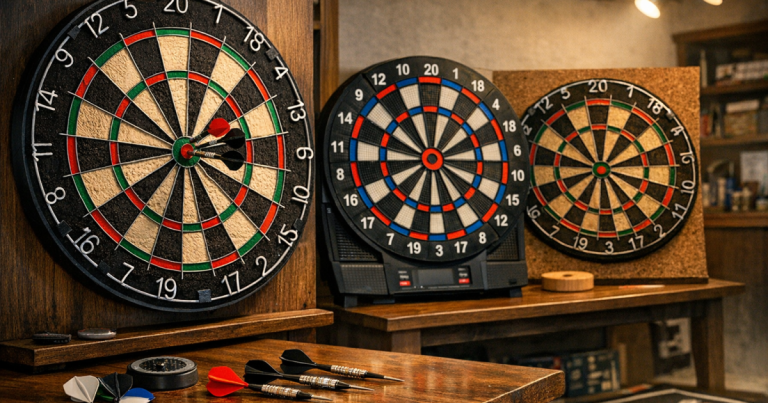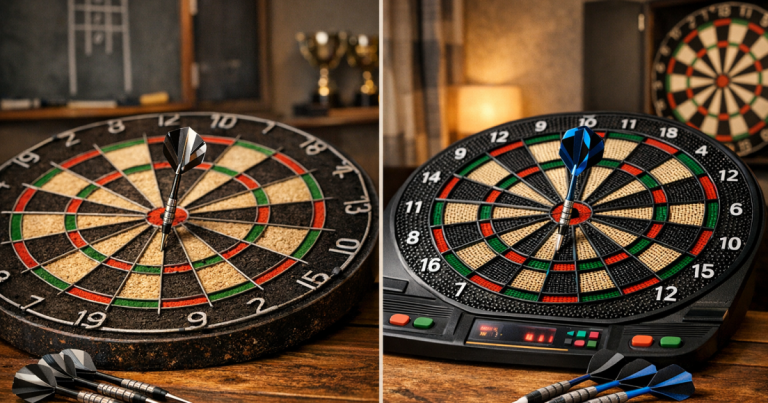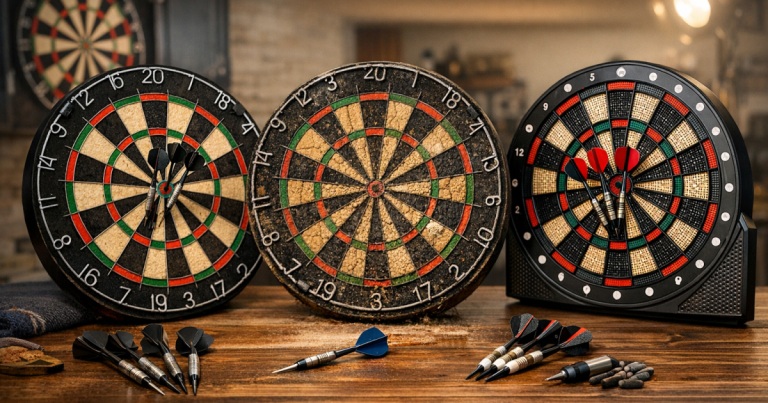
A dartboard’s spider does more than separate the beds. The way the metalwork is shaped, fixed and angled affects how cleanly darts land, how often they bounce out, and how long the scoring face stays readable. Understanding dartboard wiring helps you judge why two bristle boards can feel very different even when the numbers, colours and official dimensions look the same.
The short version
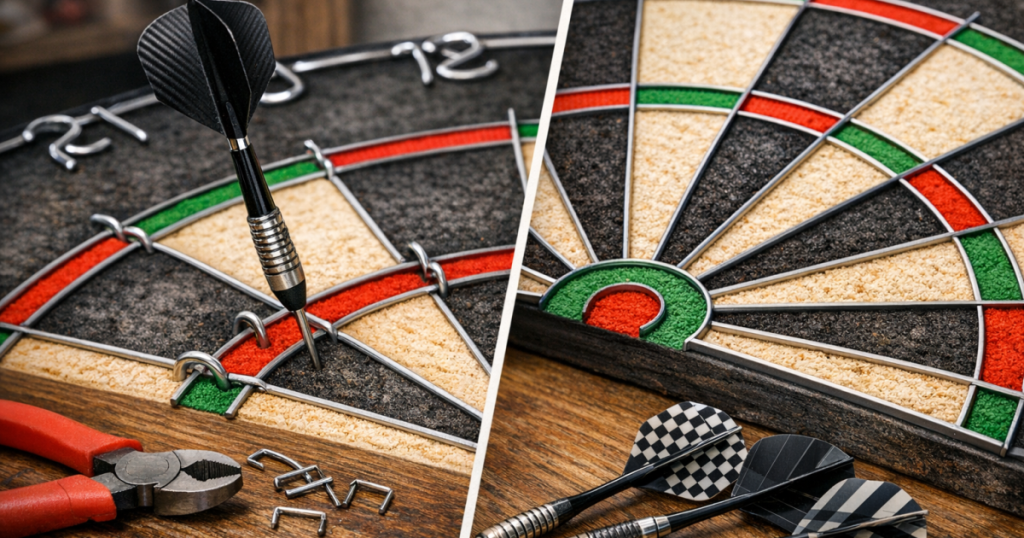
Traditional staple boards use round wire held to the face with visible staples. They are simple and familiar, but there is more metal for a dart point to hit. Modern blade-style boards use thinner, angled dividers that are usually embedded into the sisal, reducing exposed obstruction around doubles, trebles and the bull.
Neither design changes the scoring rules: a dart scores according to the bed it enters. The difference is how much metal sits between those beds, how the dart reacts when it catches that metal, and how tidy the board remains after regular home use.
What the spider is actually doing
The spider is the metal divider that splits the dartboard into numbered wedges and scoring rings. It marks the single areas, outer doubles, inner trebles, outer bull and inner bull. On a bristle board, the spider sits over or into the compressed sisal fibres, creating clean boundaries so that close darts can be judged consistently.
Good dartboard wiring has to balance three jobs: it must define the scoring areas clearly, stay fixed under repeated impacts, and take up as little target space as possible. If the metal is thick, rounded or lifted away from the face, it presents a larger obstacle. If it is too flimsy or poorly set, it can shift, rattle or leave unclear scoring edges.
This is one reason serious home players often notice the spider before they notice the printed graphics. A sharp-looking board is nice; a board that keeps the scoring beds clean and consistent is more useful over months of practice.
Staples: why older-style boards feel different
On a traditional staple board, the spider is usually made from round wire. Small metal staples hold that wire onto the face, including around key scoring areas. You can normally see the staple heads sitting on top of the board, particularly where the wires cross or curve.
The practical effect is simple: there are more hard surfaces for a steel tip to strike. A dart hitting a rounded wire may glance away because the point has no clean path into the sisal. A dart hitting a staple can also be knocked out or deflected into a neighbouring bed. Not every wire contact becomes a bounce-out, but the risk is higher than on a well-made blade system.
Staple boards can still be perfectly usable for casual play, practice games and social setups. The main compromise is tolerance. When you are aiming at trebles and doubles, especially from 2.37 m at the oche, a few millimetres of extra metal can matter. For a player trying to tighten grouping, the board can feel less forgiving.
Blades and knife-edge dividers
Blade-style boards use a thinner, angled metal divider. Instead of a rounded surface, the visible edge is narrower and shaped to guide a dart point into one side of the bed rather than presenting a blunt obstacle. Many modern bristle boards also avoid visible staples across the scoring face, so there are fewer interruptions around high-value targets.
A board such as the Winmau Blade 6 Triple Core is a recognisable example of the modern blade-board idea, although different boards vary in construction, finish and feel. The important point is not the name on the number ring; it is whether the divider system is thin, firmly set and aligned cleanly with the printed scoring beds.
Blade dividers do not make bounce-outs disappear. A blunt point, a steeply angled throw, a crowded treble bed or a board mounted with movement behind it can still lead to darts falling out. What they do is reduce one common cause: a dart meeting a raised, rounded or stapled piece of metal before it reaches the sisal.
How scoring area design affects real play
When people talk about wiring, they often focus on bounce-outs, but scoring area design is just as important. The spider defines the exact border between one score and another. If that border is thick or poorly aligned, close darts are harder to read and can become a source of arguments in home matches.
The most noticeable areas are the treble ring, the double ring and the bull. The treble 20 bed is narrow and heavily targeted, so a bulky divider around it gets hit often. Doubles sit at the outside edge of the board, where a dart can arrive at a slight angle, making wire shape more noticeable. The bull has several meeting points packed into a small space, so staple-free or cleaner inner construction can make the area feel less cluttered.
Scoring-bed clarity also matters as the board wears. Sisal fibres open and close with use, inks fade, and the most-used segments can flatten. A tidy wire system helps the board remain readable, but it cannot compensate for poor rotation habits or a board that has been left in damp conditions.
Staple, round-wire and blade systems compared
- Stapled round wire: Familiar and usually straightforward, but the raised wire and staples create more possible contact points. It can suit light use where occasional bounce-outs are not a major concern.
- Staple-free round wire: Removes some visible obstructions, but the rounded wire can still deflect darts more than a thinner angled divider.
- Triangular or angled wire: Designed to present a smaller face to the dart point. The angle can help direct the point into a scoring bed rather than back towards the thrower.
- Blade or knife-edge dividers: Generally the cleanest modern approach for reducing exposed metal across doubles, trebles and the bull. Build quality still matters, so look for neat alignment and a solid fit.
The difference is easiest to feel during repeated practice rather than one casual leg. If you throw a lot at treble 20, treble 19, doubles and bull routines, a cleaner spider system is more noticeable than it would be during relaxed party games.
Checks that matter on a home board
Start with alignment. Stand at the oche and look closely at the treble and double rings. The metal dividers should sit neatly between the printed beds rather than wandering across the colour blocks. Small cosmetic differences happen, but obvious misalignment can make scoring less clear.
Next, check whether the wire sits flat and secure. Raised sections are more likely to catch a point and can worsen over time. If the board rattles when darts land, the issue may be the mounting rather than the spider, so also make sure the board is fixed firmly and not moving on the wall or stand.
The surrounding setup matters too. A board fixed to a poor wall, at an awkward height or in a cramped position will not feel good even if the spider is excellent. If you are planning a new board location, it is worth checking how to choose the best wall for a dartboard before judging the board in isolation.
Finally, look at your dart points. A rough, burred or badly worn point can grip wire oddly, tear fibres, or increase awkward rebounds. If you are changing points, check length, profile, grip and barrel compatibility rather than treating all points as interchangeable. The notes on what to check before buying replacement steel tip points are a useful next step.
Why bounce-outs are not only a wiring problem
It is tempting to blame the spider every time a dart hits the floor, but several factors work together. A steep entry angle can make the point clip the wire rather than bite into the bed. Worn flights or loose shafts can change the way a dart lands. A board that has dried out, become uneven or been left in an unsuitable environment may not hold points as well as it should.
Rotation also matters. Turning the number ring and rotating the board spreads wear away from the most-used segments. On a home board, treble 20 and nearby beds take a lot of punishment. If you never rotate the board, the scoring face can become tired in one area while the rest still looks fresh.
Lighting can make wire contacts look worse than they are. Shadows across the treble ring can hide whether a dart is actually in the bed or sitting against a divider. Even, glare-free light helps you read close scores more confidently.
Cabinets, surrounds and the area around the spider
The wiring sits at the centre of the playing surface, but the board’s protection and presentation influence how enjoyable the setup feels. A cabinet frames the board and can hide wall fixings, while a foam surround gives missed darts somewhere safer to land. Neither changes the spider, but both help preserve the area around the scoring face.
For steel-tip darts, wall protection is not just about beginners missing the board. Bounce-outs and deflections can send darts into nearby plaster, woodwork or furniture. If you are building a tidy home setup, compare cabinet and surround materials so the board, backing and room finish work together.
When wiring quality becomes worth caring about
If you play once in a while, almost any sound bristle board can be enjoyable. Wiring becomes more important when you practise regularly, play longer formats, track averages, or care about clean scoring decisions. The more often you aim at narrow scoring beds, the more you notice the difference between a bulky spider and a cleaner blade-style layout.
It also matters if several people use the same board. Mixed ability groups create more stray darts and more impacts across the face. A robust, well-set spider helps the board stay playable, while good rotation keeps the wear pattern even.
For children or guests, the bigger priority is still the throwing area: clear space, safe retrieving habits, and a board mounted at the right height. Wiring improves play quality, but it does not replace sensible room planning.
Questions people ask
Do blade dartboards stop bounce-outs completely?
No. They reduce exposed metal compared with many traditional wire boards, but bounce-outs can still happen because of throw angle, worn points, crowded beds, board movement or tired sisal.
Are staples always bad on a dartboard?
Not always. Stapled boards can be fine for light casual use. The drawback is that staples add extra hard contact points, especially around busy scoring areas.
Does thinner wiring make the scoring areas bigger?
The scoring layout remains the same, but thinner dividers leave less metal between beds. In practice, that can make the target feel cleaner because more of the visible face is usable sisal.
Can I repair loose dartboard wiring?
For normal home players, loose or lifted wiring usually means the board is wearing out or has been damaged. Pushing metal back by hand can make scoring less consistent, so replacement is often the cleaner answer.
Why do darts bounce out of the treble 20 more often?
Treble 20 receives heavy traffic, so the bed wears faster and darts often arrive into a crowded area. Wire contacts, damaged fibres and tight grouping can all contribute.
Key takeaways
The spider is one of the most important parts of a bristle dartboard. Staples and round wire create more obstruction; blade-style dividers reduce exposed metal and usually give a cleaner experience around trebles, doubles and the bull. That does not make the board automatic or bounce-proof, but it does remove one common source of frustration.
For a better home setup, judge the wiring alongside the whole playing area: firm mounting, sensible wall choice, even lighting, board rotation, point condition and protection around the board. When those pieces work together, the scoring face feels clearer, the board lasts better, and practice is a lot more satisfying.