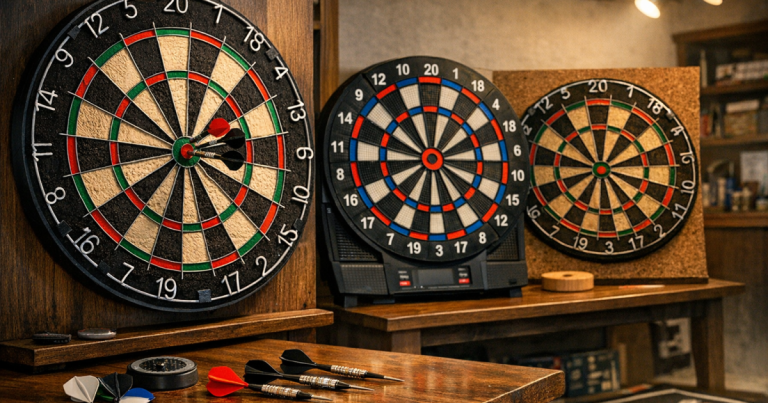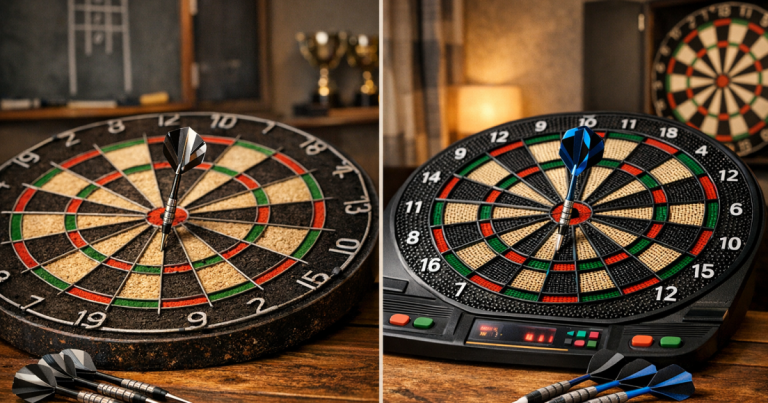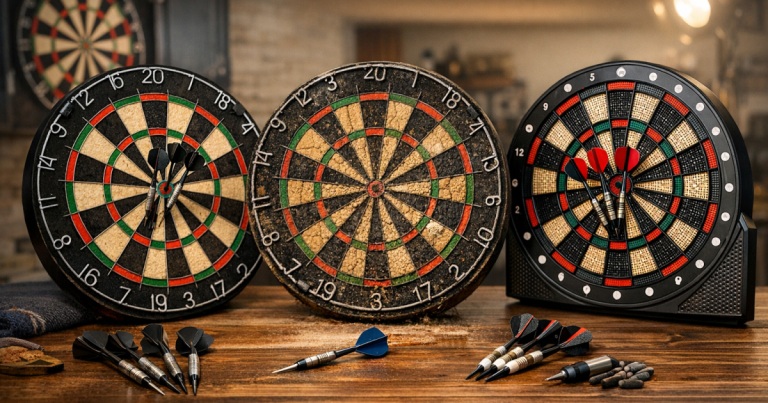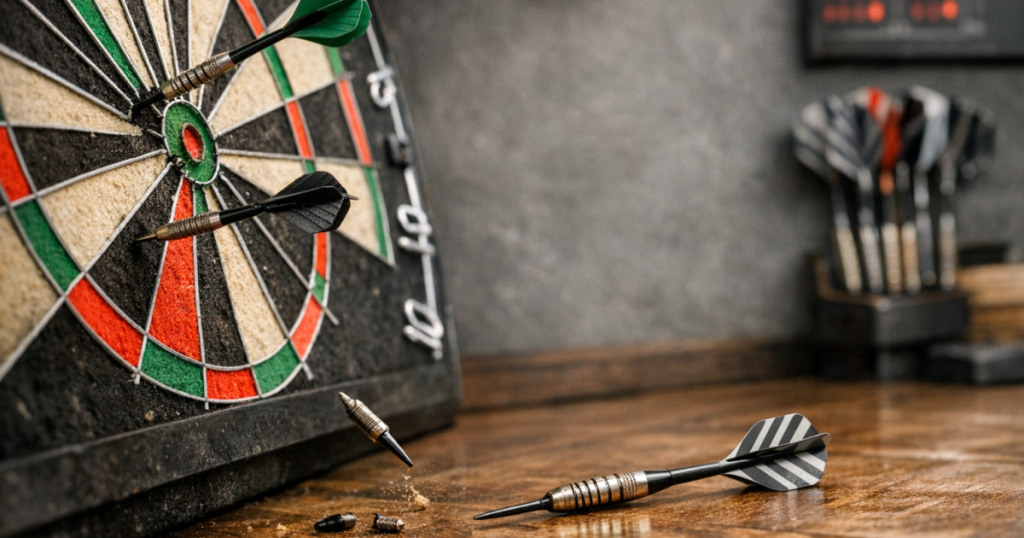
Few things spoil a home leg faster than a treble-bound dart clattering onto the floor. Dartboard bounce-outs are usually caused by a mix of wire design, board condition, dart angle, point grip and small setup errors rather than one single fault. The good news is that most causes are easy to identify once you know where to look.
In brief
- Most bounce-outs happen when the point strikes wire, a staple, a hardened sisal area or the side of another dart.
- Modern thin-wire bristle boards reduce deflections, but they do not remove the problem entirely.
- A board that is dry, heavily worn, swollen, poorly rotated or mounted loosely will reject darts more often.
- Smooth, blunt or damaged points can slide out instead of gripping the fibres.
- Correct height, oche distance and a stable board position make your throw more repeatable, which reduces avoidable deflections.
What actually happens when a dart bounces out?
A true bounce-out is not simply a dart missing the board. It is a dart that reaches the scoring area but fails to stay there. Sometimes it hits the spider wire and kicks back. Sometimes the point enters the sisal briefly, then drops because it has not gripped. At other times, the dart glances off a previous dart, catches a hard patch or lands at such an angle that the point cannot settle into the fibres.
That distinction matters because the fix depends on the cause. A dart that clips the wire every visit points towards aiming angle, grouping or board design. A dart that lands in the bed and then falls out suggests point condition, board wear or loose mounting. A dart that regularly drops from one part of the board may mean that area has become compacted or damaged.
Board design: why the spider matters
The metal dividers on a bristle board are necessary because they define the scoring beds, but they are also the most obvious bounce-out source. Older round-wire boards present a larger rounded surface to the incoming dart. When the point hits that rounded wire, it can glance away rather than slide past into the sisal.
Thin-blade or knife-edge wiring gives the dart a smaller obstruction. Instead of striking a rounded barrier, the point is more likely to deflect into one of the neighbouring segments. Staple-free construction also helps because there are fewer metal fixing points on the face of the board. This is one reason many home players notice fewer deflections when they move from a basic round-wire board to a modern blade-style bristle board.
Board construction still involves trade-offs. Very thin dividers can improve scoring-area access, but the whole board also needs consistent sisal density, a clean surface finish and a firm backing. For a deeper look at how the playing surface affects dart entry, see our guide to sisal quality, density and surface finish in bristle dartboards.
Sisal condition: the hidden cause many players miss
A fresh bristle board grips by allowing the dart point to part the sisal fibres. After the dart is removed, those fibres gradually close back up. Over time, repeated hits compress the busiest scoring areas, especially the 20, 19, 18 and bull sections. Once the fibres become too compacted, the point may not penetrate cleanly or may sit shallow and fall out.
Dryness can make this worse. In a centrally heated UK spare room, garage conversion or outbuilding, a board may become harder at certain times of year. Excess damp is not good either, because swelling, distortion and uneven drying can affect the face. A board does not need special treatment in normal home use, but it does need sensible conditions: keep it indoors, away from direct heat sources, away from persistent damp and out of strong sunlight.
Rotation is the simplest maintenance habit. If your number ring is removable, rotate the board regularly so the 20 segment is not always taking the heaviest punishment. Do not soak the board, spray it with water or try to “revive” it with home remedies. Modern sisal boards are made to be used dry, and adding moisture can cause more problems than it solves.
Dart points: sharp is not always the same as grippy
Point condition has a big effect on how well a dart holds. A point that is too smooth can slide out of the sisal, particularly if the board face is hard or polished from use. A point that is badly blunted may struggle to enter cleanly. A point with a burr or bent tip can damage the board and behave unpredictably.
There is a balance to aim for. You want the point to be clean and able to bite, not rough enough to tear fibres aggressively every time it is removed. Lightly textured or micro-grooved points can grip more positively, but they can also mark the board more if used carelessly. For many home players, the best first step is simply to inspect the points, remove obvious burrs and replace damaged ones when needed.
If you keep a small maintenance kit in your case, point checks become much easier. We have covered the usefulness of one compact option in our Viper dart repair tool kit review, including the sort of small adjustments that are handy between home matches.
Throw angle and dart setup
A dart that enters the board nose-first and at a stable angle is more likely to stay in than one arriving flat, sideways or tail-heavy. This is where stems, flights, grip position and release all matter. If your darts often land with the tail sharply down, the point may be levering itself out. If they land with the tail high, incoming darts may be more likely to strike barrels or flights already in the board.
You do not need to rebuild your entire setup after one bad visit. Look for patterns over several sessions. If one set of flights makes the dart land flatter, and another makes it sit point-up or point-down, you have useful evidence. Small changes to flight shape, stem length or grip position can alter the entry angle enough to reduce fall-outs, but changes should be tested one at a time.
Grouping also plays a part. As players improve, more darts are aimed into tighter areas, so collisions become more common. A dart that hits the flight, shaft or barrel of a previous dart may be knocked away even when the board is fine. That is not necessarily a fault; it is part of throwing tighter groups.
Setup errors that make bounce-outs more likely
Home boards are sometimes hung “about right” rather than measured properly. That can still be playable, but a small mismatch in height or distance changes your release feel and entry angle. The standard steel-tip setup is 1.73 m from the floor to the centre of the bull and 2.37 m from the board face to the oche. Measuring from the wall rather than the board face is a common mistake, especially with cabinets or thick backing panels.
If you want to reset your home layout, use our step-by-step guide on setting dartboard height and oche distance correctly. A consistent oche position matters because even a few centimetres of creeping forward or back can alter how the dart arrives at the board.
The board should also sit firmly against its mounting. If it rocks, rattles or tilts when hit, some energy is lost at impact and the dart may not bed in cleanly. Check that the centre screw, bracket and wedges or stabilisers are doing their job. A cabinet door, loose backboard or uneven wall surface can also introduce movement.
How to diagnose the cause at home
When bounce-outs start happening more often, avoid changing everything at once. Use a simple process over a few practice sessions:
- Mark the pattern: note whether darts are coming out of one segment, around the bull, near treble wires or across the whole board.
- Check the board face: look for compacted, shiny, swollen or badly frayed areas.
- Spin the board: rotate it if possible and see whether the problem follows the worn segment or stays in the same physical position.
- Inspect the points: compare all three darts for blunt tips, smooth polish, bends or burrs.
- Watch the entry angle: stand to the side after throwing and see whether the darts are sitting consistently or at awkward angles.
- Test the mounting: press the board gently at different points and check for rocking or loose contact.
If the same dart falls out more often than the others, the dart is the likely suspect. If any dart drops from the same tired scoring bed, the board is more likely to be the issue. If the problem mainly appears during tight grouping, collisions may be the explanation.
Fixes that usually make the biggest difference
The most effective fixes are often the least dramatic. Rotate the board, confirm the oche, stabilise the mount and tidy the dart points before assuming you need new equipment. These changes do not cost much time and they give you a clearer picture of what is really happening.
- Rotate regularly: move wear away from the 20 bed before it becomes severe.
- Remove darts carefully: twist gently as you pull rather than yanking straight out, which can lift fibres.
- Keep points clean: wipe away residue and deal with burrs before they damage the sisal.
- Stabilise the board: use the correct bracket and make sure the board sits flat.
- Measure the setup: check bull height and oche distance from the board face, not the wall.
- Adjust one dart variable at a time: change flights, stems or grip position separately so you can tell what helped.
If your board is heavily worn, no adjustment will fully restore it. A tired board may still be fine for casual practice, but persistent shallow entry, dead areas and frequent fall-outs are signs that the surface is past its best. Upgrading to a well-made thin-wire bristle board can reduce metal deflections and give a cleaner playing experience, provided the rest of the setup is sound.
Different explanations: board fault or player fault?
It is tempting to blame the board every time a dart lands on the floor, but the honest answer is usually mixed. A good board reduces avoidable deflections. Good points help the dart grip. A repeatable throw sends the point in at a usable angle. A stable home setup removes wobble and measurement errors. None of these factors works in isolation.
There is also a normal level of randomness in darts. Hitting a wire does not always mean anything is wrong. Even on a quality board, some darts will catch metal, collide with another dart or sit awkwardly. The aim is not to eliminate every bounce-out, because that is unrealistic. The aim is to reduce the ones caused by preventable setup and maintenance issues.
Things readers ask
Do heavier darts reduce bounce-outs?
Not automatically. A heavier dart may enter with more authority for some players, but point condition, angle of entry and board surface usually matter more. If the point hits wire, weight will not guarantee that it stays in.
Should dart points be very sharp?
They should be clean and able to grip, but needle-sharp points are not always ideal. Extremely sharp or rough points can damage fibres, while blunt or polished points can slide out. Aim for a tidy, consistent point condition.
Can a dart mat affect bounce-outs?
Indirectly, yes. A mat that creeps forward or sits unevenly can change your stance and release position. That can alter entry angle and grouping, even though the mat is not touching the board.
Why do bounce-outs happen more around the treble 20?
That area gets the most traffic in practice and match play. It combines heavy wear, tight grouping and nearby wire, so it naturally produces more deflections and shallow landings than quieter parts of the board.
Is an electronic board different?
Yes. Soft-tip electronic boards use plastic segments with holes, so bounce-outs are influenced by tip condition, segment design and how the board registers hits. The fixes are different from a steel-tip bristle setup.
Why it matters
Reducing dartboard bounce-outs is not about chasing a perfect, bounce-free board. It is about making your home setup fairer, more consistent and less frustrating. Start with the basics: a sound bristle surface, sensible rotation, clean points, correct measurements and a board that does not move on impact.
Once those are right, the occasional dart on the floor is easier to accept as part of the game. More importantly, you will know when a bounce-out is just bad luck and when it is your setup asking for attention.