Wall mounting is not always realistic: rented accommodation, solid brick you cannot drill into, plasterboard concerns, shared rooms and temporary practice spaces can all get in the way. A dartboard stand gives you a way to play at home without making permanent changes, but it still needs careful choosing if you want a safe, steady and match-like setup.
The best choice is not simply the first portable frame that fits your budget. You need to think about floor space, height adjustment, board support, wobble, storage, lighting, oche position and where missed darts will go.
At a glance
- Prioritise stability over compactness if the setup will stay in one place most of the time.
- Check that your bristle board, surround and any light ring can be supported safely together.
- Measure your throwing area before buying, not after the stand arrives.
- Allow space behind and beside the board for missed darts, rebound angles and people walking past.
- Choose a foldable or quick-pack option only if you genuinely need to move it often.
Start with the room, not the product
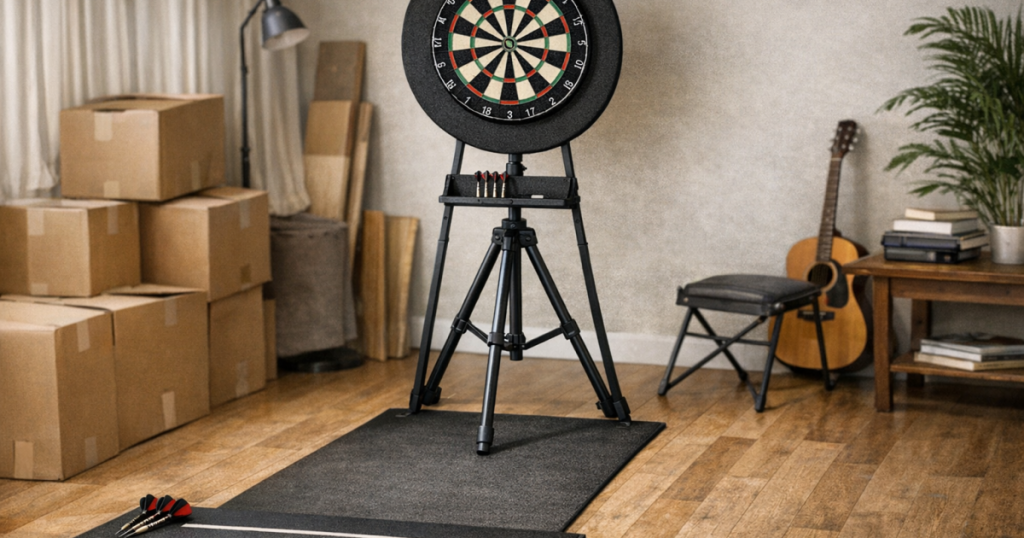
A dartboard stand is only useful if the room can still provide a proper throwing lane. Before comparing frames, mark out where the board face would sit, where the oche would land, and where players would stand between throws. A stand pushes the board away from the wall, so a room that just about works for a wall-mounted board may feel tighter once a freestanding frame is added.
Check the ceiling height, nearby doors, cupboards, radiators, TV units and furniture. Also think about how the stand legs spread on the floor. Some designs need more sideways room than they appear to in product photos, and the legs may clash with skirting boards or furniture if you try to tuck the setup into a corner.
If you are not sure whether the space works, use the same measuring process you would use for a fixed board. Our guide to checking throwing clearance before installing a dartboard is a useful next step because the clearance rules still matter with a freestanding setup.
Step 1: Decide whether it will be permanent or portable
There are two common buying mistakes here. The first is buying an ultra-portable stand for a setup that will actually stay in the same room all year. The second is buying a heavier, more awkward frame when you need to pack it away after every session.
For a semi-permanent home setup
Look for a stand that feels planted, has sensible board support and does not need constant repositioning. If it will live in a garage, spare room or dedicated darts corner, a slightly bulkier frame can be worth it because steadiness matters more than fast folding.
For a shared living space
Prioritise simple folding, manageable weight and quick board removal. The stand should be easy enough to move without dragging it across flooring or knocking the board against door frames. Also check the packed size, because a frame that technically folds may still be annoying to store behind a sofa or in a cupboard.
Step 2: Check board and accessory compatibility
Most buyers are fitting a standard bristle dartboard, but do not assume every accessory combination will work neatly. A bare board is one thing; a board with a surround, cabinet-style backing, light ring or extra protection can change the weight, depth and balance.
When comparing models, verify what the manufacturer says about compatible board types and mounting hardware. If you already own a board, check whether the rear bracket, fixing plate or centre screw arrangement will suit the stand. Do not rely on product photos alone, because small mounting differences can affect how securely the board sits.
Recognisable options such as the Winmau Xtreme 2 Dartboard Stand and Unicorn Dartmate Tri-Stand are often considered by home players, but you should still confirm current product details, included fixings and accessory compatibility before buying. Product ranges and bundles can vary by retailer.
Step 3: Make sure the height can be set accurately
A stand should let you position the bullseye at the correct playing height. Do not judge this by eye. Once assembled, measure from the floor to the centre of the bullseye and make small adjustments until it is right. If the adjustment points are limited, check whether the board can still sit correctly on your floor surface.
Carpet, thick rugs, uneven garage flooring and protective mats can all change the practical height slightly. That does not mean the stand is unsuitable, but it does mean you should test it where you actually intend to play.
Step 4: Think about wobble and rebound behaviour
No freestanding setup will feel exactly like a board fixed to a solid wall. The important question is whether movement is small and predictable, or distracting enough to affect scoring and confidence. Look for a wide footprint, solid locking points and a mounting area that holds the board firmly.
Wobble can also increase bounce-outs if the board shifts at impact or if the dart hits a wire at an awkward angle. If you are already struggling with darts falling out, it is worth checking your points, board condition and throwing angle as well as the stand. Our advice on reducing dart bounce-outs on a bristle board can help you separate equipment issues from setup issues.
Step 5: Plan the oche and floor area
The throwing line needs to be measured from the face of the board, not from the stand legs, wall behind it or back support. Because the board sits forward from the wall, you may need more usable room than expected. Mark the board face position first, then measure out to the oche.
A darts mat can make this easier because it protects flooring, marks the throw line and helps keep your stance consistent. Just make sure the mat does not interfere with the stand legs. For choosing the right footprint, see our darts mat size guide.
Step 6: Check what happens when you miss
A stand solves the no-drill problem, but it does not automatically protect the room. Missed darts can still hit plaster, doors, furniture, skirting boards or hard floors. If you are setting up near a wall, consider a surround or a larger temporary backboard behind the board area. If the setup is truly freestanding in the middle of a room, be more cautious: a missed dart has more space to travel before it hits anything.
Avoid placing the board where people might walk across the throwing lane, open a door into play, or pass behind the stand. Hallways, kitchens and through-routes are usually poor choices unless they can be made completely clear during play.
Step 7: Decide how much setup time you will tolerate
The best stand for you is one you will actually use. If it takes too long to unfold, level, position, measure and pack away, casual practice becomes less appealing. On the other hand, if you play several nights a week, spending a few extra minutes on a more solid setup may be worthwhile.
Before buying, picture your normal session. Will you carry it from a cupboard? Will the board stay attached? Will you need to move a coffee table every time? Will you have somewhere safe to put darts, flights and a scoreboard? These small workflow details often decide whether a portable setup feels convenient or irritating.
Useful buying checks before you order
- Footprint: Check the opened width and depth, then compare it with your actual floor space.
- Mounting method: Confirm that it suits your board and does not require parts you do not have.
- Height adjustment: Make sure the bullseye can be set accurately on your intended floor surface.
- Stability: Look for secure locks, firm joints and a shape that resists tipping or twisting.
- Storage: Check the folded size and whether you can move it comfortably through your home.
- Accessory load: Verify suitability if you plan to use a surround, lighting ring or backing panel.
- Room safety: Keep the throwing lane, side areas and space behind the board clear during play.
Common questions
Can a stand feel as solid as a wall-mounted board?
Usually not exactly, but a good one can be steady enough for serious home practice. The key is a firm frame, correct assembly and a floor surface that does not let the legs rock.
Can I use a cabinet with a freestanding setup?
Some players want storage doors and a scoreboard, but cabinets add depth and weight. Only use one if the stand manufacturer supports that kind of load and mounting arrangement.
Is a stand suitable for a rented flat?
Yes, provided you have enough safe throwing space and protect the surrounding area from missed darts. It is often a good option when drilling into walls is not allowed.
Should I leave the board attached when storing the stand?
Only if the design is intended for that and you can store it safely without strain on the fixings. Removing the board may be slower, but it can make storage easier and reduce accidental knocks.
Do I still need a surround?
In most home rooms, yes. A stand avoids wall mounting, but it does not stop missed darts from damaging nearby surfaces or bouncing onto hard flooring.
Key takeaways
Choose around your room first, then the stand. A stable frame with accurate height adjustment, enough floor space and safe clearance will beat a compact option that wobbles, crowds the oche or forces you to throw through a narrow gap.
For most home players, the right choice is the one that fits naturally into their routine: solid enough to practise properly, easy enough to set up regularly, and safe enough for the people and surfaces around it.