A dartboard can be mounted perfectly level and still feel awkward if the player has no room to stand, draw back and release cleanly. Checking throwing clearance before you install the board saves you from cramped footwork, blocked walkways, damaged walls and unsafe throws once the setup is in regular use.
The aim is simple: measure the board position, the oche distance, the player’s standing area, the swing space and the surrounding traffic routes before any drilling starts.
Safety note: The clearance checks here are for the darts layout itself; any new electrical work for lighting, switches or sockets around the board should be carried out by a qualified electrician to meet UK electrical safety requirements.
The short version
- Set the bullseye height first: for a standard steel-tip setup, the centre of the bull should be 1.73 m from the floor.
- Measure the oche from the face of the dartboard, not from the wall. The standard steel-tip distance is 2.37 m.
- Allow space behind the oche so the thrower can stand, step back and swap players without bumping furniture.
- Check side clearance for elbows, darts, cabinets, shelves, doorways and anyone walking past.
- Do a mock throw test before drilling, using tape on the wall and floor to simulate the board and oche.
Start with the board position
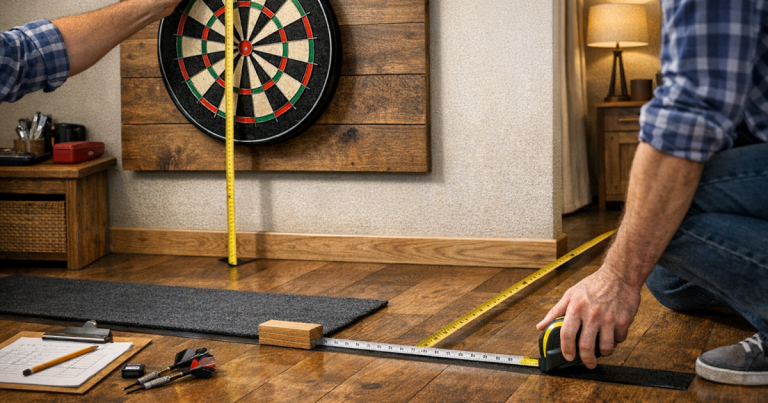
Before measuring the throw line, choose the likely board centre on the wall. Mark the bullseye point lightly with masking tape at 1.73 m from the finished floor surface. Measure from the floor where the player will stand, not from skirting, carpet pile or a raised mat edge.
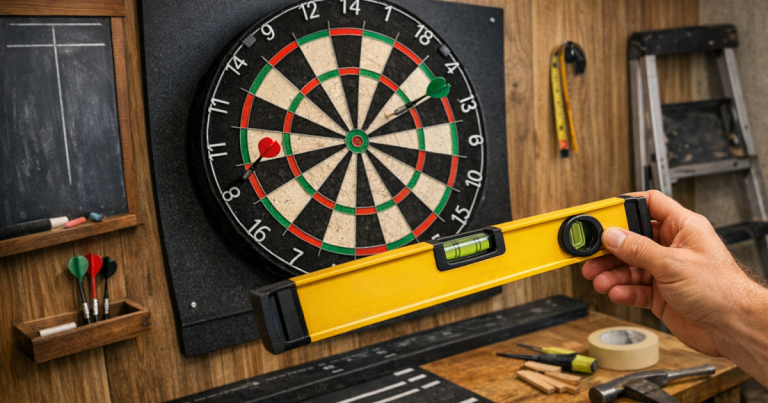
If the wall is uneven, panelled or has a picture rail, check whether the dartboard will sit flat once mounted. A board that leans, rocks or sits slightly off-centre can change the way the setup feels and make accurate measuring harder. If you are fitting a cabinet as part of the same setup, it is worth reading how to fit a dartboard cabinet without misaligning the board before you commit to the wall marks.
Also think about the area around the board. Avoid placing it directly beside windows, radiators, glass-fronted cupboards, TV screens or narrow door openings. Even accurate players miss the board occasionally, and beginners need more tolerance around the target.
Measure the oche from the board face
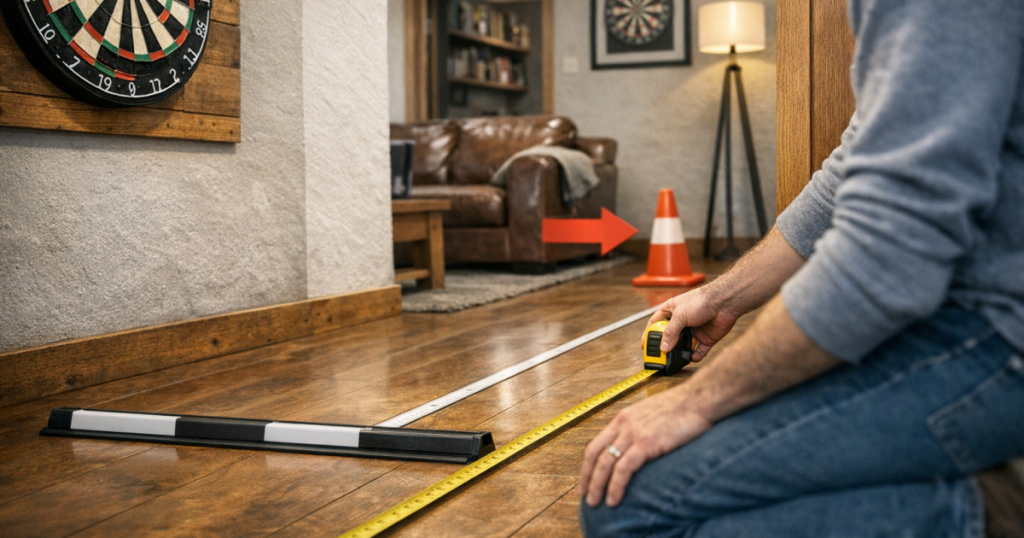
The key measurement for throwing clearance is the distance from the face of the dartboard to the oche line. For a standard steel-tip home setup, measure 2.37 m horizontally from the board face to the front edge of the throw line.
This is where many home setups go wrong. If you measure from the wall, you shorten the throw because the dartboard has depth. The simplest method is to temporarily hold the board against the wall, drop a plumb line or straight edge down from the board face, then measure out from that point along the floor.
You can also cross-check using the diagonal measurement from the bullseye to the oche, which is commonly given as 2.93 m for a standard steel-tip setup. The horizontal measurement is usually easier in a room, but the diagonal can reveal a mistake if the floor slopes, the board height is off or the tape measure was angled.
Allow room behind the throw line
The oche distance gets the rules right, but it does not automatically make the space comfortable. A thrower needs enough standing room behind the line to set their feet, lean naturally and step away between visits.
As a practical home check, stand at the marked oche and allow at least a comfortable step behind your back foot. More space is better if two people will be playing, if the setup is in a shared room, or if players will be passing behind each other during legs. A tight oche against a sofa, bed frame or garage shelving unit soon becomes irritating, even if the board distance is technically correct.
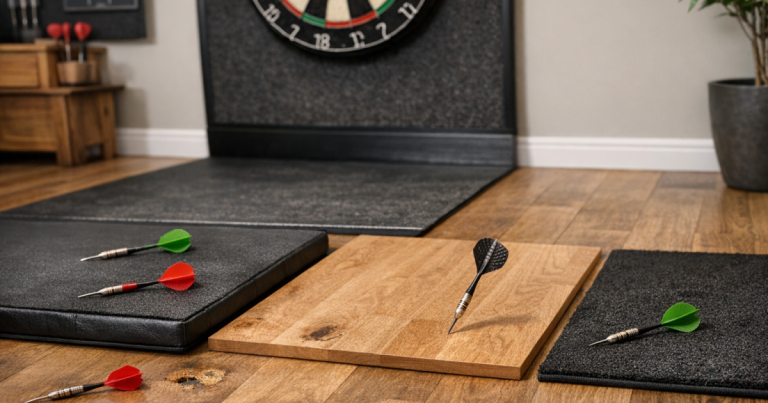
If you plan to use a mat, mark the mat position at the same time rather than treating it as an afterthought. Some mats have a printed oche line, while others need careful placement so the front edge matches your measured distance. For placement details, use the darts mat sizing and oche position guide alongside your room measurements.
Check side clearance for the throwing action
Side space matters more than many people expect. A player does not simply stand like a statue and move the forearm. Shoulders turn, elbows lift, and some players naturally drift slightly to one side of the oche depending on stance and dominant eye.
Mark the centre line from the bullseye to the oche. Then stand on the line and take several slow practice throws without a dart. Try your normal stance, then try a wider stance and a slightly angled stance. If your elbow feels close to a wall, cabinet side, bookcase, door handle or hanging coat, the setup is too tight for relaxed play.
For a single home player, you may be able to tolerate a slightly snug space if the throwing side remains clear. For family games, beginners or mixed right- and left-handed players, give the oche a wider usable zone. A setup that only works for one stance often becomes a problem as soon as someone else plays.
Watch for doors, walkways and shared spaces
The safest dartboard position is one where nobody needs to cross the flight path while darts are being thrown. That sounds obvious, but many homes have tempting walls at the end of a hallway, beside a kitchen door or in a through-room where people regularly pass behind the player.
Do a normal household traffic check. Ask where people walk when carrying washing, heading to the kitchen, entering from the garden or moving through the garage. If the answer is “straight across the throwing lane”, that location needs rethinking.
Hallways need particular care because they are narrow and often have doors opening into the throwing area. If you are considering one, read the dedicated advice on checking whether a hallway is safe for darts before treating it as a suitable shortcut.
Do a ceiling and obstruction check
Most standard rooms have enough ceiling height for darts, but low beams, sloping loft ceilings, garage door tracks and overhead storage can interfere with the throw. Stand at the oche and raise your throwing arm fully. Then mimic the release and follow-through. Nothing overhead should make you shorten the action or worry about hitting your hand.
Look beyond the player as well. Pendant lights, low lampshades, hanging plants and open cupboard doors can sit outside your direct eyeline but still affect the throwing rhythm. If you have to adjust your stance to avoid something above or beside you, the clearance is not really there.
Wall protection also plays into the clearance check. A surround, cabinet or backing panel adds width around the board. That is useful for missed darts, but it may bring the setup closer to shelves, switches or trim. Account for the full finished footprint, not just the board diameter.
Run a no-drill test before committing
Before you drill the wall, create a temporary version of the setup. Put a small tape marker where the bullseye will be. Mark the floor for the oche. If you are planning a mat, lay it down or use tape to show its footprint. If a cabinet, surround or backing panel is planned, mark its outer edges on the wall.
Then test the space in realistic conditions:
- Stand at the oche in your normal throwing shoes.
- Go through several full throwing motions without a dart.
- Have another person stand nearby as they would during a game.
- Open and close nearby doors, cupboards and garage access points.
- Check whether anyone naturally walks through the throwing lane.
- Look at the setup from the side to spot furniture or wall edges near the arm path.
If the test feels cramped without darts, it will feel worse during a game. Move the board position now, even if it means choosing a less visually neat wall. Playability and safety matter more than centring the board between pictures, shelves or furniture.
Example room checks
Spare room
A spare room often works well if the bed or desk does not sit immediately behind the oche. Check wardrobe doors, chair movement and whether guests will use the room without the darts area being cleared. A foldaway oche marker can help keep the room flexible.
Garage
Garages can provide generous length, but watch for bikes, tools, freezers, shelving and garage door mechanisms. The board wall should be stable, the floor should let you stand evenly, and the throwing lane should not cross the main route to stored items.
Living room
A living room setup can work if the board is not aimed towards seating, screens or walk-through areas. The common problem is furniture behind the oche. Make sure players can step back without hitting a coffee table, sofa arm or rug edge.
Hallway
A hallway may offer a tempting straight line, but it is rarely ideal unless it is wide, low-traffic and free from side doors. The main issue is not just the thrower’s arm; it is whether someone can appear suddenly in the line of play.
Mark the final layout clearly
Once the checks are complete, mark three final reference points: the bullseye centre on the wall, the board centre line down to the floor, and the oche position. Use masking tape until you are certain, then transfer the measurements carefully when fitting the bracket, cabinet or backing board.
If you are adding wall protection, confirm that it does not shift the apparent board centre or cover the fixing point. If you are using a cabinet, open the doors fully and check they do not hit shelves, pictures or adjacent walls. A good setup should be easy to use without rearranging the room every time you play.
Things readers ask
How much space do I need in front of a dartboard?
For standard steel-tip darts, measure 2.37 m from the face of the board to the front of the oche. You also need extra standing and stepping space behind that line, so the usable room length should be more than the official throw distance alone.
Can I measure the dartboard distance from the wall?
No. Measure from the face of the dartboard. Measuring from the wall shortens the throw because the board itself projects out from the wall.
Is a narrow room suitable for darts?
It can be, but only if the throwing action is clear for right- and left-handed players and nobody needs to pass through the throwing lane. Side clearance is just as important as length.
Should I install the board first and adjust the oche afterwards?
It is better to mark and test both before drilling. Once the board is fixed, moving it to solve a clearance issue means extra holes and more adjustment work.
Do I need a permanent oche?
No. A tape line, mat line or removable marker can work for a home setup, provided it is measured accurately from the board face and stays in the same position during play.
Main lessons
A good darts setup is not just about putting the bullseye at the right height. Check the full playing lane: board face to oche, space behind the thrower, side clearance, overhead obstructions, doors, walkways and the finished footprint of any mat, surround or cabinet.
The most useful test is also the simplest. Tape the layout, stand in the space, mimic real throws and watch how the room behaves around you. If it feels natural before installation, you are far more likely to end up with a dartboard area that is safe, comfortable and enjoyable to use.