A mat solves two home-setup problems at once: it gives you a repeatable toe line and it takes some punishment away from the floor. A good darts mat size guide starts with the board, not the mat, because the throwing distance is measured from the face of the dartboard rather than from the wall. Once that point is fixed, length and width become much easier to judge.
Main points
- The steel-tip throwing distance is 2.37 m from the face of the dartboard to the front edge of the oche line.
- The bullseye centre should be 1.73 m from the floor before you position the mat.
- A full-length home mat usually needs enough room to run from near the board area to beyond the thrower, not just to the toe line.
- Width matters for stance comfort and floor protection; many home players are better served by a stable medium or wide mat than the narrowest option that fits.
- Printed oche marks are useful, but they still need checking against your actual board position.
The measurement that controls everything
The oche is not measured from the skirting board, cabinet back panel or wall surface. It is measured horizontally from the face of the dartboard to the front edge of the throwing line. That small distinction is where many home setups go slightly wrong, especially when the board sits proud of the wall on a bracket, cabinet or surround.
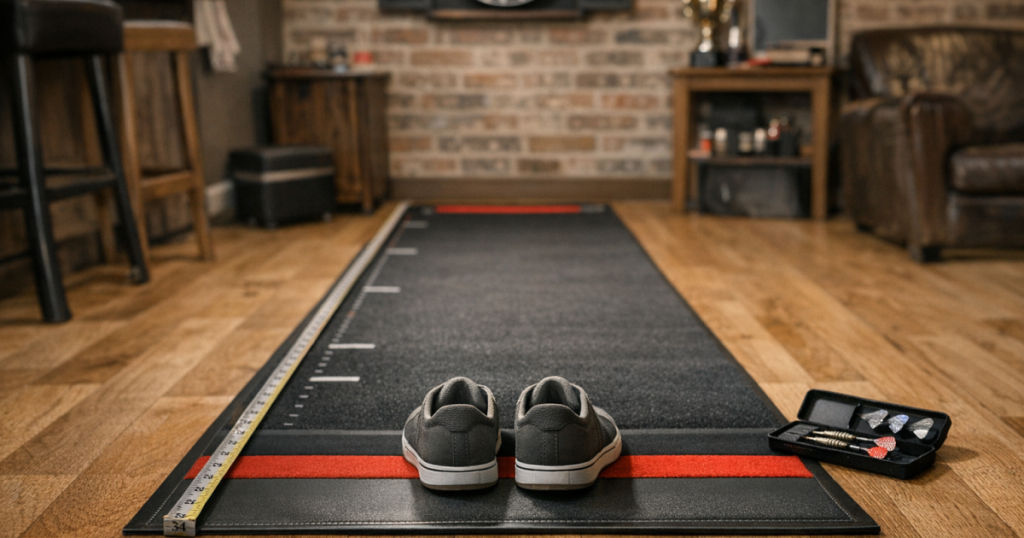
Set the board first. Check that the bullseye centre is 1.73 m from the floor, then find the point on the floor directly below the face of the board. A simple way is to hold a plumb line, tape measure or weighted string from the board face down to the floor. From that floor point, measure 2.37 m straight out into the room. That mark is the front edge of your oche.
The diagonal check is useful as a secondary confirmation. From the bullseye to the oche line, the diagonal distance is around 2.93 m for a standard steel-tip setup. It should not replace the horizontal measurement, but it can highlight obvious mistakes if your room shape or wall projection has made measuring awkward.
If you are still deciding whether a mat is enough or whether you want a raised toe stop as well, the difference is covered in more detail in our guide to a mat and oche setup.
How long should a darts mat be?
Length depends on what you want the mat to do. If the aim is only to show the throwing line, a short oche strip or compact mat can work. If the aim is to create a proper home playing lane and protect the floor where you stand, walk and retrieve darts, a longer mat makes more sense.
For most home setups, think in zones rather than just one headline length:
- Board-to-oche zone: from the board face to the throwing line is 2.37 m. A mat with a printed line needs to align with this, not with the wall by assumption.
- Standing zone: allow space behind the oche for your feet, balance and natural follow-through. Around 60 cm to 90 cm behind the line is helpful in many rooms.
- Approach and retrieval space: if the mat ends exactly at your heels, it may feel neat but not especially comfortable. A little extra depth makes the playing area feel less squeezed.
In a typical spare room, garage or converted corner, a mat around 3 m long is often the practical target because it can cover the playing lane and give some standing area behind the line. However, the exact fit depends on where the mat starts. A mat placed tight to the wall behind the board is not automatically correct, because the board face usually sits several centimetres forward of the wall.
If your room depth is tight, do not trim the throwing distance to make the mat fit. Keep the 2.37 m measurement correct and choose a shorter mat, a separate oche strip or a removable raised oche if that suits the space better. Accurate distance matters more than filling the floor neatly.
How wide should the mat be?
Width affects comfort more than many players expect. A very narrow mat may mark the oche correctly, but it can make the setup feel like a tight runway, especially if your stance is angled or you move slightly between darts. A wider mat also gives better protection to the floor around the throwing area, where shoes tend to pivot and scuff.
As a practical home guide, these width ranges are useful:
- Compact width, around 50 cm to 60 cm: suitable for narrow rooms, alcoves or occasional roll-out use, but less forgiving for angled stances.
- General home width, around 60 cm to 80 cm: a good everyday range for many players, giving a more natural standing area without taking over the room.
- Wide setup, around 80 cm to 100 cm: useful in garages, games rooms or shared setups where different players stand slightly differently.
There is no prize for choosing the widest mat possible if it causes furniture clashes or becomes a trip point. The right width is the one that lets you stand normally, step away safely and keep the throwing lane visually clear.
Positioning the oche line on the mat
The front edge of the oche line is the important point. If the mat has a printed toe line, your toes should stay behind that front edge. If you use a raised oche, the front face of the raised stop should sit at the 2.37 m mark. Do not measure to the centre of a thick strip or to the back edge of a block, as that can move the effective throwing point.
Printed mats can be convenient, but treat the printed marking as a guide to be verified. Before you rely on it, place the mat, measure from the board face to the front edge of the printed line and adjust the mat position. This is particularly important with cabinets, thick surrounds and wall-mounted board systems, because all of them can change how far the playing face sits from the wall.
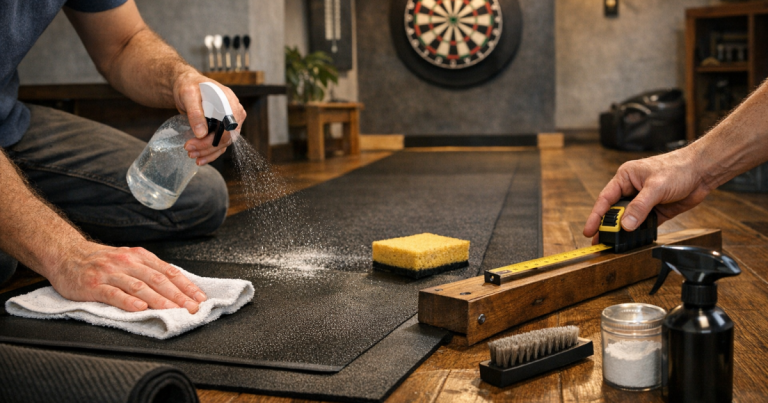
Once the line is correct, mark the mat position subtly if you roll it away between sessions. A small piece of low-tack tape on the floor beside the mat, or a note of the distance from a fixed feature such as a skirting corner, can save repeated remeasuring.
Room examples: what usually works
Small spare room
In a small spare room, depth is normally the limiting factor. Prioritise the correct oche distance, then use a medium-width mat if the door swing, desk chair or bed leaves enough clearance. If a full-length mat bunches against furniture, a shorter mat with a separate toe marker may feel cleaner and safer.
Living room corner
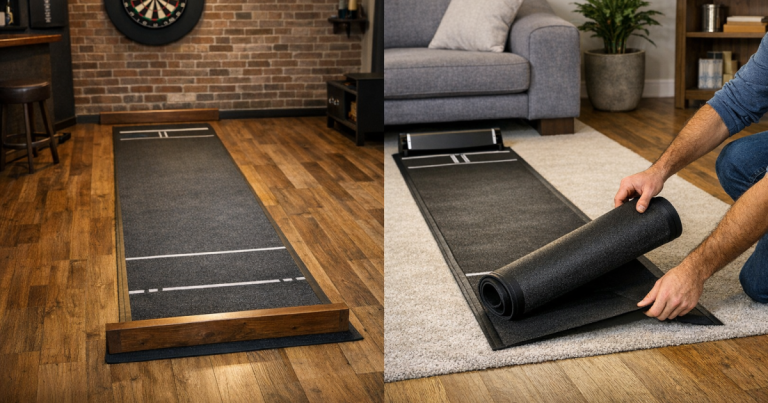
A living room setup often has to look tidy when not in use. A roll-out mat works well if it lies flat quickly and does not creep on hard flooring. Keep the oche line easy to recheck, because moving the mat in and out can slowly shift it away from the correct distance.
Garage or outbuilding
Garages usually offer more depth, so a longer and wider mat can help define the playing lane. On concrete floors, comfort and grip matter, so check that the underside of the mat suits the surface. If darts are landing near the base of the wall or you want extra impact protection around the board area, our notes on rubber gym flooring tiles behind a dartboard explain where that material helps and where it does not.
Hallway or narrow landing
Hallways can give enough length but limited width. A narrow mat can work, but only if the thrower is not forced into an unnatural stance. Also think about household traffic. A mat that sits across a walkway can become annoying even if the measurements are technically correct.
When the board, wall or cabinet changes the setup
A mat cannot correct a badly positioned board. If the board is not level, sits off-centre in a cabinet or has shifted on its bracket, the oche line may look wrong even when the tape measure says it is right. Before blaming the mat, check the board height, rotation and alignment.
The board face also needs to be your reference point every time. A thin backing board, cabinet door frame or surround can all make the wall-to-oche distance misleading. Measuring from the wall is tempting because it is easy, but even a few centimetres can be enough to make practice feel inconsistent.
If the board itself looks slightly tilted or the number ring never seems to sit square, sort that before finalising the mat. The process in our guide to fixing a dartboard that sits slightly crooked is a useful next step before you mark any permanent floor positions.
Mat thickness, edges and floor feel
Size is not only length and width. Thickness and edge shape affect how the mat behaves in the room. A thicker mat can feel more substantial underfoot and may offer better floor separation, but it can also create a more noticeable edge. A thinner mat is easier to roll away and may sit more discreetly, but it needs to stay flat enough that players are not catching their toes on curled corners.
On hard floors, look for a setup that resists sliding when you plant your front foot. On carpet, check that the mat does not wrinkle, creep or develop waves. The mat should feel boring in the best possible way: no movement, no distracting edge and no need to adjust your stance around it.
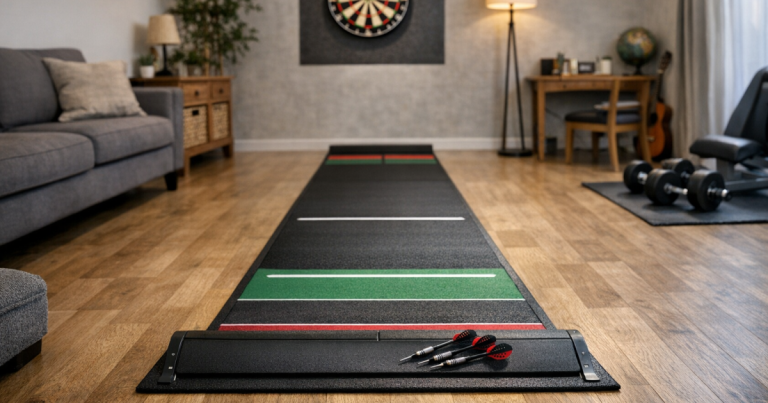
If you use a raised oche on top of a mat, confirm that it stays square to the board and does not drag the mat forward over time. The front edge of that oche remains the key reference point, so any movement changes the throw.
Common sizing mistakes
- Measuring from the wall instead of the board face: this is the classic home setup error and can make the line too far back or too close.
- Trusting a printed line without checking it: printed markings are helpful, but board projection varies between setups.
- Choosing a mat that is too short behind the oche: the line may be correct, but the thrower ends up standing partly off the mat.
- Ignoring width: a narrow mat can suit a neat room but feel restrictive once different players use it.
- Letting the mat creep: if the mat moves during play, the oche position changes with it.
Common questions
Can I put the oche line directly on the floor instead of using a mat?
Yes. A floor mark or raised oche can work perfectly if the measurement is correct. A mat simply adds floor protection, visual alignment and a more defined throwing area.
Should the mat start at the wall or under the dartboard?
It can start wherever it sits neatly, but the oche line must still be 2.37 m from the dartboard face. Do not assume the mat is correct just because one end touches the wall.
Is a wider mat better for beginners?
Often, yes. A medium or wider mat gives beginners more freedom to find a comfortable stance without stepping off the edge, while still keeping the toe line clear.
Does mat thickness change the dartboard height?
If you stand on a noticeably raised mat, the effective floor level under your feet changes slightly. In most home setups this is minor, but for a precise setup, measure board height from the same floor level you stand on.
What is the simplest way to check my setup?
Confirm the bullseye is 1.73 m high, drop a line from the board face to the floor, then measure 2.37 m out to the front edge of the oche. That sequence avoids most mistakes.
Key takeaways
The best mat size is the one that supports a correct, comfortable and repeatable throw. Start with the board face, place the oche at 2.37 m, then choose enough length for your standing area and enough width for your natural stance. A full-length mat can make a home setup feel more polished, but accuracy comes from the measurement, not from the mat itself.
Before settling on a permanent layout, throw a few short practice visits from the marked line, check that the mat does not move, and make sure the room still works for everyday use. A tidy setup that is easy to reset will get used far more than one that is technically perfect but awkward to live with.