Getting dartboard sizes right is not just about buying a board that looks the part. The height, throwing distance, bull position and free space around the board all affect how natural your throw feels. A board can be perfectly good, but if it is hung too high, measured from the wall instead of the face, or paired with a vague throw line, your practice will not match a proper game.
The short version
- A standard steel-tip bristle board has a familiar 1 to 20 numbered layout with the 20 at the top and the bull in the centre.
- The bull should be 1.73 m from the floor for standard standing play.
- The steel-tip oche should be 2.37 m from the face of the dartboard to the front edge of the throw line.
- The diagonal check from the bull to the oche is about 2.93 m and is useful for confirming your setup.
- Soft-tip electronic darts commonly use the same bull height, but the throwing distance is often 2.44 m. Always check the rules for your board or league.
What size is a regulation dartboard?
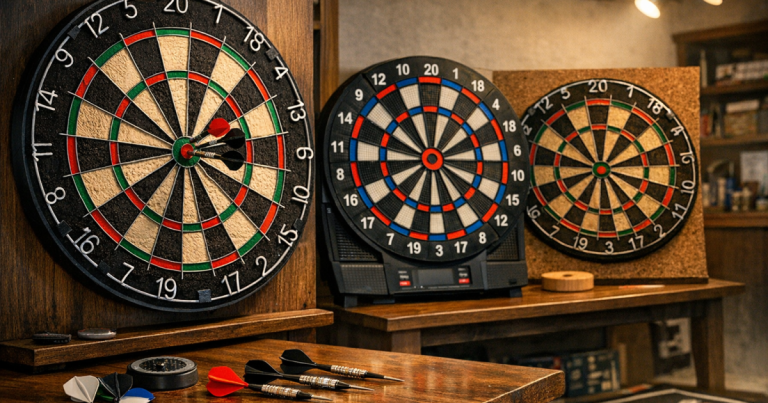
For normal steel-tip darts, the recognised competition-style board is a round bristle dartboard with a playing layout divided into 20 numbered segments. The standard overall board diameter is usually around 451 mm. Within that, the scoring area is defined by the doubles, trebles, singles, outer bull and inner bull.
The key point for a home setup is that the visible board size is only part of the story. The regulation experience comes from the relationship between the board face, the bull height and the oche position. A board that is hung neatly in a cabinet but measured from the skirting board, wall surface or cabinet frame can still be wrong in play.
If you are choosing between bristle, paper-wound and electronic boards, it helps to understand how the board type affects the playing surface, noise, durability and dart compatibility. The wider background is covered in our dartboard buying guide.
Regulation height: where the bull should sit
For standard standing steel-tip darts, the centre of the bull should be 1.73 m above the floor. Measure to the exact centre of the bull, not to the top, bottom or outside edge of the board. This is the measurement that most directly affects sight line, arm angle and repeatability.
Use the floor at the throwing area as your reference point. In many UK homes, especially older houses, floors can be slightly uneven. If your board is mounted on one wall and the player stands on a mat, rug or raised flooring, measure from the surface your feet will actually stand on. A thick mat can make a small but noticeable difference if you set the board height before placing it down.
For wheelchair darts, different height rules can apply. A commonly used accessible setup places the bull lower than standard standing play, but exact requirements depend on the organisation, event or league. If you are setting up for formal accessible competition, use the rules from the relevant governing body or organiser rather than guessing from a casual home layout.
Oche distance: the measurement that causes most mistakes
For steel-tip darts, the standard throwing distance is 2.37 m from the face of the dartboard to the front edge of the oche. The phrase “from the face” matters. If you measure from the wall, cabinet backboard or surround, your line may end up too close, because the board projects forward from the wall.
The front edge of the oche is the limit. A player may lean over it, but their foot should not cross it during the throw. If you use tape on the floor, the front edge of the tape should be the measured line, not the centre or back edge. If you use a raised oche, measure to the player-facing edge that the toe touches.
A dart mat can make this much easier because the throw line is already marked and the floor gets some protection from bounce-outs. If you are unsure how to line one up accurately, see our guide to choosing a dart mat that sets the right oche.
Using the diagonal measurement as a cross-check
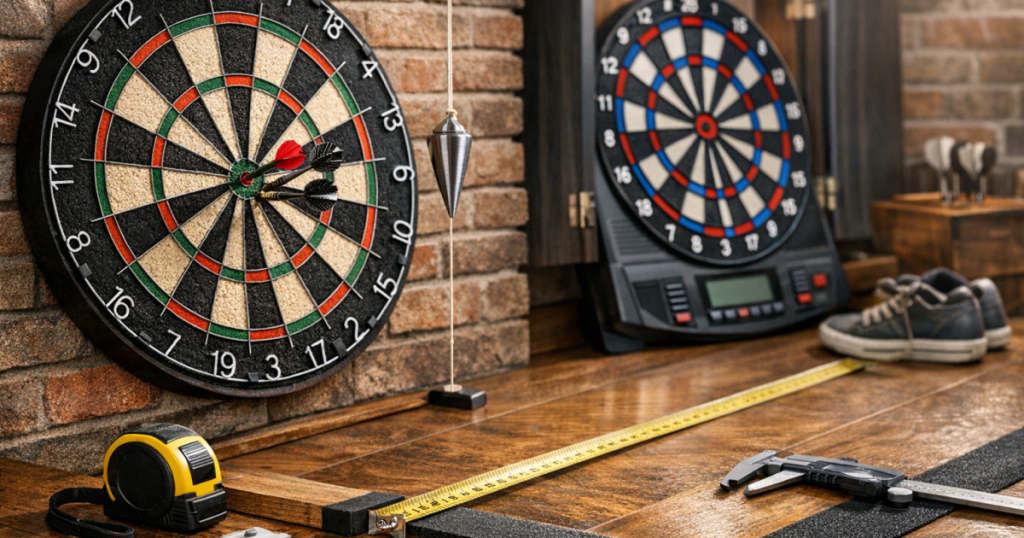
Once the bull height and oche distance are set, the diagonal measurement from the centre of the bull to the front edge of the oche should be about 2.93 m for a standard steel-tip setup. This is not a replacement for measuring the height and distance properly, but it is a useful confirmation.
The diagonal check is especially handy when the board is already on the wall and you want to confirm whether the throw line is correct. Hook the tape measure at the centre of the bull and pull it down to the front of the oche. If the figure is noticeably off, recheck whether the line was measured from the wall rather than the board face, or whether the bull height has drifted during mounting.
Steel-tip, soft-tip and youth setups
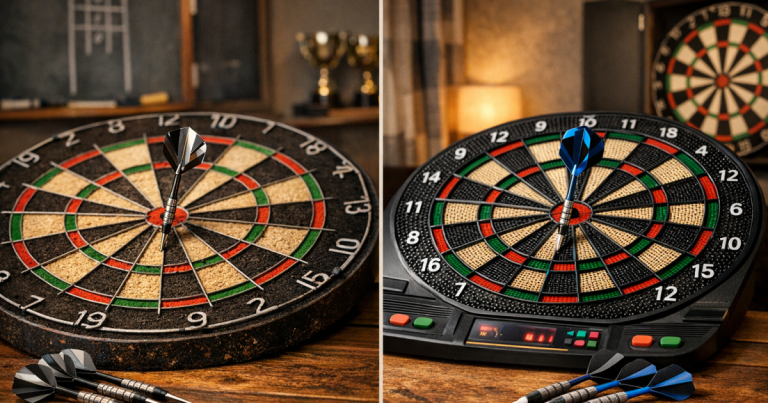
Not every dartboard follows the same setup rules. Steel-tip bristle boards are the standard for pub-style and most traditional home darts in the UK. Soft-tip electronic boards often use plastic-tipped darts and may use a different throwing distance, commonly 2.44 m. The bull height is often the same as standard steel-tip play, but electronic board manufacturers and leagues can specify their own rules.
Children and beginners may start closer to the board for comfort and confidence, but it helps to be clear whether you are creating a learning distance or a regulation setup. If the long-term aim is to practise properly, mark the standard line as well as any shorter temporary line. That way, the room is ready for both casual games and more serious practice.
For very small rooms, do not squeeze a board in if the player has to twist, throw around furniture or stand partly in a doorway. A technically correct distance is not much use if the stance is unsafe or cramped. You need enough space to stand squarely, retrieve darts comfortably and keep bystanders clear of the throw path.
Important board measurements at a glance
- Bull height for standard standing play: 1.73 m from floor to bull centre.
- Steel-tip oche distance: 2.37 m from the board face to the front edge of the throw line.
- Steel-tip diagonal check: about 2.93 m from bull centre to the front edge of the oche.
- Soft-tip oche distance: often 2.44 m, but check the board, venue or league rules.
- Standard board diameter: commonly around 451 mm for a competition-style bristle board.
- Inner bull diameter: commonly 12.7 mm on regulation-style steel-tip boards.
- Outer bull diameter: commonly 31.8 mm on regulation-style steel-tip boards.
How much wall and floor space do you need?
For the board itself, leave enough room around the scoring area for a surround, cabinet doors or backboard without interfering with doubles. A surround should protect the wall, but it should not overlap the scoring segments or make darts deflect awkwardly near the outer ring.
For the throw area, allow more than just the measured 2.37 m. You need room behind the oche for a relaxed stance, a player waiting their turn and safe movement when retrieving darts. In a typical spare room, garage or converted corner, the most common issue is not the board diameter; it is the length of usable floor space from the board face to beyond the oche.
Ceiling height rarely causes a problem in normal rooms, but sloped ceilings, low beams and garage doors can interfere with taller players or higher follow-throughs. Check the actual throwing motion before committing to a permanent fixing point.
Mounting details that affect the measurements
A board should sit flat and secure, with the 20 segment at the top. The hanging bracket, centre screw or mounting plate should hold the board without wobble, because even a slight tilt can make the measurements feel wrong and cause the board to rotate unevenly.
If you are fixing into masonry, choose fixings that suit the wall and the weight of the board, cabinet or backing panel. For more detailed wall-specific guidance, our article on mounting a dartboard on a brick wall explains the practical steps and common mistakes.
Remember that cabinets and backboards can change the distance from the wall to the board face. If you install a cabinet first, then hang the board inside it, take the oche measurement only after the board is in its final position.
Common measuring errors to avoid
- Measuring from the wall: the oche distance should start from the board face, not the wall behind it.
- Using the bottom of the board as a height reference: always measure to the centre of the bull.
- Marking the wrong edge of the oche: the front edge nearest the board is the measured limit.
- Ignoring thick flooring or mats: measure from the surface the player actually stands on.
- Letting a surround cover the scoring area: protection is useful, but the doubles must stay clear.
- Assuming soft-tip and steel-tip are identical: many soft-tip setups use a longer throw distance.
Common questions
Is every bristle dartboard regulation size?
No. Many full-size bristle boards are made to competition-style dimensions, but not every board is intended for formal play. Check the stated diameter, segment layout and bull dimensions if regulation practice matters to you.
Do I measure the oche from the wall or the board?
Measure from the face of the dartboard to the front edge of the oche. Measuring from the wall usually makes the throwing distance too short.
Can I use a shorter distance at home?
Yes, for children, casual games or limited mobility, a shorter distance can make sense. Keep it clearly separate from your regulation mark so practice distances do not get mixed up.
What height should the dartboard be in a garage?
The bull should still be 1.73 m from the standing surface for standard play. Check that the floor is level and that garage doors, storage and lighting do not interfere with the throw.
Are soft-tip dartboards measured the same way?
The bull height is often the same, but the throwing distance is commonly 2.44 m. Always follow the electronic board or league instructions for the format you are playing.
Main points
A proper home darts setup starts with three measurements: bull height, oche distance and the diagonal check. For standard steel-tip play, set the bull at 1.73 m, place the throw line 2.37 m from the board face, and use the 2.93 m diagonal as confirmation. Once those are right, the board size, surround, cabinet, mat and room layout can all work together instead of quietly throwing your practice off.