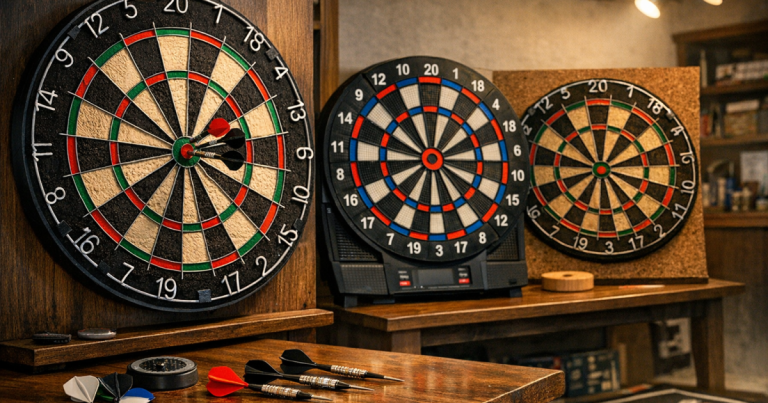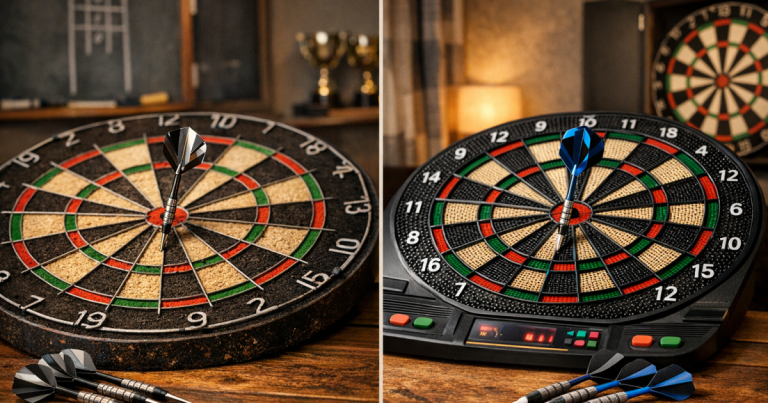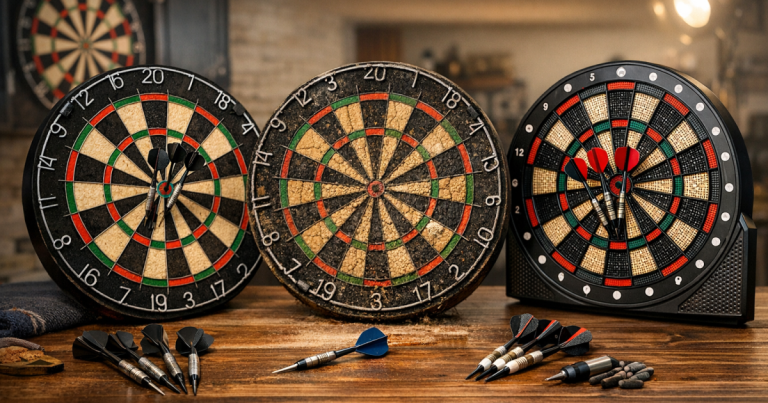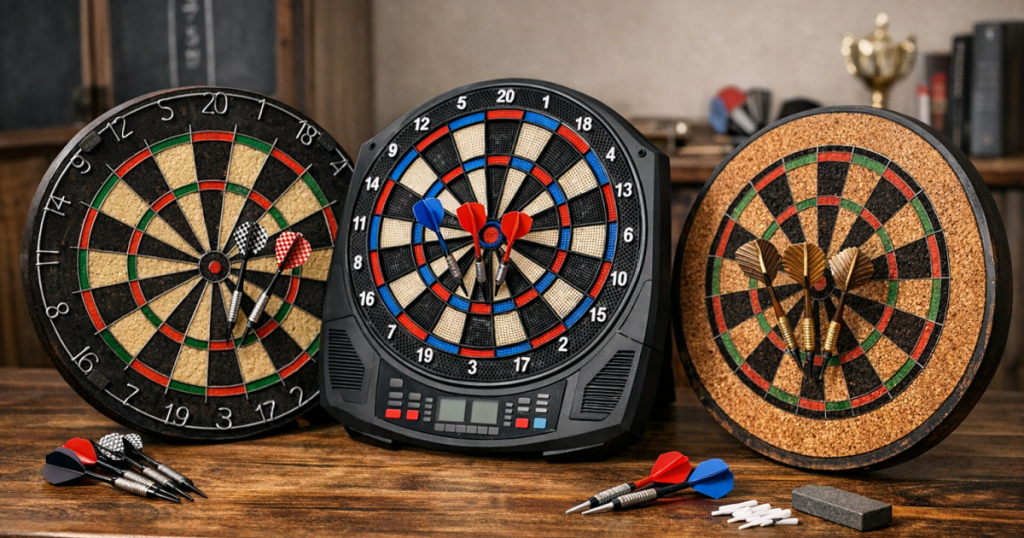
A good home darts setup starts with the board, but the right choice depends on more than whether it looks professional. This dartboard buying guide compares the main board types, materials and features so you can match the board to your room, throw style and practice goals.
Any mains electrical work for dedicated dartboard lighting should be carried out by a qualified electrician to comply with UK electrical safety requirements and relevant standards.
At a glance
- Bristle boards are the standard choice for steel-tip darts and serious home practice.
- Electronic boards suit soft-tip darts, automated scoring and more casual family play.
- Paper or coiled boards are usually budget-friendly, but they wear more quickly and feel less consistent.
- Material quality affects how cleanly darts enter, how well holes recover and how long the board remains usable.
- Your surrounding setup matters too: cabinet, lighting, wall protection, floor protection and oche position can change how enjoyable the board is to use.
The main dartboard types explained
Bristle dartboards
Bristle boards are made for steel-tip darts and are the most familiar option for a home practice area. The playing surface is usually made from compressed sisal fibres, which separate when a dart lands and then close back up after the dart is removed. That self-healing behaviour is the reason a good bristle board can cope with regular use.
For most adult players wanting to practise standard 501, doubles, trebles and finishing routines, a bristle board is the natural starting point. It gives the right board layout, dart feel and scoring discipline. It also works with typical pub-style setups, so your home practice translates well when you play elsewhere.
Recognisable examples include Winmau Blade 6 Triple Core at the premium end and Nodor Supawire 2 Bristle Dartboard for a more straightforward home-practice option. Rather than choosing on brand alone, check the wiring, bullseye construction, number ring, mounting system and whether the board is easy to rotate.
Electronic dartboards
Electronic boards use soft-tip darts and plastic scoring segments. Their main appeal is convenience: they can count scores, offer built-in game formats and reduce the need for manual arithmetic. They can also be friendlier in mixed households where younger players or casual guests are involved.
The trade-off is feel. Soft-tip darts do not land like steel tips, and the segmented surface can produce a different rhythm. Segment durability, missed-score behaviour, sound level and display readability are worth checking carefully. If you mainly want to improve for steel-tip league or pub darts, an electronic board can be fun, but it should not be your only practice surface.
Paper, cork and coiled boards
Budget boards are often made from wound paper, cork-like composites or similar lower-cost materials. They can be fine for occasional games, a spare room where use is light, or a temporary setup. The limitation is longevity: holes tend not to close as neatly, the surface may harden or break down, and bounce-outs can become more common as the board ages.
If someone is just trying darts for the first time, a simple board can make sense. If you already know the board will be used weekly, a better bristle board is usually the more satisfying route.
Materials that matter
Sisal quality is the key material factor on a bristle dartboard. A dense, even surface helps darts land cleanly and gives the board a more consistent feel across the scoring areas. Poorer surfaces can show clumping, soft patches or visible separation, which may affect scoring confidence over time.
The spider, or wire system, is another important part of the board. Thinner wiring gives darts a better chance of entering the scoring bed rather than striking metal. Staple-free bullseyes and cleanly embedded wires can help reduce deflections, although no board removes bounce-outs entirely.
The number ring should be easy to remove and rotate. Regular rotation spreads wear around the board, particularly away from the treble 20 bed. If you are trying to understand what separates a long-lasting board from a frustrating one, the deeper breakdown in what makes a quality dartboard for home practice is a useful next step.
Features worth checking before you choose
- Wiring profile: Look at how prominent the wires are and whether the bull area uses staples. Lower-profile wiring can make the board feel less punishing on tight groupings.
- Surface consistency: Check for an even playing bed, tidy printing and no obvious raised or sunken areas.
- Rotation: A movable number ring makes routine rotation much easier and helps extend usable life.
- Mounting hardware: Confirm what is included and whether it suits your wall. Some players prefer a cabinet or backboard to make mounting neater.
- Noise: Bristle boards are usually quieter than many electronic boards, but wall construction, cabinet depth and room acoustics all affect perceived noise.
- Space requirements: A standard steel-tip setup needs the bullseye at 1.73 m from the floor and the throwing line 2.37 m from the face of the board.
How the board fits into a home setup
A dartboard does not perform in isolation. In a typical UK home, the deciding factor is often the room: a spare bedroom, garage, dining room corner or garden office can all work, but each has different limits. You need safe clearance around the throw, sensible lighting, somewhere for darts and accessories, and protection for the wall and floor.
A cabinet can tidy the area, hide the board when not in use and provide storage for darts, chalk or a scoreboard. It is not essential, but it can make a shared room feel less like a permanent practice zone. If you are planning that route, read what to check before buying a dartboard cabinet before assuming every cabinet will suit every board and wall.
Floor protection also matters. A darts mat can define the oche, protect flooring from dropped darts and make the setup feel more repeatable. For measurements, mat thickness and throw-line placement, the guide to a good darts mat and oche setup covers the practical details.
Bristle, electronic or budget board: which makes sense?
- Choose a bristle board if you use steel-tip darts, want realistic practice and care about improving accuracy on standard scoring areas.
- Choose an electronic board if automated scoring, party games or soft-tip play matter more than matching pub-style steel-tip conditions.
- Choose a budget paper or coiled board only for light use, first-time experimentation or a temporary space where longevity is not the priority.
- Choose a better-quality bristle board if you practise several times a week, rotate the board regularly and want a surface that stays consistent for longer.
There is no single correct board for every home. A serious home thrower in a dedicated spare bedroom will usually value a bristle board, stable mounting and glare-free lighting. A family setup in a multipurpose room might value safer soft-tip play and automatic scoring. A casual player in rented accommodation may care most about simple mounting, wall protection and low commitment.
Common mistakes that lead to regret
The first mistake is buying the board without thinking about the wall. A quality board mounted in a cramped, shadowy corner will still be annoying to use. Measure the throw distance, check ceiling height, look at where people walk through the room and make sure doors, furniture and radiators are not in the throwing path.
The second mistake is overlooking maintenance. Bristle boards need rotation, clean dart points and sensible storage conditions. Leaving a board in a damp garage, throwing with damaged points or hammering the same segment without rotating will shorten its life.
The third mistake is choosing an electronic board for steel-tip improvement. Electronic scoring is convenient, but if your main goal is better doubles and trebles with steel tips, the practice surface should match the game you play.
Common questions
What is the best dartboard type for home practice?
For most steel-tip players, a bristle dartboard is the best home-practice type because it matches standard darts conditions and gives a realistic landing feel.
Are electronic dartboards worth it?
They are worth considering for casual play, families and soft-tip games. They are less ideal if your main goal is to practise steel-tip darts seriously.
How long should a bristle dartboard last?
It depends on use, rotation, dart condition and room environment. Regular rotation and clean, undamaged points help the board stay usable for longer.
Do I need a cabinet for a dartboard?
No, but a cabinet can help with storage, presentation and wall coverage. Check board depth, door clearance and wall fixings before buying one.
Can I use steel-tip darts on an electronic board?
No. Electronic boards are designed for soft-tip darts. Steel tips can damage the plastic segments and are not suitable for that surface.
What to remember
A good dartboard choice starts with how you actually play. Steel-tip practice points towards a bristle board with a consistent sisal surface, tidy wiring and a rotatable number ring. Casual soft-tip games point towards an electronic board with clear scoring and durable segments. Occasional use may justify a simpler board, but it should be seen as a short-term or light-use choice.
The most useful dartboard buying guide is not just about the board itself. It also accounts for the room, lighting, wall protection, floor protection, noise and whether the setup encourages you to practise regularly. Get those basics right and the board becomes part of a reliable home darts space rather than just something hung on a wall.