A good home setup protects the wall, keeps the room tidy and makes practice feel more deliberate. For many UK players, dartboard cabinets and surrounds are the simple upgrade that turns a board on a bare wall into a proper throwing area without rebuilding the room. The right choice depends less on style and more on how you use the space: casual family games, league-style practice, a shared spare room, or a compact garage setup.
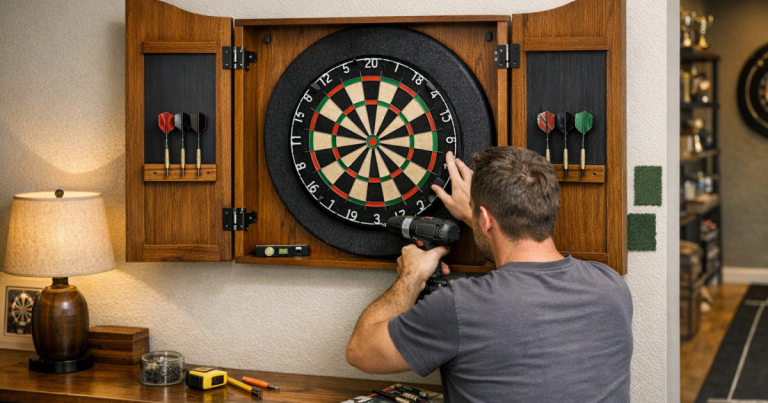
Wall drilling, cabinet mounting and fixing into masonry, plasterboard or studwork should be carried out by a competent person using suitable fixings, with checks for concealed cables and pipes to meet UK safety requirements and building standards.
The short answer
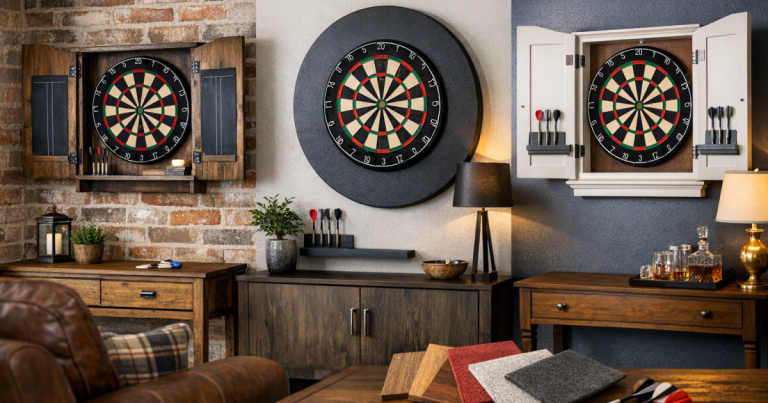
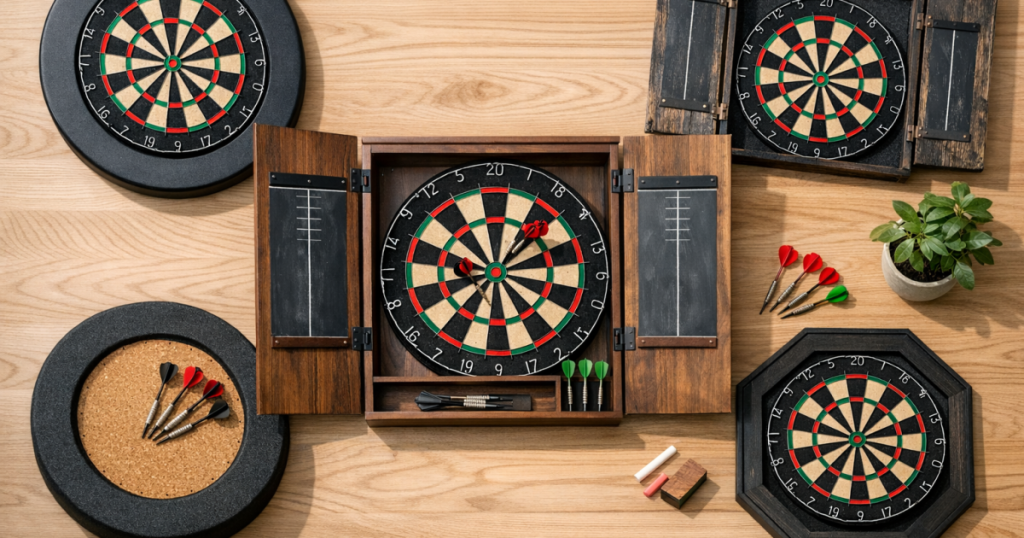
A cabinet is the neater, more furniture-like route. It hides the board when not in use, usually gives you somewhere to keep chalk, marker pens or spare flights, and can make a darts area look more at home in a lounge, dining room or spare bedroom. A surround is the more practical protection route. It sits around the dartboard and catches stray darts before they mark the wall, which is especially useful for newer players, family games and high-volume practice.
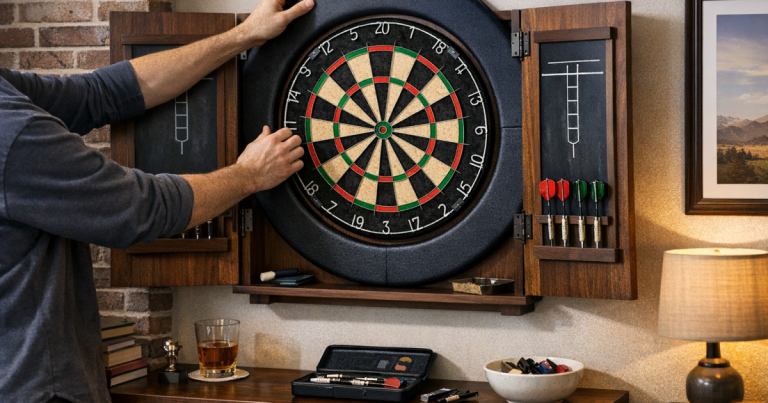
Plenty of UK home setups use both: a cabinet for appearance and storage, plus a slim surround or backing panel where the room needs extra protection. That combination is not always necessary, but it can make sense if the board is in a multipurpose room and you want fewer visible scuffs.
If you are still deciding between a traditional steel-tip board and an electronic option, it is worth reading our guide to bristle and electronic dartboards for UK home players, because the board type affects the cabinet, surround and fixing choices around it.
How cabinets change the feel of a setup
A dartboard cabinet gives the board a defined home. Rather than looking like a temporary item hung on a wall, the whole area starts to feel intentional. That matters in UK homes where the board often shares space with shelving, gym kit, a sofa, a workbench or a dining table.
The most useful cabinet features are usually simple. Doors keep the board covered when it is not being used. Interior score panels help with casual legs, round-the-clock games and practice routines. Small shelves or slots can keep spare stems, flights, chalk or a marker pen close to the board instead of scattered across the room.
Cabinets do add width and depth, so check the door swing before committing to a position. A cabinet that opens into a light fitting, curtain, shelving unit or garage door track quickly becomes annoying. In tight spaces, measure the cabinet open as well as closed. Also remember that some cabinet scoreboards are easier to write on than others; if you often play 501 at home, clear scoring space is more useful than decorative detailing.
Where a surround earns its place
A surround is less about display and more about damage control. It fits snugly around a standard sisal board and creates a soft outer ring to catch missed doubles, deflections and loose darts. For shared homes, rented properties and freshly painted walls, that protection is often the difference between relaxed practice and constantly worrying about every throw.
Surrounds are particularly useful if beginners, children under supervision, or visiting friends are likely to play. Even confident players miss wide when warming up, trying new darts, testing a grip change or throwing at awkward doubles. A surround will not protect the floor, skirting or nearby furniture, but it takes care of the most common impact zone around the board.
For a typical steel-tip setup, a one-piece foam or rubber surround is quick to fit and easy to remove. For example, a Winmau Pro-Line Surround is the kind of full-ring wall protection many home players recognise, while the Target Pro Tour Dartboard Surround is another familiar example of a simple board-mounted surround. Exact fit can vary by board and wall position, so confirm compatibility with your board size and mounting depth rather than assuming every surround sits perfectly in every setup.
Room checks before you fix anything
The biggest setup mistakes usually happen before the cabinet or surround even goes on the wall. A darts area needs enough room for the board, the throwing line and the player’s follow-through. For standard steel-tip darts, the bullseye is set at 1.73 m from the floor, with the throwing distance measured at 2.37 m from the face of the board. If you use a mat, raised oche or cabinet backing, take measurements from the board face rather than the wall.
Look at the room from the thrower’s point of view. Is there a door that opens across the oche? Does the player stand on carpet, laminate, concrete or a mat? Can someone walk across the throwing lane? In a garage or garden room, is the wall damp or uneven? These details decide whether a neat cabinet will be enough or whether you need broader protection around the board.
Lighting is another practical check. Cabinet doors can cast shadows if the room light is off to one side. A surround itself usually does not cause a problem, but a deep cabinet can make the board feel darker unless the lighting is placed sensibly. If you are using a dedicated ring light, confirm that it will clear the cabinet doors and sit securely around the board.
Cabinet, surround or both?
For a living space, a cabinet often looks tidier. It closes away the board and gives the setup a more finished appearance. In a utility room, garage or games room, a surround may do more useful work because appearance is less important than protecting the wall during regular practice. For a family setup, a surround is usually the safer starting point for the wall, even if a cabinet is added later.
A combined arrangement works best when each part has a clear job. The cabinet frames the board and provides storage; the surround or backing material protects the impact area. What you want to avoid is a crowded setup where the cabinet doors, surround, lighting and scoreboard all compete for the same space. The board should still be easy to rotate, remove and replace.
If you are using a premium bristle board, make sure the cabinet or surround does not interfere with rotation. Regular rotation helps even out wear, especially around the treble 20 and treble 19 beds. For more detail on how a high-end board fits into a serious home setup, see the Winmau Blade 6 Triple Core review.
Materials and finishes that work well at home
Wood-effect cabinets suit many indoor rooms because they look more like furniture than sports equipment. The finish does not need to be expensive to work well, but the doors should sit square, close cleanly and feel secure once fixed. If the cabinet feels flimsy before it is mounted, it is unlikely to feel better after months of door opening, scoring and board changes.
Foam or rubber surrounds are designed to absorb dart impacts without being too hard on points. Dark colours hide marks better, while brighter colours can make the board area more visible. In a smart room, a black surround is usually the easiest to blend in. In a garage or practice room, visibility and coverage may matter more than matching the décor.
Some setups use a larger backing board behind the dartboard, sometimes with a surround on top. This can be useful where the wall is uneven, newly decorated or not suitable for repeated impacts. A backing board also gives you more freedom to add a scoreboard, light controller, out-chart or small shelf without marking the original wall.
Small details that make daily use better
Good home darts setups are not just about the board face. They are about how easy it is to play a quick leg without rearranging the room. Keep a marker, cloth, spare flights and a point sharpener close enough that you do not have to leave the oche area mid-session. If the cabinet has built-in scoring panels, check that the writing surface is comfortable for both right-handed and left-handed players.
Noise can matter in flats, terraces and semi-detached homes. A cabinet fixed directly to a shared wall may transfer more impact noise than expected. A secure backing board, sensible wall choice and a quality sisal board can all help reduce vibration. Avoid loose fixings, because movement behind the board makes the setup noisier and less satisfying to use.
Floor protection is easy to forget. A surround catches wall misses, but dropped darts can still mark laminate, vinyl or timber flooring. A darts mat or protective strip below the board is worth considering if the room floor matters to you. In garages, the issue is less about damage and more about keeping the oche position consistent.
Examples of sensible home arrangements
Spare room practice corner
A bristle board, plain surround, compact mat and small side shelf can be enough. This keeps the setup open and easy to use, with no cabinet doors to manage. It suits players who practise regularly and care more about function than hiding the board.
Living room or dining area
A cabinet makes more sense here, especially if the board is only used at certain times. Choose a wall where the doors can open fully and where the oche does not cut across everyday movement. If the wall finish is important, add discreet extra protection around or behind the cabinet area.
Garage or utility setup
A surround plus a larger backing board is often the most forgiving arrangement. Garages may have uneven masonry, pipes, shelves and bikes nearby, so wider protection helps. Make sure the board is mounted flat and at the correct height rather than simply following the nearest convenient wall fixing.
Main points
- Use a cabinet when appearance, storage and closing the board away matter most.
- Use a surround when wall protection and relaxed practice are the priorities.
- Measure from the board face, not the wall, when setting the oche distance.
- Check door swing, lighting clearance and board rotation before fixing a cabinet.
- Think beyond the wall: flooring, noise and room traffic all affect how enjoyable the setup feels.
Why it matters
The right choice is the one that makes you want to play more often. Dartboard cabinets and surrounds are not just decorative extras; they shape how practical, tidy and durable the whole throwing area becomes. A well-planned setup protects the room, keeps accessories close to hand and gives the board a permanent place without making the space feel awkward.
Product mentions on Darts-180 may be supported by affiliate links, and the affiliate disclosure explains how that works. The important point is still the same: match the protection and storage to the room first, then refine the look around it.