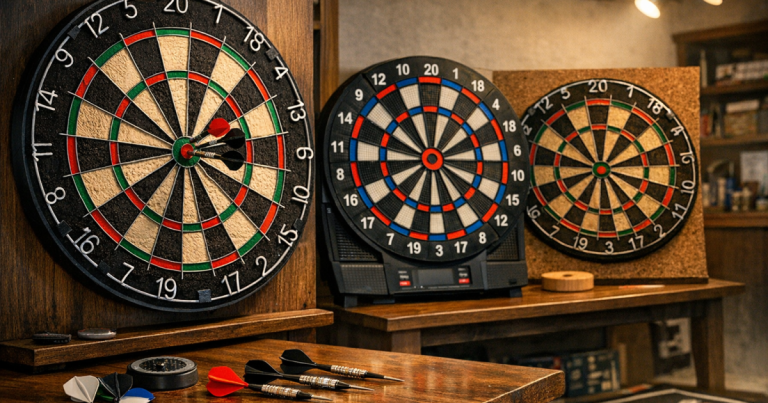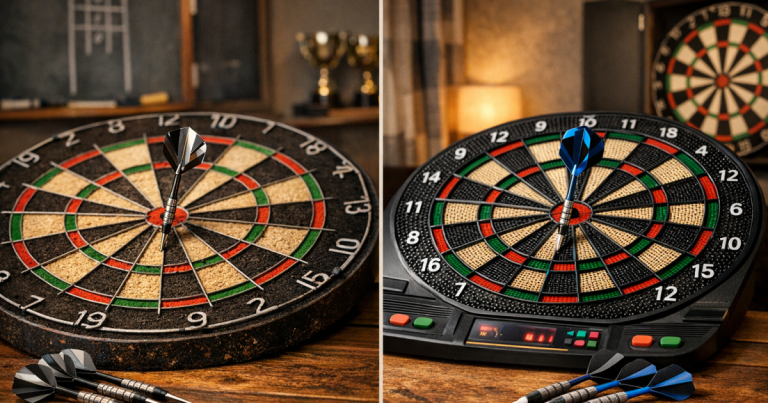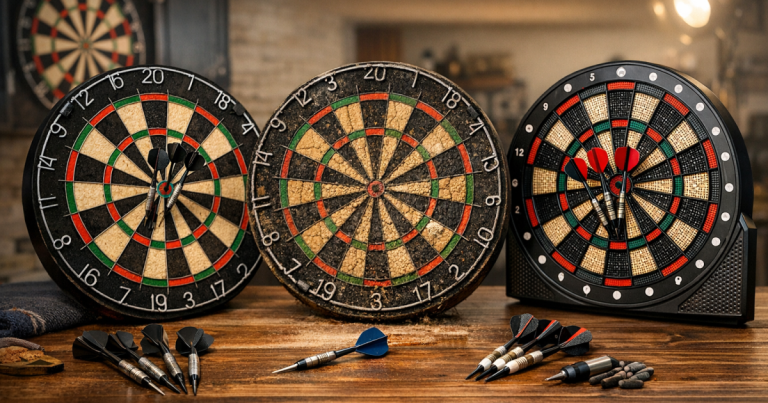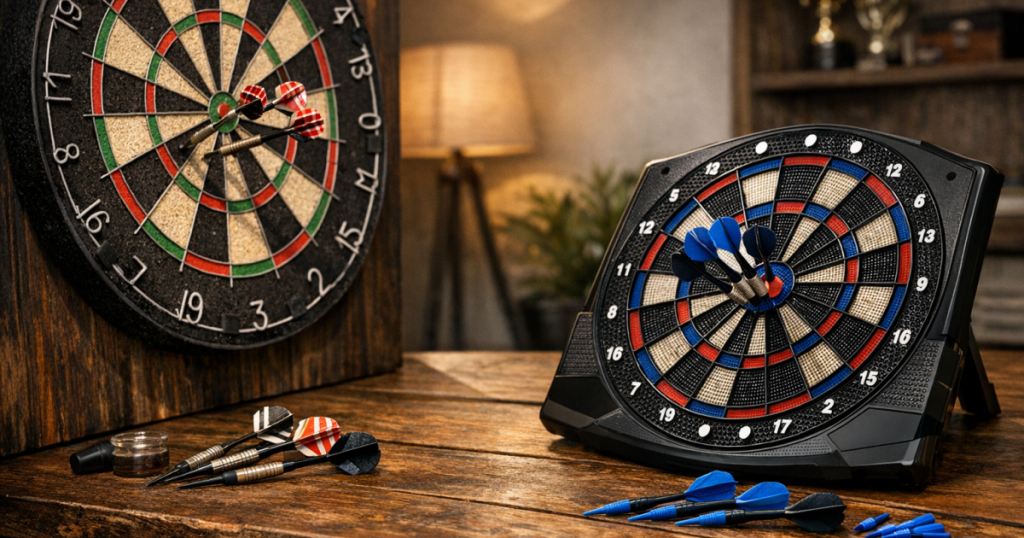
Choosing a dartboard for a spare room, garage or corner of the living room is about more than the board face itself. The real choice between bristle vs electronic dartboards comes down to how you want to practise, who will be playing, how much noise your home can cope with, and whether you prefer a traditional steel-tip feel or the ease of built-in scoring and game modes. Once you know that, the rest of the setup is much easier to plan.
For many home players in the UK, a bristle board is still the obvious starting point because it matches the steel-tip game most people watch and play. Electronic boards, however, make a lot of sense in family homes, shared rooms and social spaces where automatic scoring matters more than a match-style feel.
Main points
- Bristle boards are best suited to traditional steel-tip practice, league-style routines and a setup that feels close to pub and competition darts.
- Electronic boards work well for soft-tip darts, automatic scoring, casual games and homes where children or newer players are joining in.
- Noise is not one-sided: bristle boards make a solid thud, while electronic boards can produce sharper plastic impact sounds, clicks and scoring beeps.
- Space matters: steel-tip setups usually use a 2.37 m throwing distance from the board face, while many soft-tip formats use 2.44 m, so check the board instructions before marking the oche.
- The best home choice is less about which board is technically better and more about the type of darts you will genuinely play each week.
How a bristle board changes your home setup
A bristle dartboard is made from compressed sisal fibres and is built for steel-tip darts. It is the classic round board you will see in most traditional UK darts settings, from pub teams to more serious home practice rooms. If you want to improve your 501, work on doubles, practise checkouts and throw the same sort of darts you would use outside the house, this is the natural choice.
The feel is the big advantage. A good bristle board gives a clean, firm entry when the dart is thrown properly, and the layout feels instantly familiar if you watch televised darts or play locally. You also have the freedom to use your own steel-tip darts, change point grip, try different stem lengths and build muscle memory around a proper match-style setup.
There are a few practical things to think about. Steel tips can mark walls, doors, skirting boards and floors if the space is tight or newer players are involved. A surround, cabinet or wider backing panel can make a real difference, especially in rented homes or rooms used for more than one purpose. You will also need to rotate the board regularly to spread wear across the trebles and doubles. That is normal upkeep, not a sign that anything is wrong.
If you are planning a more serious home setup, it is worth looking at a detailed example of what a premium bristle board offers, such as this premium bristle board review. It highlights the sort of details that matter when you care about wire design, durability and a board that can stand up to regular practice.
What electronic boards do differently
Electronic dartboards use soft-tip darts and a plastic scoring surface made up of small holes. When a dart lands, the board detects the segment and adds the score automatically. That makes them easy to get on with, especially in households where not everyone wants to do the maths or keep walking up to the board to check close calls.
The main benefit is convenience. You can play cricket-style games, count-up, party formats and head-to-head scoring without needing a chalkboard or separate app. For families, guests and casual games after work, that simplicity matters. It keeps the game moving and makes darts less intimidating for people who enjoy playing but do not yet know finishes, scoring patterns or common checkout routes.
Electronic boards also reduce the risk that comes with sharp steel points, although they are still not toys. Soft-tip darts can bounce out, younger players still need supervision, and the area around the board still needs to be kept clear. Many boards also have a maximum dart weight, so it is always worth checking the manual before using heavier soft-tip darts.
At the more connected end of the market, boards such as the GranBoard 3s show how electronic darts can go beyond simple built-in scoring, with app-based play and online-style formats. Some home players will love that. Others may find it more than they need, especially if the aim is simply to have a quiet half-hour working on doubles.
Feel, practice value and scoring habits
The strongest argument for bristle is that it builds the same habits as the traditional game. You learn to score for yourself, the board looks exactly as it would in a pub or league match, and your darts behave in a familiar way when they land. If you are trying to improve under pressure, that matters, because you are not depending on automatic scoring to tell you where you are in the leg.
That scoring discipline is easy to overlook. Being able to work out 89, 102 or 126 quickly is part of becoming a better steel-tip player. A bristle board encourages that habit every time you practise. Even if you use a scoring app, the physical board is still the same type you are likely to meet in most traditional settings.
Electronic boards offer a different kind of practice value. They are excellent for volume, rhythm and keeping casual players engaged. Automatic scoring can help newer players understand the game more quickly because they see totals update straight away. Some electronic boards include training modes too, although the quality and usefulness vary, so it is best to check the actual game list rather than assume every model offers the same features.
The compromise is feel. Soft-tip darts are usually lighter, and the board face responds differently. That does not make electronic darts worse, but it does mean the practice does not transfer perfectly to steel-tip play. If your main aim is to improve for pub league nights, a bristle board is still the more relevant training surface.
Noise in UK homes: the detail people often miss
Noise is one of the biggest practical issues with home darts, particularly in terraced houses, flats and shared family spaces. A bristle board mounted directly onto a party wall can create a repeated thud that travels further than you might expect. A backing board, cabinet, stand or isolation-style mount can help, but no setup is completely silent.
Electronic boards are sometimes assumed to be quieter because they use soft-tip darts. In real use, the plastic impact can be sharper, and cheaper boards may rattle or click loudly. Built-in sound effects can also become irritating in a small room, so look for volume control or a mute option if the board will be near bedrooms, a home office or a neighbour-facing wall.
A freestanding dartboard stand can be a good option when wall noise is the main concern, although it does need enough floor space and proper stability. Good lighting helps as well, because shadows and missed segments can be frustrating on both types of board. A dedicated ring light such as the Target Corona Vision Light is often used with bristle setups, but check compatibility with your board, surround and room layout before assuming it will fit neatly.
Space, measurements and room planning
For a traditional steel-tip bristle setup, the standard board height is 1.73 m from the floor to the centre of the bull. The throwing distance is 2.37 m from the face of the board to the oche. Because that measurement starts at the board face rather than the wall, the thickness of the board and any cabinet does matter.
Soft-tip electronic darts often use a 2.44 m throwing distance, although the exact measurement can vary by board and format. Before you stick down an oche line or buy a mat, check what your board requires and what style of darts you plan to play. A few centimetres may not sound like much, but it can affect how natural your throw feels if you move between home and pub darts.
Ceiling height is rarely an issue in most UK homes, but depth behind the oche can be. You need enough room to stand comfortably without a sofa, table or doorway affecting your stance. It is also sensible to leave space for people to walk behind the thrower safely, and to avoid placing the board where missed darts can hit glass, televisions, radiators or kitchen units.
Durability and day-to-day maintenance
A decent bristle board can handle plenty of regular throwing if it is rotated and used with sensible points. The area around treble 20 usually wears fastest, so rotation really does help. It is also better to remove darts with a gentle twist rather than pulling them straight out, as this helps the sisal recover more cleanly.
Electronic boards wear in a different way. The plastic segments, sensors and catch-ring area take most of the punishment. Soft tips can break and get stuck in the board, so it is worth keeping spare tips and a small removal tool nearby. Some boards cope better than others, but you should not use steel-tip darts on a soft-tip electronic board unless the manufacturer clearly says the board is designed for it.
Power is another difference. Bristle boards do not need any. Electronic boards may run on batteries, a mains adaptor or both, depending on the model. If you are setting up in a garage or outbuilding, think about where the socket is, whether the cable will get in the way, and how the board will cope with cold or damp conditions. Darts equipment generally lasts longer in a dry, stable indoor space than in a chilly shed with big temperature changes.
Different homes, different answers
For a serious steel-tip player, the answer is usually simple: choose bristle. It gives the most relevant practice, works with proper steel-tip darts and builds the scoring habits needed for match play. Add a surround, good lighting and a clear oche, and you have a setup that can support years of improvement.
For a family room or casual games area, electronic can be the more enjoyable option. Automatic scoring keeps everyone involved, soft-tip darts feel less daunting for beginners, and built-in game modes can make a short session more sociable. It is especially handy when players have mixed ability and you do not want every leg to turn into a maths test.
For flats and shared walls, neither type is automatically perfect. A bristle board on a stand may be better than a hard-mounted board on a party wall. An electronic board with the beeps turned down may be better than one with loud sound effects. The room itself matters just as much as the board type.
For younger players, soft-tip electronic boards can feel more approachable, but supervision and sensible placement still matter. For teenagers already learning proper steel-tip technique, a bristle board with a safe surround may be more useful over time.
Where the two-board setup makes sense
Some home players eventually use both: a bristle board for proper practice and an electronic board for social play. That may sound like a lot for a small house, but it can work well in a garage, games room or larger spare room where different people use the space. It also stops every casual family game turning into a full steel-tip session.
The downside is space and consistency. Two oches, two dart types and two sets of scoring habits can get untidy unless the room is planned properly. If space is limited, one well-positioned board is usually better than two awkward setups.
Because Darts-180 is an editorial publisher, the site’s affiliate disclosure explains how product links are handled. The practical aim remains the same: understand the trade-offs before spending money on a board that does not suit the way you actually play.
What stands out
The bristle vs electronic dartboards debate is really about purpose. Bristle is the stronger route for traditional steel-tip improvement, realistic match practice and a setup that feels familiar to UK darts players. Electronic is better when scoring convenience, soft-tip safety, casual games and shared household use are the main priorities.
If you mostly practise alone and want to sharpen your 501, doubles and checkout thinking, bristle is likely to be the better choice. If the board will be used by children, visitors or mixed-ability players, electronic may get more regular use. In the end, the board that gets played three nights a week is more valuable than the technically purer option that nobody really enjoys using.
Further reading
- For more setup ideas, practical room planning and board advice, browse the Darts-180 blog.