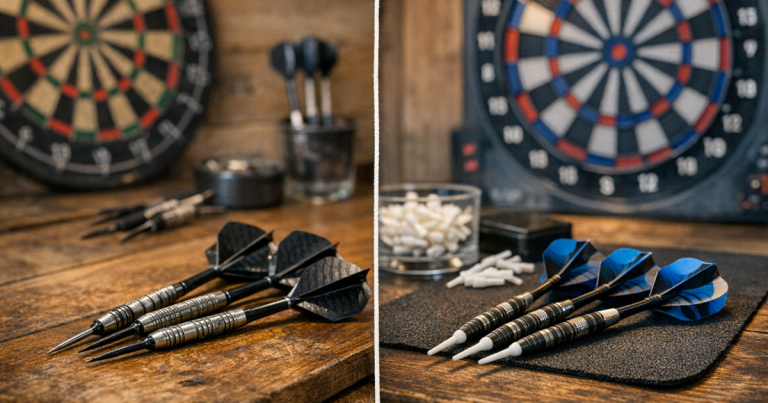
Buying a new set because your current darts feel “nearly right” can be frustrating. Choosing dart weights before you order helps you avoid a set that looks good online but fights your throw once it reaches the board.
The aim is not to find a magic number. It is to match the weight to your release, grip, board type and home setup, then buy within a sensible range rather than guessing from what another player uses.
The short version
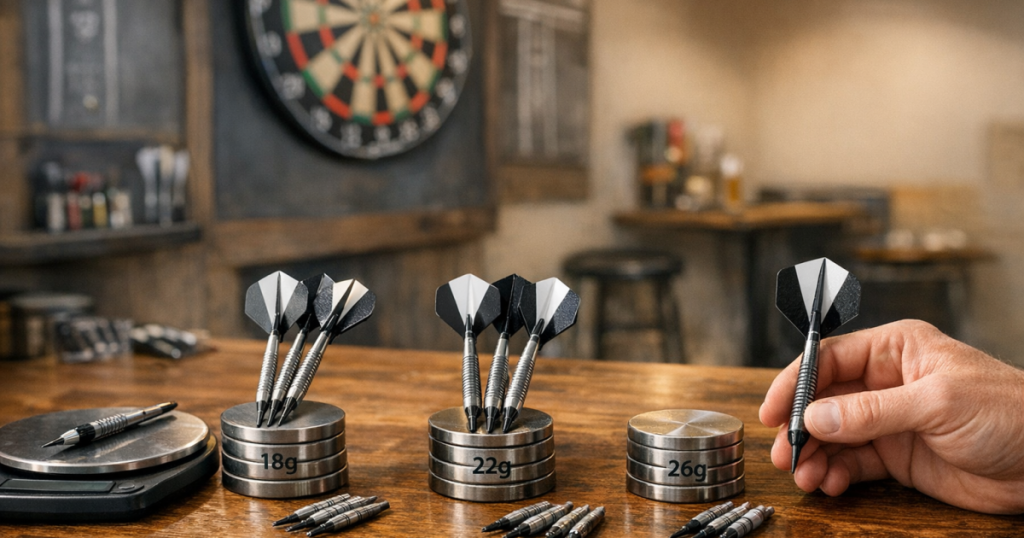
- If you are unsure, start near the middle rather than at the extremes. Many home steel-tip players are comfortable somewhere around 21g to 26g, but personal feel matters more than the average.
- Heavier darts can feel steadier in the hand, but they are not automatically more accurate.
- Lighter darts can suit a sharper, faster throw, but they may expose inconsistencies in release.
- Always check whether the listed weight refers to the barrel only or the fully assembled dart.
- Test with your normal stance, oche distance, flights and shafts before judging a weight.
Start with what you already throw
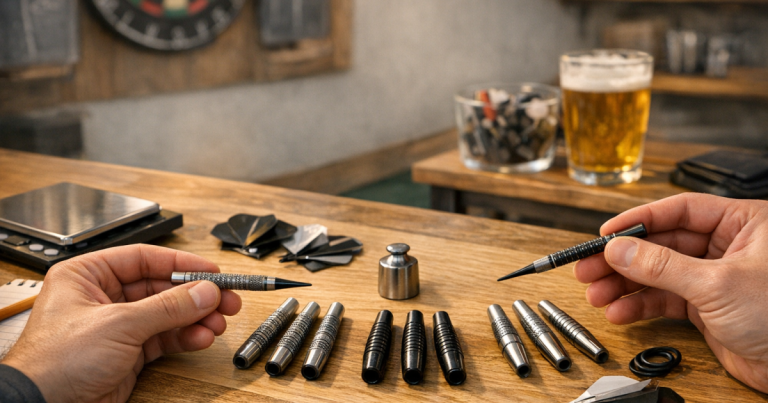
If you already own a set, use it as your reference point. Look up the listed weight if you still have the packaging or retailer information. If not, weigh one assembled dart on a small digital scale and note that this may not match the advertised barrel weight.
Then write down what is actually happening. Are you consistently dropping low? Are the darts landing with the tail high or tail down? Do you feel as though you are forcing the dart to the board? These clues are more useful than simply deciding that your current set is “too light” or “too heavy”.
If your darts feel sluggish and you are pushing them, trying a slightly lighter option can make sense. If they feel twitchy, floaty or difficult to release cleanly, a little extra weight may help you feel the dart through the throw.
How weight changes the feel of a dart
Dart weights affect three main things: how the dart sits in your hand, how much effort you feel during the throw, and how the dart reacts to small mistakes at release. A heavier dart often gives more feedback through the fingers. A lighter dart often rewards a crisp, repeatable action.
That does not mean a heavier dart is better for beginners or a lighter dart is better for advanced players. A smooth, relaxed throw can work with a broad range of weights. A tense or rushed throw can make almost any weight feel wrong.
Think in small changes. Moving from 22g to 23g is a useful test. Jumping from 18g to 28g usually tells you less, because the whole rhythm of the throw changes at once.
Match the weight to steel-tip or soft-tip play
Board type matters. Steel-tip darts are normally used on a bristle dartboard, while soft-tip darts are used on electronic or plastic-segment boards. Soft-tip setups often have maximum permitted dart weights, so check the board or venue guidance before buying.
If you are still deciding between formats, it is worth reading how to choose between steel tip and soft tip darts before settling on a weight. The right choice depends on where you play most, not just what feels good in the shop or at a friend’s board.
For a home steel-tip setup, you have more freedom to experiment. For soft-tip, compatibility comes first. A dart that feels perfect but exceeds the board’s stated limit is the wrong purchase.
Use your throw style as the main guide
If you throw with a smooth, slower action
A medium or slightly heavier dart may feel natural because it carries through the motion without needing a snatchy release. The risk is choosing something so heavy that you start pushing rather than throwing. If your shoulder or wrist feels involved too much, come down in weight.
If you throw with a quick, direct action
A lighter or medium-weight dart may suit you because it leaves the hand cleanly. The risk is going so light that every tiny grip change sends the dart off line. If the dart feels nervous rather than responsive, move up gradually.
If your release is inconsistent
Do not assume weight alone will fix it. A different barrel shape, grip level, shaft length or flight shape can change the release just as much. Weight is one part of the system, not the whole answer.
Check barrel shape and balance, not just grams
Two darts with the same listed weight can feel completely different. A short, chunky barrel places mass differently from a longer, slimmer one. Front-weighted, centre-balanced and rear-weighted designs also change how the dart sits during the throw.
If you grip near the front, a front-loaded barrel can feel secure. If you grip in the middle, a balanced barrel is often easier to manage. If you hold further back, check that the dart does not feel as though it is dragging forward out of your fingers.
When browsing real sets such as Red Dragon Darts – The Legend or Target Darts Phil Taylor Power 9Five, do not judge by weight alone. Look at the barrel profile, grip pattern, available weights and what the retailer is actually measuring.
Test your choice properly before buying more sets
If you can borrow or try darts, test them in a way that reflects your normal home throw. Stand at the correct distance, use your usual board height, and throw enough visits to get past the novelty of a different feel. A few good trebles in the first minute can be misleading.
Before judging any new weight, make sure your setup is not the real problem. Board height and throw line distance should be consistent, so use the measurements in setting the correct dartboard height and oche distance if your home board has been fitted by eye.
A useful test is to throw at big numbers first, not just treble 20. Try 20s, 19s, 18s and a few doubles. You are looking for repeatable grouping, comfortable release and a dart angle you can work with.
Do not ignore flights and shafts
Flights and shafts can make a dart feel heavier or lighter in practice because they alter stability and balance. A larger flight may slow and stabilise the dart. A smaller flight may feel quicker but less forgiving. A longer shaft can change the angle of entry; a shorter one can tighten the rear of the setup.
If you are close to the right weight but not quite settled, try a simple accessory change before buying another full set. Something as straightforward as Harrows Supergrip Shafts in a different length can alter the balance enough to confirm whether the barrel weight is really the issue.
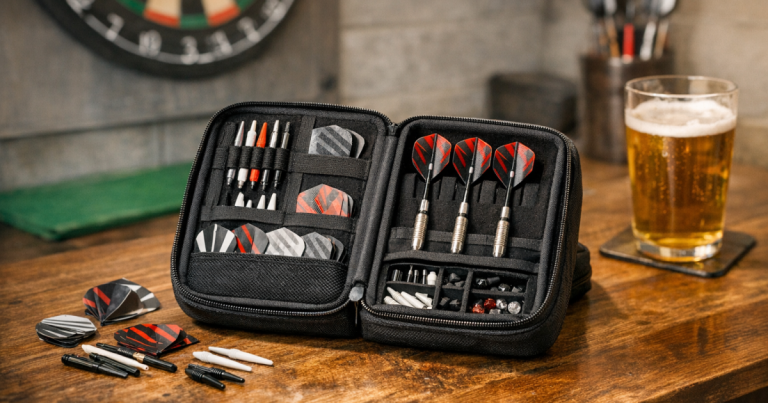
For flight experiments, keep a few shapes in your spare case and change only one thing at a time. The Red Dragon dart flights review is a useful next step if you want a sensible spare-case upgrade without overcomplicating the setup.
A simple buying method
- Step 1: Identify your current dart weight, barrel shape and any release problems.
- Step 2: Decide whether you need steel-tip or soft-tip compatibility before looking at style or brand.
- Step 3: Choose a narrow test range, such as one or two grams either side of your current set.
- Step 4: Compare barrel shapes as carefully as weight. A familiar grip position matters.
- Step 5: Keep flights and shafts consistent during the first test, then fine-tune later.
- Step 6: Buy the set that groups naturally, not the one that produces one impressive visit.
Common mistakes to avoid
- Copying a professional player: Their dart suits their throw, grip and years of repetition. It may not suit your home game.
- Changing too much at once: New weight, new barrel shape, new flights and a new stance make it hard to know what helped.
- Buying the heaviest option for “stability”: Stability comes from fit and technique, not weight alone.
- Ignoring the listed measurement: Barrel-only and fully assembled weights are not the same, so read the product details carefully.
- Judging too quickly: Give a realistic test session time to settle before deciding the weight is wrong.
FAQ
What dart weight should a beginner start with?
A middle-range steel-tip dart is usually the safest starting point, because it gives you room to move lighter or heavier later. Avoid extreme weights until you understand your throw.
Are heavier darts more accurate?
Not automatically. Heavier darts can feel steadier, but accuracy comes from a clean release, repeatable stance and a setup that matches your grip.
Should I weigh the whole dart or just the barrel?
Check how the retailer lists the product. Steel-tip darts are commonly sold by barrel weight, but your fully assembled dart will weigh more once point, shaft and flight are included.
How much difference does one gram make?
One gram can be noticeable, especially if the barrel shape stays similar. It is usually a better test than making a large jump in weight.
Can I fix the wrong dart weight with different flights?
Sometimes you can improve the feel, but flights will not completely rescue a barrel that is clearly too heavy, too light or badly balanced for your grip.
Final thoughts
The best dart weight is the one that lets you throw without forcing the action. Start from your current set, make small changes, check the listed measurement, and test with a consistent home setup. Once the dart leaves your hand cleanly and groups without constant adjustment, you are close to the right choice.